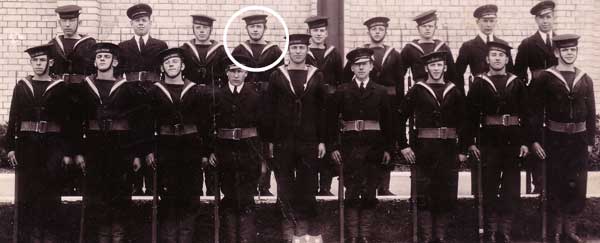
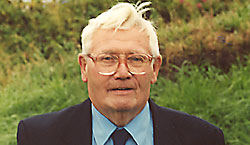
William Byer's career reads like a good book of fiction. He's seen and done so many things, from sailing up the Yellow River in China, to seeing the surrender of the Italian Grand Fleet during World War II, to having Sir Barnes Wallace sit on the edge of his desk for a chat. When you visit Bill Byers at his home overlooking the sea at Knockinelder on the Ards Peninsula, you feel it must have been fated that he should spend a large proportion of his working life at sea. Bill joined the Navy in February 1935 at 18 years of age. He briefly came out of the Navy for 6 months at the end of World War II, but poor wages at home (just enough to buy the bare essentials) encouraged him to join up again and he served until 1958. | HMS Vivian, Devonport 1935 |
|
After training at HMS Vivian, Devonport, Plymouth, the first ship Bill was assigned to was HMS Vidette (a V & W class destroyer) and in 1936 his first trip was to Gibraltar. However, it wasn't long before he was travelling much further afield. In 1937, on board the cruiser HMS Capetown, he set off for China. His ship had been detailed to join the China Fleet. Britain had maintained a fleet in this region since the Boxer Rebellion and at this time it was a substantial size, with aircraft carriers, cruisers and destroyers. | And now for my next trick...!
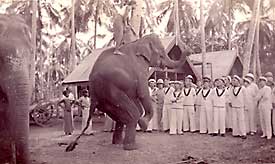
Crew of HMS Capetown in Colombo, 1937 |
Their route to Hong Kong took them via Gibraltar, Malta, Port Said through the Suez Canal to Aden and across the Indian Ocean to Colombo, in Ceylon (now known as Sri Lanka). There they were obviously entertained in style judging by this photo from Bill's collection. Next stop was Singapore and Bill recalls one young crew member having a close encounter with a shark while painting the bows of the ship in the harbour there. As the shark circled round and around, the lad hung on like grim death to a rope, hoping it wouldn't part, while other members of the crew took pot shots at the shark with rifles. |
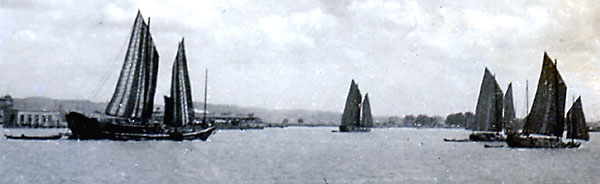
1937 - 1938: China When HMS Capetown arrived in Chinese waters, China was under attack from the Japanese. Wherever the Capetown went Japanese cruisers or destroyers would shadow them. If they anchored, the Japanese would anchor close by and watch them from their bridge with binoculars. Before the Japanese bombed Nan King a signal was sent to Bill's ship to move out and he remembers watching the bombing from 8 miles away, up the Yangtze river. Audio clip 1:
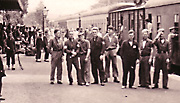
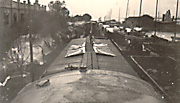
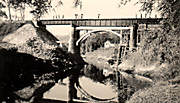
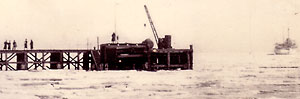
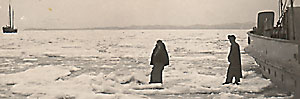
Bill describes the Yangtze river. When they had been up river a number of months the Japanese threw a barrier across, near the mouth of the Yangtze, and the Capetown couldn't move back down to the coast. Heading further up river, they abandoned ship at Han Kow, leaving only key personnel aboard. A barge took the rest of the crew ashore, where a train was waiting to take them south. The journey to Hong Kong took 3 days, with only hard wooden benches to sit on and a few basic rations to eat. However, Bill says the countryside they travelled through was very beautiful - high cliffs on both sides and narrow rivers. At one point in the journey they came to a bridge which the Japanese had been attempting to destroy. Bombing had weakened its structure and it couldn't take the weight of the train, so they all had to get out and walk to another train waiting on the other side. On arrival at Hong Kong Bill was assigned to the naval police until 6 months later, after successful negotiations, HMS Capetown was let through the Japanese barricades. During his time out in China Bill's ship visited Wei Hai Wei a number of times, which is situated on the north coast of China. In the summer the Royal Navy's China Fleet held their regatta there, but in the wintertime conditions were very different. You could walk ashore over the ice and crews were allowed to stop work at lunchtime because it was too cold to continue on. Bill remembers how he and another bloke used to jog round the perimeter of the island at Wei Hai Wei and then come aboard to have a cold bath!!! World War II From 1938 - 1939 Bill served in the Home Fleet and they were on a general state of alert as war loomed. Bill was on board the destroyer HMS Fame at Invergordon in Scotland when war broke out. Audio clip 2:
War is declared on 3rd September 1939 Just a few hours later they put to sea and by evening they were at the Faroe Islands patrolling for enemy submarines. They hadn't been patrolling long when they were sent off to pick up survivors from the passenger liner Athena, which had been torpedoed off north west Donegal. The Athena had been making her way from Liverpool to New York with school children who were being evacuated. Sadly around 100 people lost their lives jumping ship. The HMS Fame picked up 30 to 40 survivors, who needless to say were in a shocked state, and took them to Greenock. Norway In the late spring of 1940 Bill found himself patrolling the fijords of northern Norway in an area close to Tromsø, Narvik and Harstad. There was nearly continual daylight with no darkness to hide them from the bombers overhead. The bombing went on throughout the day, every day and many allied ships were lost. HMS Fame kept on the move all the time, because if you stopped at all it left you an easy target to German aircraft. Audio clip 3:
The constant bombing was bad for the nerves Inside the Arctic Circle, these waters round Norway were not somewhere you would choose to take a dip. One day they recovered 3 men from the sea after their ship had been attacked. Wrapped in blankets, smoking cigarettes, sipping rum - they seemed to be well on the road to recovery. However, Bill will never forget what happened next. One minute the survivors were chatting and laughing and the next minute they were all dead! A reaction to the cold had set in. HMS Fame had quite a few near misses during Bill's time with the ship. On one occasion they had gone to the aid of a damaged submarine when they came under attack themselves and a bomb slid off their upper deck and exploded going down the side. Seven men were killed and 50 injured. North Atlantic By 1941 Bill had been made up to leading seaman and was aboard the destroyer HMS Hesperus on convoy duty in the North Atlantic. They were away from Liverpool for around a month at a time, taking about a week to reach Newfoundland and then a week on the return journey. A convoy travelled at the speed of the slowest ship and could stretch out over a distance of 30 miles. It was quite a task trying to watch over all the ships, particularly at night when they could stray away. Often you wouldn't even know if a ship had been lost from another part of the convoy. Audio clip 4:
Friendly fire is nothing new - accidents occurred between Allied ships Just before arriving in Newfoundland occasionally their captain would say he fancied some fresh fish to eat and they would drop depth charges. Then it would be cod for breakfast, lunch and tea! When they finally reached the American military base at Argentia in Newfoundland they would moor up alongside the American navy. You could purchase anything you wanted when you went on board the US ships. Bill remembers buying up cartons of cigarettes, which he then swapped for eggs when they called in at Londonderry. There was a proper barter rate set of a dozen eggs for a packet of 20 cigarettes. In return the Americans came on board the British ships thinking a ready supply of rum was to be had! HMS Fame's service with the British navy came to an abrupt end early one morning when they were en route to Newcastle. During the night a young sub lieutenant made an error when changing course and brought the ship 3 miles closer into shore than they should have been and onto rocks called the Black Steels. The Fame's bottom was ruptured and there was an explosion in the boiler room. A nearby holiday camp was commandeered while the crew went on board every day to salvage as much as possible. It was dangerous work. Bill was on the upper deck when a wire rope snapped and threw him across the deck. After 6 weeks in hospital he was left with a scarred back, but he'd had a lucky escape. Another bloke died the same day in a different incident on board. Mediterranean The next ship Bill was assigned to was the destroyer HMS Raider and soon they were on their way, via the Cape of Good Hope and the Suez Canal, to join the Allied forces at the Italian battle in the Mediterranean. When they arrived the invasion of Sicily was beginning and Raider's role was to protect the battleships from enemy submarines. Bill remembers the night sky lit up red with tracer shells and the noise of them passing overhead as the shoreline was bombarded. The Americans were landing troops, but unfortunately the soldiers were disembarked too far out and sadly many of them drowned. Over the coming months, as the battle against the Italians progressed, HMS Raider moved further and further up the east coast of Italy. Rations were very scarce, they were allocated 2 slices of bread a day, and they were hungry a lot of the time. Bill recalls an occasion when they seized a cargo of onions, which then featured regularly on the menu for quite a while! Before Italy surrendered they had reached as far up the coast as Brindisi and Bari. At night they would pop across to Albania to shell German e-boats and ammunition ships. Sometimes they would capture an e-boat, bring it back and help themselves to its cargo, which could even include British corned beef! When Italy at last threw in the towel, HMS Raider was detailed to escort the Italian fleet from the assembly point off the coast of North Africa at Cape Bon (near Tripoli) to the surrender point at Malta. Bill will never forget the vision of dozens of dozens of ships all sailing in the same direction. Audio clip 5:
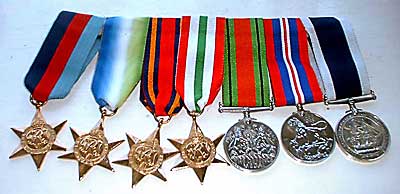
The surrender of the Italian Fleet was a sight to behold Burma Not long after the surrender of the Italian fleet HMS Raider was then sent to join the Allied Fleet out in Burma. They were based at Trincomalee on the east coast of Ceylon (now Sri Lanka). Along with other destroyers, cruisers and aircraft carriers the Raider would cross the Bay of Bengal to carry out raids on Japanese jetties and depots on the Andaman islands near Sumatra and further north along the coast of Burma and in the Brahmaputra delta. On one occasion HMS Raider was sent to the aid of a submarine called the Shakespeare. She'd been attacked by Japanese aircraft and was adrift in enemy waters and leaking badly. The Raider was to take her in tow the next morning, but in the meantime she needed to be kept afloat. Bill was in charge of a chain of 8 men who spent the night in near darkness filling and empyting buckets over the side. This is not the only time Bill found himself adrift at sea. A new crew were sent out to take over HMS Raider and Bill and his fellow crew members found themselves being sent back to Britain. On the journey home the corvette (HMS Linaria) that Bill was travelling on broke down in the middle of the Indian Ocean and was at the mercy of Japanese submarines. Noise travels quite a distance over water and with lots of loud hammering emanating from the engine room it seemed much longer than 24 hours before the problem was finally fixed and they were underway again. Bill finally arrived back in Portsmouth on the day war ended. At first they weren't going to be given leave. When they eventually did get ashore the celebrations were well underway and there wasn't a drink to be had. Bill remembers that the people of Portsmouth were tearing doors off their hinges to make celebratory bonfires. When Bill reached Plymouth the following day there wasn't a drop to drink there either - not even a lemonade! | | | | | (left to right) 1939-45 Star; N. Atlantic Star; Burma Star; Italian Star;
Defence Medal; Victory Medal; Blue Peter Medal
View enlargement |
1945 - 1958 Nearly a year after the war in Europe was over, Bill's war had finally come to an end and soon after he left the navy. Audio clip 6:
Work was hard to get when he returned home.Maybe life in the navy wasn't so bad after all. Six months after returning home Bill signed up again. Within weeks he was drafted to HMS Nelson, flagship of the Home Fleet, where a very strict regime was followed. He was with the Nelson from 1946 to 1949 until she was decommissioned and taken to the breaker's yard in Scotland. Bill was then moved to a shore post in Malta to work on the Admiral of the Mediterranean Fleet's staff. He was Chief Boswain's Mate at Camarata Barracks between 1949 - 1951. This was also an embarkation barracks for crew being transported home. Malta was a very social place and Bill was Vice President of the Petty Officers mess. At Christmas time he made sure there was enough rum to give the Christmas pudding that extra kick! | | 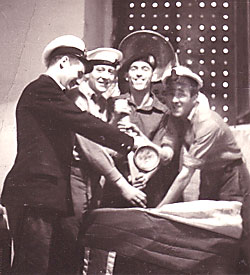 | Don't forget to add the rum!
Stirring the Christmas pud.
Camarata Barracks, Malta 1949 |
|
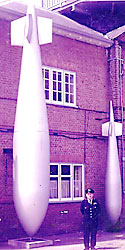
Life outside the navy | Bill with 10 ton and
5 ton bombs,
designed by
Barnes Wallace. |
| | Bill finally said goodbye to the navy in 1958, having served 14 years as a petty officer. He then undertook a number of jobs, such as painting and decorating and working for the submarine engineers C. B. Gormans, before joining Vickers Armstrong (now British Aerospace) in 1963. He was a policeman in their works police at Weybridge. Security was of great importance because of the nature of the work being undertaken by the company. When Bill started with the firm they were building the TSR2. Bill says some of the technology that was developed in the creation of this fighter bomber then went into Concorde. Dr Barnes Wallace was working in the Research and Development department of the company at that time. Despite being well known for his work on the bouncing bomb, Bill found Barnes Wallace very down to earth with a great sense of humour. Bill said it was typical of the man that he turned down 2 knighthoods before accepting one. He would often come and sit on the edge of Bill's desk and have a good chat. Audio clip 7:
Sir Barnes Wallace worked long hours. Barnes Wallace was responsible for designing the two World War II bombs featured in this photograph. The 10 ton bomb was carried by Lancasters and was used early on in the war during an attack on German sub pens at St Nazaire on the French coast, when 28 submarines were destroyed. Bill recalls that the 5 ton bomb was used in an attack on a pocket German battleship in the Norwegian fijords, when it pierced through the ship causing it to turn upside down. The lower window in the picture belongs to Barnes Wallace's office and Bill's desk was situated just outside it. |
Now Bill is retired and living back in Northern Ireland he only has to gaze out from one of his windows at the sea view to be reminded of his eventful and varied career with the navy.
| 


 print version





















 POST A COMMENT ON THIS ARTICLE