Banbridge and district was well occupied mainly with British Regiments who set up camps in such places as Ballydown [based on Chinauley House] and Edenderry House now Banbridge Academy. From 1942 onwards troop training in its many forms was a daily sight around the town and surrounding countryside. As well as British regiments soldiers in the distinctive GI uniforms of the US Army became a commonplace sight in town and then, in 1944, following D Day and the relief of Belgium, four brigades of Belgian troops came to Northern Ireland for training. One of those brigades, the 4th was based in Banbridge and their camps was Nissen huts in fields off the Kilpike road, opposite the village church in Seapatrick. They were still based there when the war ended. Banbridge Aircraft Factory That there was an aircraft factory is an almost forgotten fact and few of the people who worked there are still with us. One still going strong is Tommy McMaster who was a wood machinist operating a router and mass producing wooden parts for the Miles Messenger. In 1942 the Messenger was born from an unofficial (and unauthorised) request to Miles Aircraft Limited by some British Army officers for a unique Air Observation Post and liaison aircraft. Developed in only 3 months from the (similar) Miles M28 Mercury, the aircraft first flew on the September 12th 1942. It quickly became a technical success, but senior Army officials reacted indignantly by posting the upstart officer, who had instigated the initial request, to the far reaches of the North African Desert Campaign! From that curious start its production moved to Banbridge and to Walker's linen factory that had only recently closed - in it's later stages being employed in making a material known as 'tent duck' from which, of course, tents were made. Tom McMaster and his brother Christy, a fitter, were happy to move from linen to aircraft but, as Tom told me "we were surprised at the accuracy at which we had to work..as a joiner I had never before worked to 100ths of an inch all the plans we worked to had measurements down to two decimal places.and if a piece wasn't perfect you'd get it thrown back at you". Over 200 Banbridge folk worked on the aircraft in less than favourable conditions, "being an old mill" said Tom, "it had lots of supporting columns and sometimes it was a bit of a puzzle juggling the long aircraft fuselages through the building". However Miles did provide work for many joiners and fitters who might otherwise have been out of work. When talking about the Miles messenger Tom told me that a definitive piece had been written by a mutual friend, Billy Fivey, sadly no longer with us or he'd have jumped at the chance to contribute.
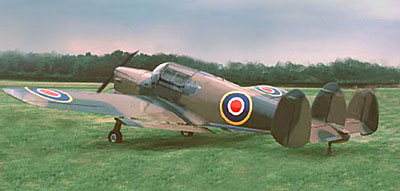
The Miles Messenger M38/Mk11 liaison and spotter aircraft that was built by over 200 folk from Banbridge and the surrounding district |
It is interesting to note that the Miles Messenger was first built at the private request of certain army officers in June 1942, George Miles designed and built the prototype of an air observation post (AOP) aircraft. It was required to carry a crew of two, radio, armour protection and other military equipment, and to be able to operate out of and into small tree-surrounded fields in all weathers. The resulting Miles M.38 prototype (U-0223) was a cantilever low-wing monoplane with fixed tail wheel landing gear, powered by a 140 hp de Havilland Gipsy Major inline engine. The wing incorporated fixed aerofoil trailing-edge flaps and when flown on 12th September 1942 it was found that these provided the requisite STOL performance. Great enthusiasm for its capability was shown by an AOP squadron which Miles allowed to flight test the aircraft, but shocked by the design, construction and testing of a military aeroplane without its knowledge, the Ministry of Aircraft Production refused to order this prototype into production for the AOP role. In late 1943 a small order was placed for the aircraft for use in a VIP transport role under the designation M.38 Messenger and eventually a total of 21 were built. Among VIP operators allocated personal Messengers were Field Marshal Sir Bernard Montgomery and Marshal of the RAF Lord Tedder. | 


 print version






















 POST A COMMENT ON THIS ARTICLE