Andrew Nicholl (1804-86): Belfast Artist in Colonial Ceylon - Page 2
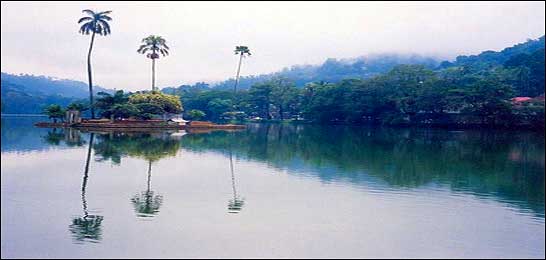
Article by Joe Simpson (Duncan, BC, Canada) Page 2 | (Above) Kandy Lake, central Sri Lanka, 2002 - admired by Andrew Nicholl in July 1848 |
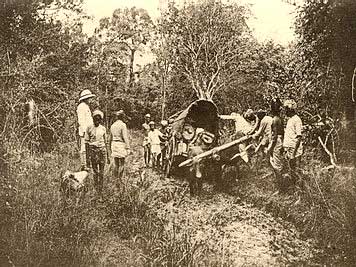
| After Kandy, the travellers visited the historic rock temple of Dambulla, before entering the northern jungles that had until recently utterly concealed Ceylon's ancient ruined cities - rather like Cambodia's Angkor Wat. Other sights that amazed Nicholl included devastated giant "tanks" or artificial reservoirs that had once sustained a thriving, but now vanished civilizations. To everyone's amusement, the expedition's doctor had brought along a European-style lavatory seat, carried around a porter's neck! Nicholl was somehow reminded of St. Kevin's Bed at Glendalough, when he saw one sacred mountain with many steps to the summit. | | (Above) The incredible rigours of jungle travel in 19th Century Ceylon (now Sri Lanka) |
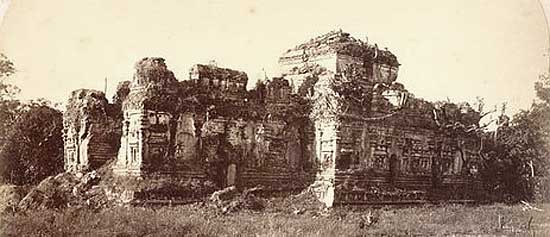
| (Above) Part of the the ruined ancient Sri Lankan city of Polonnaruwa, photographed in the mid-1890s, looking very much as it would have appeared in its wild jungle setting to the artist Andrew Nicholl in the later 1840s. |
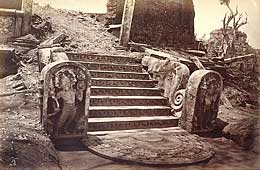
| | (Above Left) The entrance to a ruined circular Buddhist shrine ("vatadage") in Polonnaruwa, again photographed in the mid-1890s, but in similar condition to when Andrew Nicholl sketched it half a century earlier. His later watercolour painting of this scene now hangs in the Colombo National Museum.
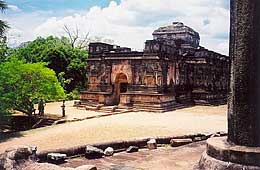
(Above Right) The very same spot today, no longer overgrown by jungle as it was in Nicholl's time. |
At Anuradhapura, the most ancient Sinhalese capital but by then a "poor, mean village" in deep jungle, Nicholl parted ways with Tennent and the others, who all headed north-west for the coast and then south to Colombo. After several days' happily sketching the ruined temples and statues of the former royal city, Nicholl took leave in late July of his kindly host, District Judge Tranchill, and proceeded south back towards Dambulla and Kandy, intending from there to head south-west to Colombo. | 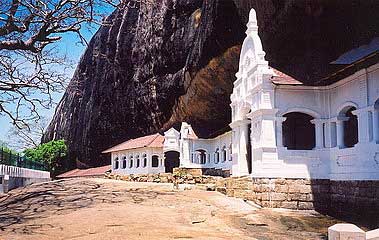 (Above) The ancient Buddhist rock temple of Dambulla, looking much the same in 2002 as it must have done when visited by the two Belfast men Andrew Nicholl and Sir James Emerson Tennent, just before the July 1848 rebellion broke out in the surrounding area. (Above) The ancient Buddhist rock temple of Dambulla, looking much the same in 2002 as it must have done when visited by the two Belfast men Andrew Nicholl and Sir James Emerson Tennent, just before the July 1848 rebellion broke out in the surrounding area. |
His only companions were a Sinhalese guide, a horse-keeper and two porters (then called "coolies"). Three miles before Dambulla, they met crowds of frightened villagers fleeing into the jungle, who told them that a rebel "king" had just been "crowned" in the rock temple of Dambulla, and that his followers were already "massacring" Europeans. (The latter rumour, fortunately, was much exaggerated, but Nicholl of course was not to know this at the time). 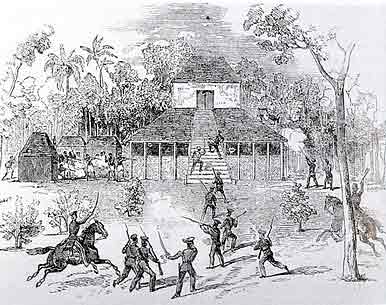
(Above) Contemporary depiction of a skirmish between government troops and Sinhalese rebels during the brief uprising of 1848 | Wisely, Nicholl turned back in the direction he had just come, and took off as fast as he could for Anuradhapura. On the way, he learned to his great alarm that the new "king" had sent out a search party to capture him. After two gruelling days' constant travelling, he arrived back at Judge Tranchill's house. From there he left for the north-west coast, in the footsteps of his erstwhile companions, and finally returned, almost barefooted and "completely exhausted" - yet still carrying his valuable sketches strapped over his shoulder - to the safety of Colombo on August 10th, where he awoke the next day with a malaria or sunstroke-induced "jungle fever" after dining the previous night with Sir James Emerson Tennent and some British army officers.
|
In the meantime, he had received the chilling (if in fact accurate) news by letter from Judge Tranchill that a Tamil informant had told him about armed Sinhalese rebels in the Dambulla area blocking the Kandy road and asking about an English gentleman (Nicholl!) whom they knew to be in the area, and whom they intended "cut to pieces should he come that way". It had been a narrow escape, and an unforgettable once-in-a-lifetime adventure for the Belfast drawing master! To quote Andrew Nicholl himself, writing in 1852: "Thus terminated my sketching tour through the forests of Ceylon, the most interesting I ever had in my life; and though attended with both danger and fatigue, yet the enjoyment which I derived from it far more than compensated for the hardship of the journey, and will ever be considered by me the most delightful of all my sketching excursions, either at home or in distant lands." The Ceylon 1848 rebellion, such as it was, was quickly suppressed by the British forces, many thought afterwards with needless ferocity, and a Parliamentary Enquiry followed that effectively ended Sir James Emerson Tennent's colonial career and any hopes that he might have entertained about becoming Governor. Tennent died in 1869, after a second career as a civil servant in London, and Nicholl lived on until 1886, dying in London at the ripe old age of 83, no doubt still dining out on his Ceylon experiences. A large exhibition of his life's work was held the following year in Belfast, at 55 Donegall Place, and in 1889 his daughter Mary Anne presented 56 of his watercolours of Ceylon plants and trees to Dublin's Royal Hibernian Academy in memory of her father. And, of course, the fond memory of the Northern Irish boot-maker's son turned mid-Victorian landscape artist extraordinary, lives on at the Sri Lankan National Museum in Colombo. That Ulster History Circle blue plaque in Church Lane was well-earned, for sure! << return to page 1 | The author wishes to thank Mr Palinda de Silva for kindly permitting the use in this essay of some 19th century images of Sri Lanka (formerly Ceylon) from his personal collection. Readers of this article are invited to visit Palinda's excellent website at: www.imagesofceylon.com |
YOUR RESPONSES MaryJane - Apr '07
Hi Joe ,
What a wonderful article and with stunning pictures too. I am the daughter of a burgher lady from Ceylon and funnily enough I was born in Northern Ireland(now living in England) My mother arrived in N.Ireland in about 1947 after a 2 year stay in England. It seems that N.Ireland and Ceylon have a lot of ties !! My mother was an Andree whose family had photographic studios in Galle, Matara, Jaffna and Colombo. I think Ismeth Raheem may know of this family. I would like to have contact with Ismeth and would ask you if you could kindly pass my email address on to him maryjane(underscoredash)oclAThotmailDOTcom please and thank you. I have read many of your very interesting and fascinating articles over the years. Do keep up the great work of keeping us all in touch with our SL roots.
MJ Joe Simpson - Mar '07
Message for Terry Morahan - Hi, Terry, I don't have a belfast contact telephone number for you, hence my not calling you when I was last over there in Oct - please email it to me at my office - tjslawATtelusDOTnet - as my home computer is 'kaputski' just now. Next time I go over, I'll definitely contact you, if I have your number. Probably my next visit will be in the early autumn '07. My dad is not doing so well health-wise so it may be sooner. Regards, Joe S. Terry Morahan - Feb '07
There are at least 6 portraits of Nicholl extant - pencil drawings by Piccioni in the Ulster Museum ;see "Art in Belfast 1760-1880 "by Eileen Black. You did not call in October when you were over !! Cheers Terry
Terry Morahan - Feb '07
Thought you might have contacted me when you were over in Belfast recently - anyhow re your request for Andrew Nicholl likenesses - there are several of him - charcoal drawings by Felix Piccioni; see Art in Belfast 1760-1880 by Eileen Black page 107 ; Irish Academic Press www.iap.ie
Cheers.
Madora Pereira - Nov '06
1. 1818 Irish man named captain O'Neill captured the Singhales rebel leaders and later executed them.
2. 1848 there was a great Irish man named ....ELLIOT' was in ceylon and helping the locals(1848Revolution)he seems to be a jounarlist! British were damn against him! Does any one know about this Character? Srilal Fernando - Nov '06
Hi Joe, An excellent presentation as usual. I was made aware of A N by Dr rajpal de Silva & admired his skilled paintings.
Chaminda Weerawardhana - Sep '06
I am a Ceylonese/Sri Lankan postgraduate based in Tours, central France. I know Ireland quite well, and my partner comes from there. Reading through this wonderful piece of writing, I was reminded of 1998, the 50th anniversary year of Independence, when I visited the National Museum in Colombo with my parents as a 16-year-old high schooler, to be enthralled by AN's paintings of Ceylon. I wish to note here that AN and Sir Tennent were not the only Irishmen who played significant roles in British Ceylon, and there are so many who have been unfortunately forgotten, such as the Rev. Ireland Jones, who founded a school in the Ceylonese hill country & called it 'Trinity College'! My discipline is comparative political history and I am currently working on the British Govt's democratization ventures in her colonies (Ireland & Ceylon included). I'll be pleased to hear of any Irish/Empire/comparative/Ceylonese historians who are interested in unearthing the work of forgotten Irishmen (& women) who served Ceylon. My mail address is chami 82 @voila.fr Joe Simpson - June '06
Message for Raymond O'Regan and/or Terry Morahan - genlemen, many thanks for both your fascinating comments. I will be back in Belfast area in Oct 2006 for 3 weeks from my home here in BC, Canada - I would very much like to meet up with you both, and also to put you in direct touch with architect and art historian Ismeth Raheem in Colombo, Sri Lanka, who is an Andrew Nicholl expert so far as AN's brief time in Ceylon is concerned. Ismeth knows Martyn Anglesea at the UM. Can contact me here (home) at otesagaATshawDOTca or (work) tjslawATtelusDOTnet - Kind Regards, Joe Simpson Raymond o'Regan - May '06
What an excellent article on Andrew Nicholl. As a lecturer in Irish History I am always amazed at the diaspora of the Irish throughout the world.
Andrew Nicholls father was a shoemaker in Church Lane, formally known as School House Lean because of the 1666 Latin School that was built there and paid for by the Earl of Donegall.
Joe mentions James Emerson Tennant a man who has two streets named after him on the Shankill Road i.e. Tennant St. (formally Parliament St.) and Emerson St.
He had married the daughter of William Tennant, Merchant, prominent United Irishman and member of the First Presbyterian Church in Rosemary St. Emerson also adopted his father in laws name into his own .
Most people remember Andrew Nichols painting of the old long bridge that used to stride the Lagan from 1688 to 1844 and it gratifying to know of his exploits in Ceylon. Joe Simpson - Feb '06
Message for Terry Morahan:
Terry, many thanks for your comments, and for correcting me on my assertion about Andrew Nicholl being "scarcely remembered" today in N. Ireland. Truth to tell, in late 2003 on my one and only visit to the Ulster Museum since well before we moved to Canada from East Anglia in the 1980s, the UM exhibition rooms were being completely renovated and therefore all the display artwork (including AN) was in storage! Anyway, I would be delighted to view your collection when next I revisit my home city, thanks. Terry, do you know of anyone - e.g. in the Nicholl family today - who might have a photo portrait of Andrew Nicholl? Ismeth Raheem, a Colombo, Sri Lanka senior architect and published art historian, is collecting material on Nicholl in Ceylon, for a possible future book, and would dearly like to find such an image. Ismeth tells me that he has among his collection the original pencil sketch book that Nicholl carried on his back during his 1848 jungle adventures, which dovetails with his account published in the Dublin University Magazine of 1852. His Ulster-born patron & friend Sir James EmersonTennent later borrowed it to send to Longmans, publishers of Tennent's 1859 twin-volume "magnum opus" on Ceylon, which includes engravings of many of Nicholl's drawings of the island's ruined ancient cities. According to Ismeth, Nicholl's family owned this sketch book until the 1940s, when it was sold at a London auction to a Ceylonese law student friend of Ismeth's father. Ismeth then acquired it from that individual or his family about 30 years ago. Terry Morahan - Feb '06
I very much enjoyed your article - though it is an extreme exaggeration to say he is " scarcely remembered " here; there is a good selection of his paintings on display in the Ulster Museum and his pictures are competed for in the local auctions in which they frequently surface ; re the reference to Turner influence - I have a very " Turneresque " Nicholl in my possesion and as they overlapped in London it is plausible that they knew of each other - but have been unable to obtain proof . You are welcome to see my paintings when you next visit Belfast ; I have been trying to research his Belfast contemporary - artist James Howard Burgess ( 1810 - 1880 ) - he IS neglected !! (And I think often better than Nicholl !) Emma Trehane
I have been reading through the comments here on Nicholl and am interested to know if anyone has ever come across the name Eliza Louisa or Thomas Emmerson of 20 Stratford Place, London, in relation to this artist. Eliza Emmerson a good friend of the Poet John Clare and her husband Thomas Emmerson was a renowned art dealer in the mid nineteenth century. Emmerson had a tendency to promote the works of young self taught artists and poets and became their self appointed votary. Eliza Emmerson mentions in a letter to Clare of 1835, of her friendship with a gentleman from Belfast; a self taught artist. She claimed to own many of his "beautiful views on the Irish coast". I have also found a reference in an article on Google Books which suggests a connection between Nicholl and the Emmerson's or at least that Andrew Nicholl may have visited 20 Stratford place on April 10, 1837 The reference suggest Nichol had a younger sister Eliza. Is this correct? See. "http://books.google.com/books?id=IDY0AAAAIAAJ&q=stratford+place+emmerson&dq=stratford+place+emmerson&lr=&pgis=1" Where can I find more information about this artist? Could Nicholl and Emmerson's have had a connection of any kind? If any one has any information it would be very much appreciated.
|



 print version






















 POST A COMMENT ON THIS ARTICLE