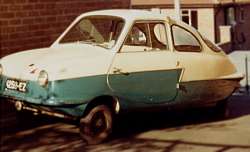
Did you build these? What was the York Nobel like? Well, trouble is I can't remember much about the mechanical side of things. I have tried prowling all the search engines on the web but am still no better off. So I look forward to some help from you your place and miners to fill me in. Perhaps you even helped build these mighty little beasts? Seating layout The body was fibre glass and they were all produced in exactly the same two-tone colour. Unlike most bubble cars of that period there were real doors to get in and out. The seating consisted of two seats in the front and a bench seat behind them. The front seats tipped forward to allow the passengers to slide into the back. Mine was a left hand drive so I guess they were built for export too. Mechanical problems The engine was housed in the rear narrow end and there was no way to get at the machinery apart from climbing inside to the back of the car, removing the back parcel shelf/engine cover and leaning over the back seat. This meant that when the vehicle broke down on the road, the back seat passengers had to get out whilst you climbed in to try and sort out the problem. We still have vivid unhappy memories of us breaking down in the snow on the Ards Peninsular and my wife and the children marching up and down the bleak country road trying to keep warm whilst I struggled to fix the engine. Breakdowns happened regularly. The fault turned out to be dirt in the fuel tank which ended up in the carburettor and no matter how often I cleaned the carb the dirt would return. My wife had only just come out of hospital on one occasion and we were in Belfast, Chichester Street I think it was, when the inevitable happened and we broke down. So she ended up, with her legs still in bandages, pushing me in this thing down the street until some lorry drivers took pity on her and joined in the effort. | | | 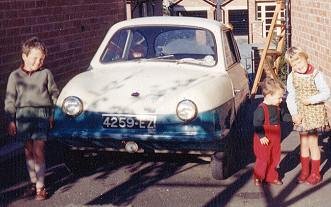 | |
The family pose with the Nobel car. | |
Reverse order As you can see from these photos the vehicle was a three wheeler. Well actually that's not quite true. All the original ones produced had three wheels but eventually they changed the single back wheel design into a pair mounted only a few inches apart. I suspect to improve the stability. So to be accurate mine had four wheels. The engine was mounted right beside this set of back wheels . It was a motorcycle engine but I can't even remember if it was two-stroke or four. This drove the back wheels via a belt system. And it was this system which was the clever bit, for when one wanted to go into reverse the belt would be changed by a mechanical device to make the drive go anticlockwise. So the engine's propulsion was going in the same direction but the wheels in the opposite direction. This meant that if you were brave enough you could use all four gears whilst reversing!! I didn't try this very often! Hurtling backwards in this wedged shaped device in top gear was a thrill I did not indulge in regularly. I hit a gate post trying this once and tore off the door handle. But it was our first car and we loved it to bits. We had an expression "let's go and look at cows". And we would do just that. Into the thing and off out into the country just for the sheer joy of having our own transport.- And go look at cows. Gone but certainly not forgotten What happened to it? I sold it for thirty pounds Yes I felt great about that, - the same amount as I gave for it originally. And the next time I saw it the new owner had changed it over to a right hand drive. All clever stuff. I guess it has long gone to the great bubble-car car-park in the sky. Northern Ireland Editor added:
At least one of us remembers this car too! There is still one to be seen. Here's a picture of one which is in the Ulster Folk & Transport Museum in Cultra Co. Down. | | | 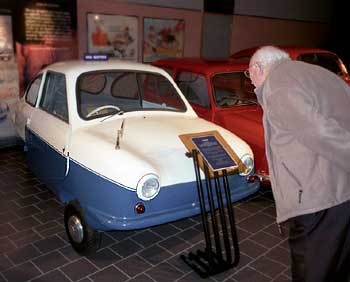 |
A Nobel car seen here preserved in the
Ulster Folk and Transport Museum at Cultra | |
| 


 print version






















 POST A COMMENT ON THIS ARTICLE