The Church of Christ The Redeemer is Lurgan's most recognizable landmark. This Church Of Ireland, gothic building is situated in Church Place, in the centre of Lurgan and can be seen miles away from the town. The original church was sited in Shankill Graveyard, which is half a mile from the present building. The old church became too small for the congregation and had fell into dilapidation.
So in the early 18th century a new church was built in "The Green" in Lurgan. The site of Shankill graveyard itself and the old church has historic importance dating to pre-christian times. It is also known that there was a Mediaeval church here which was probably destroyed in the "Nine years War" at the end of the 16th Century. | 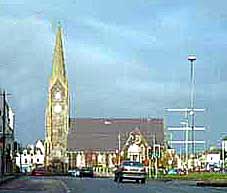 | Church of Christ the Redeemer, Lurgan |
|
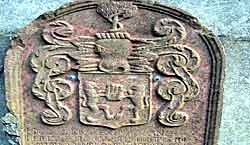
William Roulston (Ulster Historical Foundation) explains that in the early 17th Century the land was granted to the Brownlow family, who founded Lurgan. They restored the church as a place of worship for the influx of English settlers during the plantation. The most dominant feature in the churchyard is the Brownlow Mausoleum where "the most noble family of Abercorn" are buried. Not surprisingly, the graveyard has changed several times and the earliest legible headstone today dates back to April 1690. Kieran Glendinning has written a considerable number of documents about this graveyard and he talks to Mary Ferris about the Brownlows and some of the other families who are buried here. He also tells the fascinating story of one Margorie McCall, a woman who's famed in these parts for having been buried twice! | 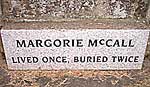 |
Mary spoke next to Mrs Greer. The Greers, who were formerly the McGregors, were proscribed in their native Scotland and settled in Cumbria. They came to Northern Ireland during the plantation - originally to Dungannon and Moy - and then to Lurgan in 1757 where they bought the family home at Woodville which still stands today. Mrs Greer who continues to live in the family home has plotted the family tree which is so complex she used a roll of wallpaper to write it on! She tells Mary Ferris of how her recent ancestors were involved in both Whiskey and Linen... Woolsey Gracey is the archivist at the Church of Ireland and has a great understanding of local history and heritage. The archived records go back to 1675. He shows us the minutes of a vestry meeting just after the first church on the site was built in 1725. Many of those whose signatures appear on the document are buried outside in the churchyard. One of them is Rev Arthur Ford who was rector in the parish for twenty years. He insisted in his will that he would be buried in the North end of the graveyard in a bid to dispel an old superstition that the Northern end was 'unholy ground' and only for paupers. Particularly interesting are the records Woolsey holds of the deaths and burials during the period of the famine, which was at its worst in 1847. Charles Brownlow, first Baron of Lurgan died of Typhus whilst helping the poor and needy of the town. John Neill, a member of the congregation is a solicitor for the firm which is responsible for the Brownlow estate. He tells how his recent ancestors raised funds to buy new bells for the church. Gerard McAtasney is the author of the book "This dreadful visitation" which recounts stories surrounding the famine in the Lurgan and Portadown area. He tells us how the Shankill graveyard had more burials than any other graveyard in Ireland at that time. Conditions in the workhouses were appalling and many new recruits were brought in and given clothing left behind by those who had died of disease. The survival rate was dismally low. The workhouse graveyard was bursting. Often there were 5 bodies to one coffin and up to 30 bodies to a grave. When it eventually overflowed, a 'paupers pit' was opened in the Shankill graveyard. These would have been unmarked graves. At the height of the famine there were 492 burials in Shankill which included 233 'workhouse burials', the worst workhouse death-rate in Ireland. Today no-one really knows whereabouts in the Shankill graveyard the workhouse bodies are buried. | 


 print version