Just half an hour north of Belfast by motorway, you come to the outskirts of Ballymena. Once off the modern motorway, a maze of small roundabouts flanked by recent red bricked houses. However, as you turn off the Galgorm road into Cennick road, you are greeted with a beautifully preserved, picturesque, Moravian village. More than 200 years peel away and you instantly feel affected by the atmosphere of the place.
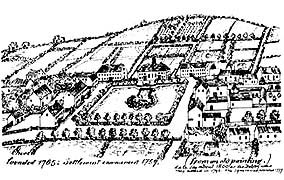 | | Sketch from @1800 showing how the square of Gracehill was formed. - copyright Dr David Johnston |
Although not the oldest of the Moravian congregations in Northern Ireland, Gracehill is regarded as the "Mother Church" because it was the only full scale Settlement built by the Moravians in Ireland. The Moravian settlement at Gracehill had its beginnings in the 15th Century. Inspired by the writings of Wycliff - the English theologian, John Hus, the then Rector of Prague University, preached fearlessly for reform in the Catholic Church. Because of his outspoken views he was condemned at the Council of Constance and died at the stake in 1415. Hus could be described as the first Protestant, as it would be 100 years later until Martin Luther nailed his thesis to the church door in Wittenberg (Germany) demanding similar changes. The followers of Hus kept the Unitas Fratrum (United Brethren) teachings alive, and their beliefs spread to the Americas, the Carribean, Africa, eventually landing in England, where John Wesley and his associates took interest. One of John Wesley`s associates - John Cennick, was to become instrumental in founding the Moravian church in Ireland. 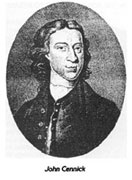 | John Cennick |
| While preaching in Dublin in 1746, Cennick inspired a Ballymena merchant called Joseph Dean, who asked the preacher to speak in his hometown. The initial audience in Ballymena- just a few dozen, grew to over 2000 in the days that followed. Although the majority greeted the new thinking with an open mind, some in the neighbourhood were far from happy. Cennick had his life threatened and had to leave hastily. Two years later in 1748, with the support of the Bishop of Down and Conor, Cennick began to preach to hamlets in and around the Ballymena area, making a family home in Craigbelly (Crebilly). A year later in 1749, he settled in Gloonen, a townland between Ahoghill and Gracehill. However John Cennick`s relentless preaching, travelling and working on the land, took its toll - "he laboured until dusk and wrote at starlight"- and a violent fever took his life, aged just 39. |
The untimely death of John Cennick was a devastating blow, but as always in the history of the Moravian church, the seeds sown were nurtured and, in time, a thriving and successful settlement was formed. It was on land leased from Lord O`Neill that the Ballymena brethren built their dwellings similar to the grid-like pattern of villages in Europe. It consisted of a centrally situated church - with a separate door for the men and women - surrounded by homes for the congregation, which spread out in a large square. The square included brethren houses, communal houses for the single sisters, single brethren and widows, and also day and boarding schools for boys and girls.
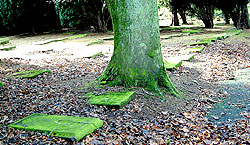 For Moravians, the burial ground was known as "Gods Acre" and had a strict layout. Men were buried to the left and women to the right of a central path. All the headstones were of the same shape and design - the Moravians believe that everyone is equal in death - and were laid almost flat on the ground. For Moravians, the burial ground was known as "Gods Acre" and had a strict layout. Men were buried to the left and women to the right of a central path. All the headstones were of the same shape and design - the Moravians believe that everyone is equal in death - and were laid almost flat on the ground.
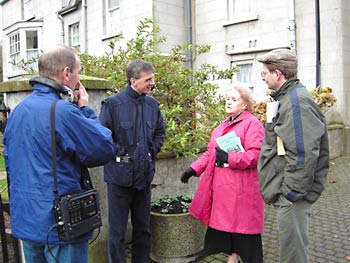
Jim Kelso explored the Moravian burial ground or "God's Acre" in Gracehill along with William Roulston (Ulster Historical Foundation), Dr David Johnston & Roberta Thomspon (tour guides).
| From left to right: Jim Kelso, David Johnston,
Roberta Thompson and William Roulston |
In the audio clip below you can listen to Roberta explaining how many of the bodies now buried in Gracehill were exhumed from their previous graves in nearby Gloonen |



 print version