Casting the Net Article by Laura Haydon
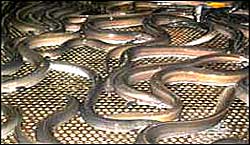
Feb 2007 It’s one of Northern Ireland’s best-kept secrets, but it’s under threat. Lough Neagh is home to the largest commercial wild eel fishery in Europe, exporting some 650 tonnes of produce a year to outlets in Billingsgate, Holland and Germany. Today, the European eel fishing industry is in crisis. The eel population has dropped, partly because profit-oriented management of fisheries has led to overfishing and sale of elvers to the Far East. 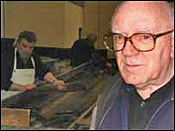 | Father Oliver Kennedy
Chairman, Lough Neagh Fishermen's Cooperative |
| Lough Neagh now has the only remaining commercially viable wild eel fishery in Europe. It also constitutes one of the most unusual examples of Christian ministry on this island: for more than 40 years it’s been run by a priest, Father Oliver Kennedy, concerned to safeguard the livelihoods of his parishioners. As chairman of the Lough Neagh Fishermen’s Cooperative Society, his ministry is a very practical one and consists of running the fishery in the long-term interests of his flock. When he arrived in 1961, a powerful London company owned the fishing rights on the Lough and fishermen had to sell eels to the company at whatever price it determined. Families who had fished eels for generations were seeing their livelihoods evaporate. Father Kennedy, who had grown up in Andersonstown in Belfast, knew little about eels, but he soon realised he would have to become an expert. |
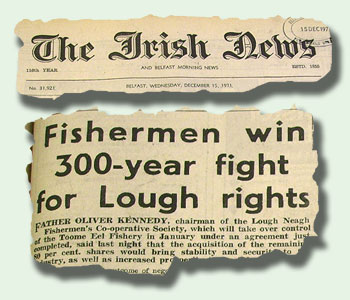
In 1965, Father Kennedy founded a cooperative society and began raising money to buy shares in the London-based company. It took six years, but by 1971, the cooperative had accumulated enough shares to buy the company out and take control of the fishing rights. It was a coup of 'David and Goliath' proportions and it made the front page of many local newspapers. The 1971 newspaper cutting here appears by courtesy of The Irish News. On the heels of that extraordinary triumph, Father Kennedy’s Bishop gave him leave to run the cooperative as his full-time ministry. 
. . . BILLINGSGATE MARKET The traditional market for Lough Neagh eels is Billingsgate in London. Eels have always had a special place here: in the 17th century, Dutch eel fishermen, whose boats were moored on the Thames, helped feed the people of London during the Great Fire and in exchange were granted a monopoly on eel trading at Billingsgate. Until recently, pie and eel shops abounded and shop window displays of live wriggling eels were a common sight across London. Nowadays, they’re few and far between but jellied eels are still sold from stalls in front of pubs, especially in the East End. Mick Jenrick has been selling eels at Billingsgate Market since the 1960s. 40% of all the eels pass through the UK market go through him. He runs his business, Mick’s Eel Supply, with his brother and he’s been trading with Father Kennedy for more than 40 years. They sell about 5-7 tonnes a week, the bulk of which are processed into jelly in Mick’s own factory. | 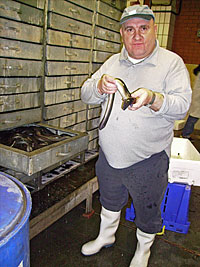 | Mick Jenrick of 'Mick's Eel Supply' - Billingsgate Market, London. |
|
In the winter, Mick buys in farmed eels from Holland; from May to October, he switches over to Lough Neagh eels. But the catches are getting poorer. “At the moment the fishing's really, really poor and we're probably getting 150 boxes a week. But if the catches were really good we'd be taking 150 boxes a day.” 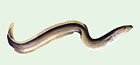
Your Responses Dave Pearce - Feb '08
Hello I am Dave Pearce, a commercial eel fisherman. I have a few numbers for you to ponder over: 1 kg of elvers if 100 percent survive would become 3/4 tone of adult eels 9 (I know 100 percent is not possible acording to the enviorment agency) 10 tone of elvers a year are caught so 10 x 1000kg=100000kg x 3/4 tone adult eels 3.500,000 tone a year is being taken out of the system.
As for eel farming that's a joke, they buy the elvers to grow om they cant breed eels they say buy farmed to save wild eels - they are the eels biggest enemy
Dave Pearce stainlessdave@talktalk.net if anyone wishes to contact me feel free. Philip Watson - Mar '07
It's not clear from your article (except by inference based on season) how many are autumnal and migratory silver eels or how many are "yellow" eels, the resident phase in their life cycle. Also, what lunacy allows elvers to be caught and exported? That's robbing the fishery of recruits, and it's a risky enough journey from the Sargasso Sea to the river and up to the Lough. I remember loads of elvers going through the eel gates at Castleroe near Coleraine in the 1970s and many were artificially transported upstream to the Lough to try and help their survival. Is this all history now? A very worthy topic - good to read of it. Aidan O'Kane - Mar '07
First salmon now the eels, its sad we have to destroy mother nature for greed.
|



 print version