Philip Patterson is eight years old and it was his grandfather, John Pattison 1 who described to me his growing of flax in Fermanagh during the war. Flax that was destined for use in aircraft manufacturer. (A752041) So, spurred on by grandfather's tales, Philip and his older brother, Timothy, decided to make flax their next project. The whole family accompanied me to the Ulster Aviation Heritage Centre to discover how linen was used to cover aircraft.(See bottom of this page for link to Timothy's report) and they have subsequently visited the Irish Linen Centre and Museum at Lisburn to see and hear about the process that turned flax into the fabric which is famous the world over. Philip has written this story as seen from the eyes of one of the workers - his grandfather perhaps? | | | 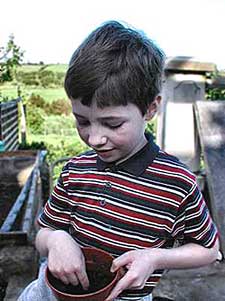 | |
Philip plants some precious flax seeds | |
"My Trip to the Linen Museum"
By Philip Patterson First we pulled the flax and tied it up with plaited reeds into bundles which were called beets. Then we put them in a flax hole which is a dam, near a river. Then after nine days we lifted out the flax and laid it out to dry. When it had dried we put it into carts to transport it to the flax mill. Then in the flax mill we scutched it by beating it and then holding it against a blade. The blade moved very quickly and got away the shoves which was the outside of the flax, we used the inside of the flax for the linen, after we had got away most of the shoves we combed it with spikes on a bench and then we wet spun the flax. Then we took it and we wove it for aeroplanes. The End |
Next visit? I'm told the family is planning a trip to the Wellbrook Beetling Mill. Click to read brother Timothy's report on his visit to the Ulster Aviation Heritage Centre
1 Yes the surnames are similar. YOUR RESPONSES
Edward (Ted) Dunlop - Sep '06
I was born in Lisburn, I think it was Ballynahinch Road, I am 81 years young, my mother worked at the Mill. Our address was 66 Gregg street, and went down the lane (called the loney) to Barbers Mill. I would watch for the women from our (house which was across the street) and they would gather and have a great time talking. Shauna Magennis - Jan '06
In response to Kathleen McCrory from Canada - the school you are talking about is now called St. Josephs Primary School at 42 Castle Street, Lisburn (Check out their website). It is still open although I'm sure its changed since you last new it. I was a pupil there myself from 1985/1992 and I too have many fond memories. The tech is also still standing and has had quite a bit of work done to it recently and Castle Gardens is currently undergoing a restoration project as it had become run down over the years.
Kathleen Mc Crory, (nee Knox ) Canada - Jan '06
I went to Sacred Heart of Mary grammar school in Lisburn, and have often wondered what happened to the original Convent, which I was told was a victim of the troubled times in Northern Ireland. Next to the convent was Castle Gardens, and almost opposite was Lisburn Tech. Are these old landmarks still there? What exactly happened to the convent all those years ago. When I visit Ireland this year, I hope to make a trip through memory lane, but would like to know if there is anything still standing that I might recognise. I have such fond memories of Lisburn in the 1950's.
Isabel Gilmore - August '05
As this is the only article on the site regarding Lisburn, I wondered if there were no other people in the new 'City' of Lisburn who had any memories of this interesting town that could be contributed to tell us all more about the place that gave us the amount of history that we can all be proud of, but which I am not able to put on paper. There is (and was) more to Lisburn (Lisnagarvey) than just linen! Come on you historical people and give us more. Lisburn Camera Club gave us lots of interesting films, there must be more out there. | 


 print version






















 POST A COMMENT ON THIS ARTICLE