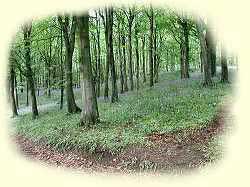
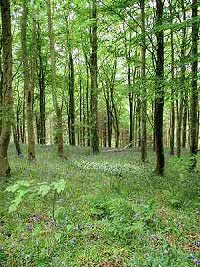
Darryl Ridge is the Forest Officer of the Northern Ireland Forest Service and is responsible for 3,250 hectares in the Bann Valley and Antrim Glens area. (i.e., Glenariff, Portglenone, Bann Woods South, Cleggan, Craigs) North District woods under State Care. He has written this history of the forest for your place and mine. "The best timber in Ireland" Portglenone Forest is a known to have been woodland since the early 1830·s, the evidence is the 1st edition Ordnance Survey maps of that time, but is probably much older. The area was shown in maps and contemporary accounts (in McCracken 1971), to be wooded in 1600. It is said these woods (Mountreivelen, Killetra, and Glenconkeyne) formed one of the biggest, and possibly the densest, oak forest in the country; together they stretched north-west from Lough Neagh, down the Bann valley, nearly to Coleraine, and across to the Sperrin mountains in the east. In 1607 this area was described by Sir John Davys, the Irish attorney-general, as ·well nigh as large as the New Forest in Hampshire and stored with the best timber in Ireland· (in McCraken 1971). There are few references to tree species other than oak in 17th century accounts, but in Glenconkeyne, it is recorded that elm and ash also grew (Hall 1992). In 1609, King James gave permission to cut timber from Glenconkeyne, which was supposed to be used to build Londonderry. He permitted 50,000 oak trees at 10s. each, 100,000 ash trees at 5s. each, and 10,000 elm at 6s. 8d to be felled. Hall (1992) suggested that the high proportion of ash trees indicated that Glenconkeyne was not pristine or untouched by man before this time (she suggested Ash required man made clearings to grow to maturity). Casks and barrels By 1635 the woods of south Derry had become mostly depleted, the great woods of Glenconkeyne and Killetra were felled to make staves for casks and barrels. The woods were exploited for profit; Glenconkeyne has a ·most peculiar and scandalous history· (Hall 1992). The Civil Survey of 1654 - 1656 (in Hall 1992) showed that the woods had all but gone. In the tenth year of William III (1698) an Act was passed entitled : An Act for Planting and Preserving timber trees and Woods, but in Ireland generally over the next 200 years, the nation became depleted of woodland. It is probable that Portglenone Forest remained intact because it was under the protection of the landowners with estate at Portglenone. | Lords and ladies Ecological evidence that Portglenone has been continuously wooded with mainly native broadleaved trees comes from the species composition of the ground flora under the 45 hectares. It is predominated by species that are indicators of an ancient woodland site, such as wood anemone, wild garlic (Ramson), bluebell, lords and ladies, broadleaved helleborine and birds nest nest orchid. |
Americans During World War II the American troops were rested after the Italian campaign before returning to D Day landings. The foundations of their Nissan huts can still be seen throughout the wood. Of archeological interest is a rath dating from 800/1500BC. Original woodland Up to 1947 the wood belonged to Bishop Alexander. The wood was felled before it passed to Forest Service ownership who replanted it mostly with native broadleaved trees. Additionally there is natural regeneration of all the main tree species, some species such as oak, elm, lime and hornbeam probably link directly to the original woodland. The woodland flora is a direct link to the original woodland community that existed here for centuries. (But don't take Darryl's word for it. visit Portglenone Forest and see for your self- Brian) Back to first page of Portglenone Forest Your Responses Robert Wheeldon - Apr '07
I am currently researching my family tree and wonder of you have any details regarding the late alexander family?
|



 print version






















 POST A COMMENT ON THIS ARTICLE