Quercus robur and Quercus petraea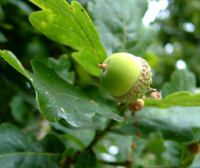 If you are lucky enough to own a large, spacious garden then why not consider playing host to one of the kings of woodland. This month, take a closer look with the Woodland Trust at one of our best-known and best-loved species – the mighty oak. If you are lucky enough to own a large, spacious garden then why not consider playing host to one of the kings of woodland. This month, take a closer look with the Woodland Trust at one of our best-known and best-loved species – the mighty oak.
It goes without saying that the oak is definitely not ideal for the modest-sized garden. This species demands its rightful space and even the smallest will soon be towering magnificently over the tallest of gardeners.
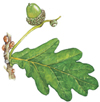
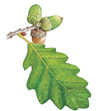
Photo above: WTPL/Margaret Barton. Our two great native oaks are Quercus robur (pedunculate) and Quercus petraea (sessile). Sessile oak is the traditional Irish oak, but the pedunculate or English oak is also considered native. To tell them apart just take a close look at the leaves and acorns. With pedunculate oak the leaves have almost no stalks but the acorns do.
| | pedunculate oak | sessile oak |
Illustrations reproduced from the Field Studies Council foldout chart 'The tree name trail: A key to common trees.' J. Oldham (1999)
|
With sessile oak it’s the opposite - the acorns don’t have stalks, but the leaves do!
Pedunculate oak prefers our ‘better’ soils. Sessile oak can tolerate thin, poorer soil but - unlike the pedunculate - does not tolerate flooding.
Both however are considered native and both provide a home and source of nourishment to an extraordinary range of insects and birds. In fact, a mature oak provides a potential habitat for an amazing 423 different species of leaf-eating insects. The acorns of course provide food for squirrels (but did you know that, in the past, wild boars would have made a meal of any acorns falling to the ground?) 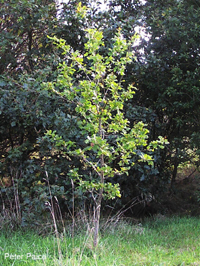 If you aren’t quite ready, or just don’t have the room, to introduce either of the above giants to your garden, then you may feel safer with a cultivated species. Quercus ilicifolia, for example, is a small oak, which may grow up to 20 ft high and which will bring striking autumn colour to your garden. If you aren’t quite ready, or just don’t have the room, to introduce either of the above giants to your garden, then you may feel safer with a cultivated species. Quercus ilicifolia, for example, is a small oak, which may grow up to 20 ft high and which will bring striking autumn colour to your garden.
Deep rooted, with a large girth and a wide canopy of branches, the oak really is a magnificent specimen. We can’t think of a better way to bring the beauty of natural woodland to life in your garden. But be prepared; this one will be with you and your future generations for hundreds of years!
Photo: WTPL/Peter Paice from Belfast.
Back to Terrific Trees homepage |