Betula pendula
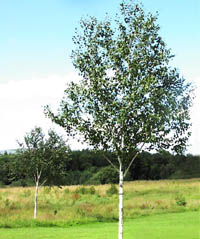 You may already recognise the Latin name. If not, perhaps the description of slender, elegant and attractive may help you to picture this month’s tree. Betula pendula, or ‘Lady of the Woods’, is better known of course as Silver Birch. Like last month’s Rowan, we think of Silver Birch as a ‘medium’ sized tree, which doesn’t demand a huge, spacious garden. You may already recognise the Latin name. If not, perhaps the description of slender, elegant and attractive may help you to picture this month’s tree. Betula pendula, or ‘Lady of the Woods’, is better known of course as Silver Birch. Like last month’s Rowan, we think of Silver Birch as a ‘medium’ sized tree, which doesn’t demand a huge, spacious garden.
Silver Birch is easily recognisable by its attractive silvery-white peeling bark, which develops deep, dark fissures with age. A delicate tree, it has fine branches and small, oval leaves, edged with double teeth. Silver Birch is deciduous and its hairless leaves begin to decorate the tree around March/April. Eventually they will turn yellow, then golden, bringing striking autumn colour to your garden.
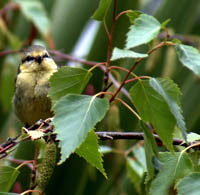
Photos above right and below left thanks to: WTPL/Peter Paice from Belfast 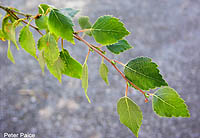 This tree also boasts fine displays of catkins (the male catkins are yellow and generally larger than the slender, green female catkins). These tight clusters of tiny flowers appear at the same time as the leaves and, by autumn, contain mature seed. The catkins provide a pretty picture, while the seeds prove popular with small seed-eating birds, such as the colourful siskin. The small birch seeds are also a welcome source of food for one of our very special wild inhabitants, the endangered red squirrel. This tree also boasts fine displays of catkins (the male catkins are yellow and generally larger than the slender, green female catkins). These tight clusters of tiny flowers appear at the same time as the leaves and, by autumn, contain mature seed. The catkins provide a pretty picture, while the seeds prove popular with small seed-eating birds, such as the colourful siskin. The small birch seeds are also a welcome source of food for one of our very special wild inhabitants, the endangered red squirrel.
Photo below right: WTPL / UKPN / Margaret Barton
 Birch will grow in poor soils; however if you do decide to bring some elegance to your garden in the form of Silver Birch, then it ideally favours a sunny position and good drainage (unlike Downy Birch which tolerates wet soils). It’s best planted when small and ideally around late winter or early spring. In return, the Silver Birch will establish quickly and will soon reward you with glorious colour, from its silver bark to its golden autumn leaves. What a wonderful way to bring the beauty of natural woodland to life in your garden! Birch will grow in poor soils; however if you do decide to bring some elegance to your garden in the form of Silver Birch, then it ideally favours a sunny position and good drainage (unlike Downy Birch which tolerates wet soils). It’s best planted when small and ideally around late winter or early spring. In return, the Silver Birch will establish quickly and will soon reward you with glorious colour, from its silver bark to its golden autumn leaves. What a wonderful way to bring the beauty of natural woodland to life in your garden!
We’ll be back next month with another native tree for you to enjoy.
Back to Terrific Trees homepage
|