Woodland Planting
1 December 2007 If you have a serious amount of land that you want to plant as woodland then seek information and help from the Woodland Trust. www.woodland-trust.org.uk. The Northern Ireland branch is based in Bangor, Co. Down and they are all lovely people. 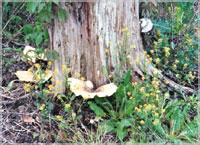 On the other hand if your garden is modest in size you may still do your bit for the environment by planting a small copse of trees or a shelterbelt. On the other hand if your garden is modest in size you may still do your bit for the environment by planting a small copse of trees or a shelterbelt.
Select trees that add year round interest and colour to the garden while providing a habitat for wildlife. A small wooded area becomes a great adventure playground for young children. Meandering paths through closely planted trees will make the leaf canopied area seem larger and will be a joy for that late evening or early morning stroll after or before work for the day. 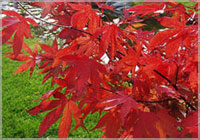 Apart form the trees there is a range of woodlanders that prefer to be planted in shaded conditions. Acer palmatum, deciduous azaleas, rhododendrons, shimmia and camellia will all succeed as will early spring bulbs such as winter aconites, Anemone blanda and English bluebells. Apart form the trees there is a range of woodlanders that prefer to be planted in shaded conditions. Acer palmatum, deciduous azaleas, rhododendrons, shimmia and camellia will all succeed as will early spring bulbs such as winter aconites, Anemone blanda and English bluebells.
Select a mixture of deciduous and evergreen trees. The autumn leaf show on rowan tree, birch, beech and cherry will be spectacular leading to a carpet of colour to walk on. In winter these deciduous trees give way to the evergreen foliage of holly and pine. 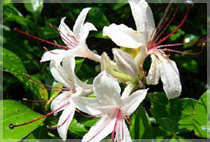 Plant some scented honeysuckles, sometimes referred to as woodbine (Lonicera). They will scramble through the trees drizzling their fragrance down to welcome you to their domain. Plant some scented honeysuckles, sometimes referred to as woodbine (Lonicera). They will scramble through the trees drizzling their fragrance down to welcome you to their domain.
I prefer to use small plants 2-4 ft in height. They become established more quickly than bigger trees that tend to sit and sulk for a couple of years. Bare root plants are available in winter and these are cheaper than container grown plants. A close plant spacing of 2 metres or 7 ft apart will form a thick copse and force the trees up to the light. If the planting is random, rather than in rows, then it will be easier to form a meandering path. Take care when planting. Make a hole larger that the root area and add some compost, farmyard manure and a handful of bone meal to each planting pit. Plant at the same depth as previously grown. Firm the soil around the roots and water well after planting.  A rustic wooden seat somewhere in the copse will encourage you to linger. A rustic wooden seat somewhere in the copse will encourage you to linger.
back to John's index page
|