Weeping Trees
September 2007 In a grand landscape scene it is tree shapes that stands out. The large, rounded headed specimens in the English countryside, tall, pointed conifers on Scottish hillsides and elegant birch growing on an Irish peat bog draw your eyes to the far distance. In most gardens there isn’t the space to indulge in lots of big trees but by planting weeping trees we can create the same impact. They look different and at anytime in the year are sufficiently interesting to add to the garden view.
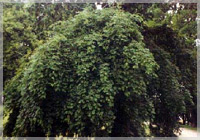 Even then some wonderful weeping trees will become too large for the average sized garden. The weeping ash, Fraxinus excelsior ‘Pendula’ is majestic in old age but you have to think ahead and provide 100 square metres for its needs. Even then some wonderful weeping trees will become too large for the average sized garden. The weeping ash, Fraxinus excelsior ‘Pendula’ is majestic in old age but you have to think ahead and provide 100 square metres for its needs.
 There are several weeping birch trees. Betula pendula has pendant branchlets but two of its offspring are truly weeping. B. p. ‘Tristis’ is tall and slender with good white bark. B. p. ‘Youngii’ is dome shaped with its branches heading out before arching down. There are several weeping birch trees. Betula pendula has pendant branchlets but two of its offspring are truly weeping. B. p. ‘Tristis’ is tall and slender with good white bark. B. p. ‘Youngii’ is dome shaped with its branches heading out before arching down.
The weeping, purple leafed beech is remarkably small only growing to 10 ft in height with a similar spread. It forms a rounded head with deep, dark purple, deciduous leaves.
For something small and interesting in winter plant a weeping cotoneaster, C. ‘Hybridus Pendulus’ grown as a standard. It won’t be out of place in the smallest of gardens and may even be grown in a large container. The dark green leaves are evergreen with clusters of small, white flowers in summer followed by bright red berries. Take precautions to prevent birds destroying the crop before you can enjoy their winter show. Then there is the dwarf weeping cherry, Prunus ‘Cheal’s Weeping’.It's pink, fully double flowers are a show in late spring as they trail down to the ground.
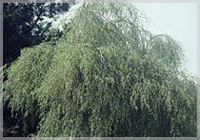
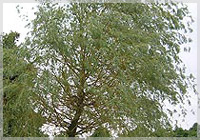 The large weeping willow (Salix x sepulcralis ‘Chrysocoma’) with its yellow barked stems is a memorable sight along the rivers in England. It isn’t as happy in our climate suffering from canker disease resulting in only a few good specimens in Northern Ireland. There is a dwarf weeping willow Salix caprea ‘Kilmarnock’ that is top grafted and the branches trail down from where it has been grafted. It doesn’t excite me but if carefully pruned it produces a good shape. The large weeping willow (Salix x sepulcralis ‘Chrysocoma’) with its yellow barked stems is a memorable sight along the rivers in England. It isn’t as happy in our climate suffering from canker disease resulting in only a few good specimens in Northern Ireland. There is a dwarf weeping willow Salix caprea ‘Kilmarnock’ that is top grafted and the branches trail down from where it has been grafted. It doesn’t excite me but if carefully pruned it produces a good shape.
back to John's index page
|