|  | |  | | | Pussy Willows
22 February 2007 Willows tend to get a bad name in Ireland. They are common, fast growing and most of them are boring for a lot of the year.
 The reason they are common is their tolerance of moist, wet or even waterlogged ground and there is no shortage of that. They will also root like weeds and poles of willow used by farmers as fence and gate posts actually root becoming trees before you can say “cut it down”. The reason they are common is their tolerance of moist, wet or even waterlogged ground and there is no shortage of that. They will also root like weeds and poles of willow used by farmers as fence and gate posts actually root becoming trees before you can say “cut it down”.
There is a grafted, weeping willow, Salix caprea ‘Kilmarnock’ that is 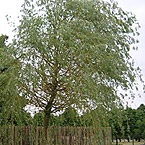 suitable for small gardens but it needs regular attention to remove suckers from the main stem below the graft and the old, dead stems under the outer canopy of branches. suitable for small gardens but it needs regular attention to remove suckers from the main stem below the graft and the old, dead stems under the outer canopy of branches.
The contorted willow has a long name, Salix babylonica var. pekinensis ‘ Tortuosa’. Its bare, twisted branches look beautiful against a dull, winter sky. Regular pruning will reduce the height and furnish it with new, manic-like growth.
The willows with coloured bark on the young stems are worth growing. In winter they are noticeable from a distance as a coloured blur on the landscape, not unlike a cloud of yellow or orange.
If you haven’t a large garden they may still be grown and either coppiced or pollarded every second winter. With coppicing the stems are cut down to stumps every other winter encouraging a mass of new growth with good bark colour. As the bark ages it loses its brightness.
Pollarding is the same principal but the tree is grown as a standard with 6 ft of un-branched stem. The branches are pruned where they form a head.
Salix alba var. vitellina produces young growths with bright yellow bark. Salix a.var. v. ‘Britzensis’ has bright orange-red stems.
Then there is the beautiful golden weeping willow Salix x sepulcralis ‘Chrysocoma’ with slender, weeping branches of bright yellow stems. Unfortunately it is prone to canker disease and most trees eventually succumb in our moist climate.
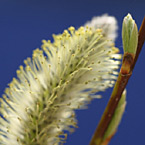
Many of the willows are female producing the silken catkins in winter and early spring. Salix gracilistyla ‘Melanostachys’ has an upright habit of growth making 9-12-ft in height. It has unusual catkins that are black with red anthers.
back to John's index page
| |
 |
| |
| 



|
| |
|