SEDUM
15 August 2006
The stonecrops are properly labelled sedum and there are hundreds of species and cultivars. Some are annuals but most are perennials or sub-shrubs.
Many are ideal in the rock garden or scree bed with smaller species fit for an alpine trough. Others make a bold edging to a path or along the front of a herbaceous border.
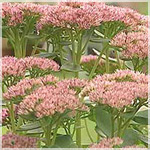 Sedum spectabile, the ice plant, is a deciduous perennial with grey-green leaves. The flat clusters of small, star-like flowers appear in late summer and are loved by bees. The variety ‘Brilliant’ has bright pink flowers. ‘Iceberg’ has white flowers. Sedum spectabile, the ice plant, is a deciduous perennial with grey-green leaves. The flat clusters of small, star-like flowers appear in late summer and are loved by bees. The variety ‘Brilliant’ has bright pink flowers. ‘Iceberg’ has white flowers.
Sedum telephium maximum ‘Atropurpureum’ is a lovely orpine. The stems and leaves are dark purple with pink-red flowers in late summer and autumn.
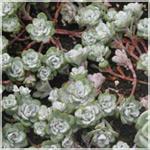 Sedum spathulifolium is my favourite with tiny, spoon-shaped, rosettes of evergreen leaves. The star-shaped, bright yellow flowers appear in summer. Sedum ‘Purpureum has reddish-purple foliage and S. s. ‘Cape Blanco’ has small leaves powdered white. Sedum spathulifolium is my favourite with tiny, spoon-shaped, rosettes of evergreen leaves. The star-shaped, bright yellow flowers appear in summer. Sedum ‘Purpureum has reddish-purple foliage and S. s. ‘Cape Blanco’ has small leaves powdered white.
With most gardeners Sedum acre is practically a weed. It is mat forming only growing to 5 cm (2 inches) high with pale green leaves and yellow flowers in summer. Sedum humifusum is similar in habit with yellow flowers in early summer and grows to less than 2 cm (1 inch) in height.
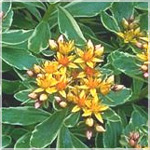 Sedum kamtschaticum ‘Variegatum’ has pink-tinted, mid-green leaves with pale cream margins and yellow flowers that age to crimson during late summer. Sedum kamtschaticum ‘Variegatum’ has pink-tinted, mid-green leaves with pale cream margins and yellow flowers that age to crimson during late summer.
Another variegated sedum is S. sieboldii ‘Mediovariegatum’ with glaucous-blue leaves, cream centres and occasionally red margins. The star-shaped, pink flowers appear in late summer.
They prefer a fertile, well drained, alkaline soil in full sun. Keep a close watch for vine weevil attacks where they devour the roots.
back to John's index page |