Rose Hips
1 September 2005 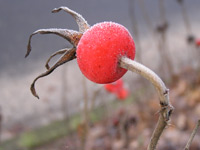 They are wonderfully useful seed packets. Rose hips are good for you, make a fine syrup and are extremely irritating when the hairy seeds are craftily slipped between your shirt and bare back during class. They are wonderfully useful seed packets. Rose hips are good for you, make a fine syrup and are extremely irritating when the hairy seeds are craftily slipped between your shirt and bare back during class.
The best known hip is that of the wild rose, Rosa canina better known as the dog rose. The tough skinned, urn shaped, orange-red hips ripen early and by October have fallen prey to hungry birds. My favourite rose hip is the big, fat, tomato- like fruit of Rosa rugosa. As it ripens it turns from bright orange to a deep, dull red. The large, single flowers are available in white and shades of pink and mauve. A favourite food for birds they can, like other fruit, look untidy when half eaten. The small, pale orange hips of bush, climber and shrub roses often look pathetic and that is how it should be. That you have noticed them in your garden means that you are not dead heading your roses. This will result in a loss of flowers and a weaker plant. 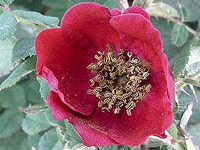 For style it is difficult to beat Rosa moyesii. It forms a 10 ft high shrub and in late summer is plastered with large, bright red, flask shaped hips. The variety R.m. ‘Geranuim’ produces bright orange-red fruit of the same attractive shape. For style it is difficult to beat Rosa moyesii. It forms a 10 ft high shrub and in late summer is plastered with large, bright red, flask shaped hips. The variety R.m. ‘Geranuim’ produces bright orange-red fruit of the same attractive shape.
Rosa glauca has reddish green stems and attractive, greyish purple foliage. The single, cerise pink flowers are followed by spherical bright red hips in autumn in sufficient quantities to bend the branches. Rosa ‘Empress Josephine’ is properly named Rosa x francofurtana and is not easily found in garden centres.The semi-double, deep pink flowers appear in early summer and are followed by deep red, cone shaped hips. 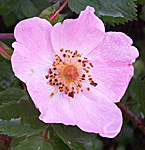 The Incense rose, Rosa primula has aromatic, fern-like foliage and single, primrose-yellow flowers in late spring followed by small, cone-shaped purple-maroon fruit. The Incense rose, Rosa primula has aromatic, fern-like foliage and single, primrose-yellow flowers in late spring followed by small, cone-shaped purple-maroon fruit.
Scotland has its own rose, Rosa pimpinellifolia (Scots rose, Burnet rose).Early summer, creamy-white flowers are followed by masses of small, spherical, blue-black fruit.
back to John's index page |