Hostas
15 July 2005 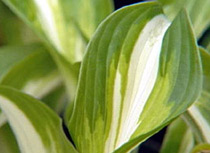 There is no perennial more useful in so many parts of the garden. It is a great plant for a shady situation. It looks good along the front of a wide mixed shrub and perennial border. They will soon fill a large patio container with their bold leaves overhanging the rim. There is no perennial more useful in so many parts of the garden. It is a great plant for a shady situation. It looks good along the front of a wide mixed shrub and perennial border. They will soon fill a large patio container with their bold leaves overhanging the rim.
Planted in the bog garden or close to a pond or stream they quickly become established with their large leaves forming summer ground cover. They prefer a shaded situation in a moist, free-draining, fertile soil. 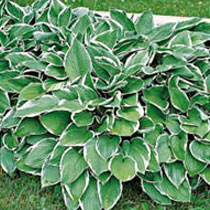 The foliage ranges in colour from light green through deep green and blue-green to deep blue. Green leaves with cream or yellow margins or splashes of variegation through the leaf are particularly attractive when they are planted in a woodland situation. The foliage ranges in colour from light green through deep green and blue-green to deep blue. Green leaves with cream or yellow margins or splashes of variegation through the leaf are particularly attractive when they are planted in a woodland situation.
The white or pale blue flowers appear on long stems in early summer. They are seldom spectacular but although short lived they do add height and interest to a large clump. Slugs and snails love hostas. They can destroy whole leaves in an evening. The leaves are, at best, full of holes or devoured down to the main veins. 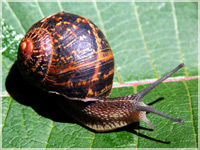 Some varieties such as ‘Sum and Substance’ have pale green-yellow, metallic-like leaves and are practically immune to slugs and snails. Baiting and trapping with slug pellets works but use them sparingly. It is a waste to scatter them at a density closer than 10 cm apart. Container grown hostas may be made safe by smearing the rim of the container with Vaseline. They will refuse to move through the barrier. You may win the battle but, with these pests, in the long run you will still lose the war. Some varieties such as ‘Sum and Substance’ have pale green-yellow, metallic-like leaves and are practically immune to slugs and snails. Baiting and trapping with slug pellets works but use them sparingly. It is a waste to scatter them at a density closer than 10 cm apart. Container grown hostas may be made safe by smearing the rim of the container with Vaseline. They will refuse to move through the barrier. You may win the battle but, with these pests, in the long run you will still lose the war.
The easiest form of propagation is by division in early spring. Split large clumps retaining 1-2 growth buds on each small, rooted portion. Pot them up in a soil based compost for a season before planting them out in their permanent positions.
back to John's index page
|