Hydrangea
27 June 2008 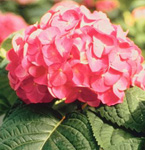 Everyone knows what a hydrangea looks like. Non-gardeners may not know the name but mention a big, mop head flowers and they will remember it. Everyone knows what a hydrangea looks like. Non-gardeners may not know the name but mention a big, mop head flowers and they will remember it.
The trouble is there is more than one type of hydrangea. Even the mop headed types have differences. There is the common Hydrangea macrophylla which is divided into Hortensia with the typical spherical flower head made up of sterile flowers and Lacecap with flattened heads with small fertile flowers in the centre surrounded by larger sterile flowers.
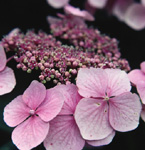
Confusion is centred around the fact that they change their flower colour depending on the amount of lime or lack of it in the soil. Acid soil encourages blue or shades of purple while alkaline, limy conditions will make the flowers pink or red. H. villosa has beautiful dark green, velvety leaves and rich blue fertile and rose-lilac sterile flowers.
The leaves and stems of H. sargentiana are very bristly with purple fertile flowers surrounded by white, sometimes tinged with purple, sterile flowers. It has an upright habit of growth making 10 ft in height.
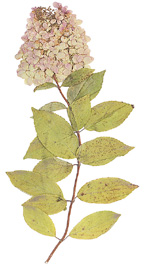
One of my favourites is H. paniculata ‘Grandiflora’ with large flower heads shaped like a bunch of grapes made up of mainly white sterile flowers that become tinged with pink as they age.
The oak leafed species H. quercifolia has deeply lobed, oak-shaped leaves and white flowers.
 Then there are the climbing hydrangeas with H. petiolaris the best known. It is deciduous and vigorous with dark green leaves that turn buttery yellow in autumn. It clings to its support using aerial roots. The clusters of white, fertile and sterile flowers appear in summer. Be warned, given the chance, this climber will climb to 45-50 ft. Then there are the climbing hydrangeas with H. petiolaris the best known. It is deciduous and vigorous with dark green leaves that turn buttery yellow in autumn. It clings to its support using aerial roots. The clusters of white, fertile and sterile flowers appear in summer. Be warned, given the chance, this climber will climb to 45-50 ft.
The evergreen climbing hydrangea, H. seemannii has leathery, bright green leaves with greenish-white fertile flowers and pure white sterile flowers in summer. It is not fully hardy succeeding best in a sheltered, sunny site. It is not as vigorous as H. petiolaris but will grow to 30 ft in height.
back to John's index page |