ORNAMENTAL LEAVES
july 2006
There are plants that are disappointing in flower and many trees are without colourful bark but there are very few plants that don’t display interesting leaves. Leaves add structure to a garden providing a backdrop to the flowers and berries.
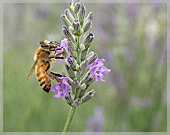 Many, such as Choisya ternata (Mexican Orange Blossom), bay tree, eucalyptus tree and lavender, are aromatic. Many, such as Choisya ternata (Mexican Orange Blossom), bay tree, eucalyptus tree and lavender, are aromatic.
Leaves come in all shapes and sizes. Cordyline (Cabbage palm), Phormium (New Zealand flax) and yucca (Spanish dagger) have long, thin, sword-like leaves often with sharp tips.
Then there are the palmate or hand shaped leaves. Good examples include the Japanese maple and the large, mid-green, leathery fingered leaves of Fatsia japonica.
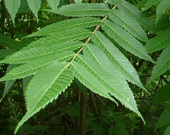 A good example of a plant with pinnate leaves is the common ash tree. Others include The Tree of Heaven, Ailanthus altissima where the whole leaf is made up of many leaflets resulting in a structure 60 cm (24 inches) long. Most hairy leaves have a silky, soft feel. Think of Lambs’ Ears, Stachys byzantina. A good example of a plant with pinnate leaves is the common ash tree. Others include The Tree of Heaven, Ailanthus altissima where the whole leaf is made up of many leaflets resulting in a structure 60 cm (24 inches) long. Most hairy leaves have a silky, soft feel. Think of Lambs’ Ears, Stachys byzantina.
Hydrangea villosa has velvety, dark green, deciduous foliage. Then there are the plants with rough surfaced leaves such as Hydrangea sargentiana with large, dark green, bristly leaves that make a rasping sound as you move your hand across.
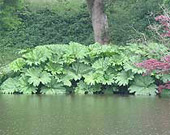 Plants with large leaves are very popular at the present time. They don’t come much larger than Gunnera manicata.It is a deciduous perennial plant with leaves 2 metres( 6 ft ) across on 2.5 metres ( 8 ft) long stalks. Plants with large leaves are very popular at the present time. They don’t come much larger than Gunnera manicata.It is a deciduous perennial plant with leaves 2 metres( 6 ft ) across on 2.5 metres ( 8 ft) long stalks.
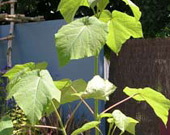 Paulownia tomentosa is sometimes referred to as the Foxglove tree. The softly hairy, bright, light green leaves are 30 cm (12 inches) across. If the tree is cut down each spring to within 12 inches of the base it will produce a 2-3 metre(6-10 ft ) high tree within the season and the leaves will be up to 45 cm (18 inches) in size. Paulownia tomentosa is sometimes referred to as the Foxglove tree. The softly hairy, bright, light green leaves are 30 cm (12 inches) across. If the tree is cut down each spring to within 12 inches of the base it will produce a 2-3 metre(6-10 ft ) high tree within the season and the leaves will be up to 45 cm (18 inches) in size.
There are sufficient leaves to provide the forty shades of green along with yellow, red, plum and blue. In autumn the leaf colour of some of our deciduous trees is spectacular. Liquidambar, maple, birch, rhus, chestnut and oak change from summer green to vivid yellow, orange, red and purple.
Variegated foliage is useful in the garden especially if the plants are evergreen.
back to John's index page |