Fruit Tree Shapes
26 March 2007
Pruning promotes growth and this is used to good advantage when shaping a fruit tree. When growing fruit the trees may be trained in an amazing range of shapes. Some such as fan trained are ideal where the fruit is to be grown against a warm, sheltered wall. A sunny wall will ensure that the fruit skin colours well and ripens early. Others, such as cordons, are suitable for small areas and yet more, such as goblet trees, are really grown for the pleasure of pruning and training. The final shape, elaborate or simple, revolves around how the tree is pruned. Suitable examples are where you prune to a growth bud pointing in the direction you wish the shoot to grow, removing shoots where there is congestion, encouraging the tree to produce more fruit buds at the expense of additional growth and renewing old branches with new growths. The framework branches that will serve the tree for decades are formed in the first few years. Bush
The traditional tree shape and suitable for most types of tree fruit. The framework of branches spread out like the spokes of a wheel from the trunk at a height of 1 metre above soil level. The centre of the bush is kept free of branches.
Half-standard
This is a bush tree on a taller trunk. It makes a large tree with the additional problems of maintenance and fruit picking.
Standard
As before but with a trunk 2 metres in height before the branches spread. This size of tree has to be grown on a vigorous rootstock. There is certainly no difficulty using a ride-on mower to cut the grass under the branches!
Cordon
The shape is best suited to apples and pears planted in a small space. The single stem is grown at an angle and supported with a stake or tied to horizontal wires. The growth is restricted by regular pruning resulting in quality fruit easily ripened in the sun.
Double cordon
Unlike the single cordon the two-stemmed tree is usually trained vertically with the twin stems 60 cm apart. French nurserymen used to produce cordons with up to four branches resembling overgrown digging forks.
 Espalier Espalier
The horizontal branches are trained in pairs one on either side of the main trunk. The tiers are uniformly spaced. Ideal for apples and pears growing against a wall.
 Fan Fan
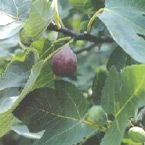
This shape is suitable for most tree fruit but is ideal for wall grown peaches, nectarines, figs and cherries. The trunk forms two branches, one heading to either side and close to the ground. From these two arise the side branches that form the bones of the fan.
Stepover
This is an unusual tree formed from a single cordon bent over and trained on a wire horizontally 30 cm from the ground. It may make an attractive low edging to a path but picking the fruit is as sore on the back as picking strawberries!
back to John's index page |