Sedgeford, near Heacham, has been around for more than two millennia. The Sedgeford Historical and Archaeological Research Project (S.H.A.R.P.) has been investigating the village since 1996 and has uncovered a past stretching back to the Bronze Age. Although the site was initially investigated during the 1950s, when some 70 burials were lifted from the aptly-named Boneyard Field, SHARP is the first extensive and detailed study of the site. Up to the end of the 2002 season, a further 177 burials have been found and this year the body count is eight, and rising. The Dig 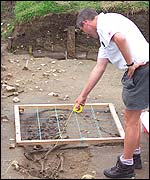
Archaeologist looking at a find in the boneyard |
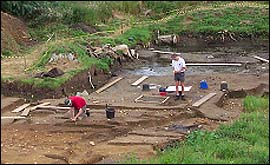
The Boneyard is on the south-eastern edge of the modern village and it is from the trench, pictured right, that most of the recent finds have been discovered. At the bottom of the slope, the ground is often water-logged but it is known that there are several burials in the swampy ground. Many of the bodies are infants, yet to be uncovered. Archaeologists on the site are certain that infants were buried closest to a church or chapel and so have a reasonable expectation that, if they can continue to fund the excavation eastwards, they will find what is likely to be the village's first Christian place of worship. Most of the graves, which are aligned east-west, as typical of Christian burials, date back to the Saxon period, in the ninth century. It is clear from the evidence that sometime in the 10th and 11th centuries, the Saxons moved the village westwards from the Boneyard. The Vikings later moved in to the abandoned eastern lands and set up home - on top of the older Saxon burials. The remains of their buildings cut through some of the graves, and a drainage channel severed a number of Saxon skeletons. SHARP has been at work elsewhere in the village, carrying out exploratory work at West Hall, on the site of a moated manor and the parish church of St Mary the Virgin. 
Gareth Davies |
The workers SHARP is run by a combination of trustees, directors and a managing committee, but much of the leg-work is carried out by students of archaeology, many of whom are on courses run by the University of East Anglia. Excavation of the Boneyard Trench is under the co-direction of Dr Neil Faulkner, Gareth Davies, and Sophie Cabot and Jean McGinty OBE is Chairman of the Trustees. As a charity, SHARP relies on donors to fund its work, which sometimes includes the hiring of specialist assistance to identify some of the finds - especially fragments of animal and bird bones, and pollens. If you want to find out how you can get involved or become a volunteer with SHARP, you can find out more information from its website: http://www.sharp.org.uk Read more: SHARP open day » | 





 View
View