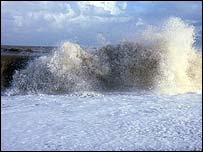
You may be wondering why the spring tides in Norfolk are often very dramatic. Well, it's because of the Sun and the Moon. We all know that our closest neighbour in space is the Moon. On average, it's about 380,000km away and although this seems a very long way, it is still able to have a very important impact on our lives. Gravity Like all objects in space, the Moon has gravity. Gravity is the force that holds you and me on the Earth and stops us floating off into space. It holds the Earth in its orbit around the Sun and it keeps the Sun travelling around the middle of our milky way galaxy. While the gravity of the Earth pulls on the Moon, the Moon's gravity is also pulling on the Earth. This pull of gravity causes a bulge to appear on the Earth as the Moon pulls that part of it very slightly toward it. We don't really notice this when it's the land but when it's the sea, we see a much more dramatic effect. The sea seems to rise and we see this as high tide. A similar effect is seen directly opposite on the other side of the Earth. As the Earth spins on its axis, we experience these two of these high tides every day. In between this we experience a low tide. Spring tides in Norfolk 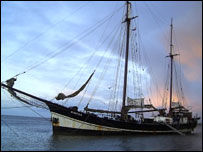
High spring tides lift the Albatross at Wells-next-the-Sea. Picture by Wells Harbour. |
Have you heard about Spring and Neap tides and wondered what they are? When the Moon is in line with the Sun and Earth, we experience our usual high tide from the Moon, but the Sun's gravity adds to the force and makes the tide even higher. This is when we experience a spring tide. When the Sun and Moon are at 90 degrees from each other (such as when the Sun is setting and the Moon is high in the sky) we see the lowest of the high tides, or neap tide. We get two spring tides each month and two neap tides each month. Not only do the tides have an effect on ships and fishing, but the tides are very important to life in the sea. Without them it would be a very different world. |