The Norfolk Nelson Museum boasts around 900 items dedicated to the naval hero from letters, books and ceramics to paintings, medals and a piece of wood from the Victory. Officially opened on 18 July 2002 by the Duke of Edinburgh, the museum trust's patron, it shows what Horatio Nelson's life was like below the decks through sight, sound and smell. Interactive displays A replica of a boat houses an interactive display where children can climb into hammocks, hear Nelson's commands and the commotion on board a battleship, see the crew's meagre daily rations and smell cannon-fire. A room recreating Nelson's home at Merton Place in Surrey is dedicated to his life outside of battle. A wax model of Nelson sits at a desk, and glass cases feature displays of how he looked and his colourful love life. Ben Burgess The museum was the brainchild of the well-known Nelson enthusiast Ben Burgess, who lived in Norwich. His father had a keen interest in Nelson, but Ben's own interest was fired after he attended his hero's school, the Paston in North Walsham. Before his death in 2000, Mr Burgess set up the Ben Burgess Nelson Memorabilia Trust to raise money for a museum so his family's 600-strong collection would remain in the county. South Quay The trustees spent six years looking for a suitable building before plumping for the one on the South Quay in Great Yarmouth. 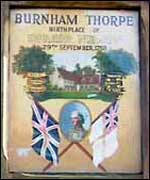
Village sign at Burnham Thorpe |
They decided to house the collection in Great Yarmouth rather than Nelson's birthplace of Burnham Thorpe or Norwich because of the admiral's close maritime links with the town. Nelson would have been familiar with the South Quay building. He landed at the port when he returned from the Battle of Copenhagen in 1801 and the North Sea Fleet operated from the town during the Napoleonic War. The museum cost around £750,000 to set up - and it needs to be funded by donations to remain open. If enough money can be raised, the museum will be able to host touring exhibitions. Volunteers are also needed to staff the museum and run educational projects. Lessons in history 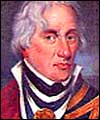
Portrait of Lord Nelson by Matthew Henry Keymer |
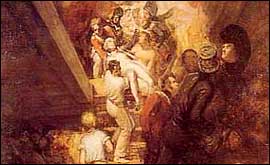
Education will be an important focus. Children can attend activity days: in the Naval Room they can play battle games and copy Nelson's signature, while in the Below Decks Experience they can find how people used to live in Georgian times by opening up information panels on the cut-out models. "We'd love to have schools visit - as many as possible," said museum curator Faith Carpenter. "I think schools really liven up a museum. Also Nelson is an individual and in the National Curriculum, projects can be done on individual heroes." A-level and degree students can also use the museum's library - which includes a manuscript draft of an important biography written by Admiral Mahan in 1897, bought in New York. "We've got all the books here, we've got pictures - it's perfect as a resource," she added. Top exhibits The exhibition's showpiece is a large oil painting by Samuel Drummond which shows the dying Nelson being carried below the Victory's decks. It was bought by the Ben Burgess collection in Ireland. 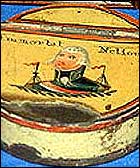
The curator's favourite item - a Toleware snuff box. |
However, the curator's favourite piece is an 1804 Toleware snuff box which is on display in the Naval Room. "It has a little lid with a Nelson picture on and it is so naive - even crude," says Faith Carpenter.
"It's got a long neck and a big circular head and it's really sweet," she added. | 




 View
View