|  | When you see the holiday brochures for Norfolk, it's easy to forget that the idea of a holiday in the county is far from new!
The Victorians loved coming here, and so have successive generations.
And that's why a new exhibition at the Lynn Museum in King's Lynn is taking a look at the Norfolk holidays of yesteryear, from Victorian times to the 1960s.
A short history...
Robert Walpole, Britain's first prime minister used to have holidays here in the 18th century, but his Norfolk congresses at Houghton were strictly for the elite, who spent the days hunting and the evenings dining and talking politics. But for most of us, holidays arrived in Victorian times and it was the coming of the railways that made Norfolk the place to visit. Tim Thorpe, is the curator of Lynn Museum he explains how the North Norfolk seaside became so popular.
"It was in 1862 that the railway first arrived in Hunstanton. Up till then, Hunstanston was only a sleepy little village with only a few houses. The man that actually campaigned for a railway also owned hotels and guesthouses and the place literally exploded," added Thorpe. It wasn't just Hunstanton that grew with the holiday trade. A series of books and articles which can be see at the exhibition, helped to make the area fashionable with the Victorians. "There was a freelance journalist called Clemence Scott who first visited Cromer in August 1883. He wrote several pieces and it really grabbed the local imagination, especially his descriptions of the way the poppies were growing up on the cliff tops.
"He wrote several books, Poppyland and Vera in Poppyland and they really attracted huge numbers of people to Cromer," said Tim Thorpe. 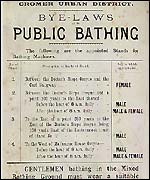
Bathing poster |
Cromer also has another claim to fame. It was the first place where mixed bathing was allowed, although gentlemen, according to one of the posters in the exhibition, had to be properly attired, from neck to knee!
All sorts of people were attracted to the the Norfolk coast. Indeed part of the exhibition is devoted to the 'finds' dropped by visitors through the slats of the piers at Hunstanton and Cromer.
Everything from rings and brooches coins, buttons, even cutlery. A special find included some treasure hunt tokens from the 1960s.
The national newspapers were well known for having treasure hunts, and on display, are two tokens from the Daily Mirror from 1969 that were buried on purpose for children to go and find.
The rise of the holiday camp
By the 1950s the genteel Victorian and Edwardian holidays had given way to the era of holiday camps.
The first holiday camp in Britain was at Caister and opened in 1909. "It was a huge attraction to be able to go from work for a week and take your whole family and actually go and live in a holiday camp in Butlin's or any of the other holiday camps where everything was provided," explained Tim Thorpe.
"Whole factories would close down for the summer, and the entire workforce would go off together and mass book their trains and their holiday camps," added Mr Thorpe.
Today the tourist trade has changed again. The train no longer comes to Hunstanton, but the summer crowds still do.
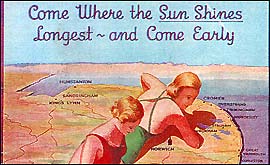
The exhibition features photographs, posters, ephemera, souvenirs and reminiscences about the traditional bucket-and-spade Norfolk holidays of the past.
There is a reconstructed beach hut, Punch and Judy tent, period swimming costumes from the 1920s to the 1960s, and a large collection of objects lost by Victorian holiday-makers and recently found under the old Hunstanton pier site by a local metal detectorist. |



 View
View