| 24 September 2014 |

| |
| BBC Homepage | | |
| |||
| Contact Us | | |
Theatre & DanceYou are in: Norfolk > Entertainment > Arts, Film & Culture > Theatre & Dance > Review: Macbeth by Glyndebourne On Tour 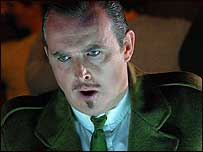 Stephen Gadd in the title role Review: Macbeth by Glyndebourne On TourBy Tom Simmons Glyndebourne On Tour continue its Norwich residency with a psychologically powerful and sober production of Verdi's opera Macbeth - the second performance at the refurbished Theatre Royal since it re-opened its doors. In a revival of the recently premiered 2007 festival production - directed in this version by Geoffrey Dolton - Glyndebourne On Tour chose an unconventional approach to integrate sections from both adaptations of Verdi's famous opera.
Help playing audio/video Bold choicesCombining large sections of Verdi's 1865 version of the opera with the finale of the earlier 1847 edition, the company reinstated the battle scene and Macbeth's final Death Aria. These were bold judgements, reflected in uncompromising decisions made in other parts of the production, resulting in an opera which draws to an unsettling conclusion, bleakly focusing on Macbeth's lonely death. 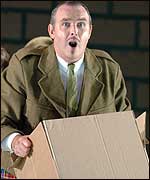 Gadd's performance is "remarkable" Stephen Gadd's performance of Macbeth was remarkable. He combined a powerful projection of the character's inner turmoil with the musical nuances Verdi is known to have put so much energy into writing. Likewise, Svetlana Sozdatleva (Lady Macbeth), Ilya Bannik (Banquo) and Stefano Ferrari (Macduff) mirrored Macbeth's desperate plight with similarly strong performances. Ultz's brave design, for the most part set in blue faux castle walls using tartan textiles to emphasise the tribal divisions inherent to the libretto proved a considered, if unconventional setting. It brought the opera into the context of a post-war Britain. The witches offset the stark qualities of these scenes whose multiple characters - which were inventively choreographed by movement director Linda Dobell to elucidate something of Macbeth's devilish liaisons - were humorously conceived. 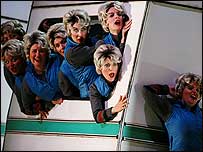 The witches gather. Credit: Mike Hoban. Intelligent set designThe decision to use just one of the three caravans, that have been a feature of previous performances, in these scenes worked well. It focused the audience's attention on the relationships between the three sets of characters. The decisions to strip the production of the opera back to the fundamental issues explored in the libretto and in the music created room for the development of allegorical references to corrupt rulers, moral distinctions, allusions to heaven and hell. They also pointed towards a return to Verdi's emphasis in Macbeth on the development of opera as a form of music drama - a concept more famously developed in contemporary works by Richard Wagner. Conductor's city returnRobin Ticciati returned to Norwich to conduct the opera and the GOT orchestra, whose excellent performance of Verdi's score further demonstrated a serious interpretative talent. Featuring significant brass and percussion sections, the orchestra delivered Verdi's intricate music in a confident manner. Developing superbly judged relationships between dynamic range and phrase structure, the various strands of the vocal and instrumental lines were assiduously balanced. GOT continue their visit to Norwich with performances of Britten's Albert Herring and Donizetti's L'elisir d'amore until Saturday, 17 November, 2007.The performance of Macbeth will be repeated on Saturday at 7.15pm.last updated: 16/11/07 SEE ALSOYou are in: Norfolk > Entertainment > Arts, Film & Culture > Theatre & Dance > Review: Macbeth by Glyndebourne On Tour   Listings Providers
The BBC is not responsible for the content of external websites |
| | About the BBC | Help | Terms of Use | Privacy & Cookies Policy |