 | 29 October 2014 |

| |
| BBC Homepage | | |
| |||
| Contact Us | | |
General FeaturesYou are in: Norfolk > Features > General Features > Interview: Rick Stein 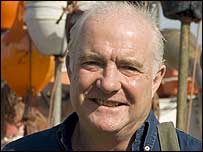 Rick Stein loved our cockles Interview: Rick SteinHe's toured the world, championing local food and the simplicity of cooking fish. Having carved out a role as an ambassador of local produce, Rick Stein was taken to Norwich Market by Radio Norfolk's Nicky Barnes to sample our seafood. Audio and Video links on this page require Realplayer Rick Stein's skill as a chef and relaxed presenting style brought him to viewers' attention on television, but it's his enthusiasm and never-ending quest to hunt out the tastiest local produce which has sustained his popularity as a presenter and food champion. His latest TV series and book, Mediterranean Escapes, brought him to Norwich where more than 200 people turned out for his book-signing and demonstration at Jarrold's on Thursday, 20 September, 2007. BBC Radio Norfolk presenter Nicky Barnes thought he might be in need of a snack beforehand, so took the Cornwall chef to Norwich Market where they tucked into a plate of cockles. The restaurateur said his market trip reminded him of his tour around Britain when he filmed Food Heroes and visited Stiffkey Marshes to sample its blue cockles. Rick told Nicky why seeing the market had been reassuring, how his love of food and travel make perfect partners and about life without his four-legged companion Chalkie. 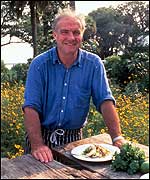 Rick Stein has championed local food NB: I thought why don't we come out and have a plate of cockles on the market and you can sample a bit of prime Norfolk, so here we are… we've got two pots of cockles here. Are you a vinegar and chilli sauce man?RS: No, I like vinegar and white pepper. It's got to be malt vinegar too. NB: You did your tour around Norfolk and found your Food Heroes, were cockles on your menu then?RS: Absolutely. We went to Stiffkey… Stewkey? NB: Depends where you come from...RS: We went out with a guy who must have been all of 90, going for some Stewkey blues. NB: Were they very good?RS: They were very good - they were also a nice shade of blue. NB: You're often touring around the country, just tell us about your highlights when you come to Norfolk. What's on the menu?RS: Well, I was just having a look at the samphire and the crab which presumably come from Cromer because they're nice small ones. Also, the brown shrimps from The Wash, again a fond memory of Norfolk for me, and the pink ones as well. NB: Do you feel heartened when you turn up in a place like this and you see this array of stuff here on sale to local people becoming very much every day?RS: Well, I do, I must say. This market has always been a great pleasure to me and I was a bit concerned to hear that it had been rebuilt, but it does seem to have been done rather well. It's probably lost a bit of that higgledy-pidggledyness that it used to have but health and safety, and we've all got to abide by the rules these days. NB: How much do you think our search for local food is about nostalgia?RS: I don't know if it is, I just think that it's an innate understanding in most human beings that nature doesn't come in straight lines and I have to say just having done this programme and book about the Mediterranean that's very much the case there. I think certainly that people I know and like would be attracted to a stall like this because it just looks natural. NB: You've been off on the canal boats in France and you're now touring the Mediterranean - is that the sort of thing you enjoy or would you rather be in Cornwall or just trucking around England?RS: Well, I like both really. I just think I've got quite a nice job to be paid to go round all those lovely parts of the Mediterranean that people go on holidays and eat local food - and talk about it as intelligently as you can - although having said that, having had half a bottle of wine before you start talking about it! 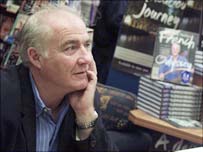 The restaurateur at a French Odyssey book signing The favoured way of talking about it, for me, is going to a Mediterranean restaurant, having a couple of glasses of wine and then talking about it - but that is lovely. Today I'm on this book tour and I was remembering what it was like doing the Food Heroes and just travelling around Britain and there's something very nice about it. It's very nice doing a book tour because as you progress through the country you see the way it changes. You taste all the different things and I just quite like travel really and I think travel in Britain is very good fun. NB: Is that what's good for you: the travel and also the people as much as the food?RS: Yes, it is. I find people interesting and I love regional accents. I love the Norfolk accent actually but I haven't heard much as I've only just arrived but I shall go out and find it. I suppose I've got a restlessness about me which is only alleviated by travel and I like being on the road. NB: There was a time, not that long ago, when you wouldn't see such an array of fish on a stall like this, although these fish stalls on Norwich market have always done pretty well. There's a much greater variety now and do you take some credit for that because a lot of people find it difficult cooking fish?RS: They do and I think for the reason that they don't know what to do with it - they do know what to do with cod, plaice and haddock and one or two others but otherwise it is a problem, so anything that can teach them how to cook lesser-known species is good and that's one of the points of doing all the fish programmes that I have done. Let's have a look over here and see what we've got. Turbot, which a lot of people would probably have a bit of a problem [with] - a pan big enough to put it in and the price is always extremely high but it's worth every penny of it in my view. Bass, now, people are quite conversant with - thanks funnily enough to farmed bass because it's become a price that people can afford generally. Tuna, 20 years ago, came in tins - people are very familiar with it now. It's nice to see some fresh herrings on the fish stand. NB: How much do you feel a part of this. When you set out did you have a campaigning head on or did it just happen accidentally?RS: It came accidentally really because living in Cornwall, as I did, I was familiar with the species of fish which no-one else seemed to be able to get hold of, things like monkfish. When I started the restaurant 20 years ago you couldn't mention it as monkfish - 30 years ago, what am I talking about - because no-one knew what it was and now, of course, it's really well known and everyone's clamouring for it and the price reflects that. Other species - John Dory was another one, gurnard, lots of ones, particularly local to Cornwall fish like megrim sole - I was aware of the quality of all these fish and felt like telling everyone about it. And what about squid - that's exactly the price of squid at the moment £12 a kilo, but I can remember when it was £2 a kilo, not that long ago because people know how good it is. Our local squid is so much better than the frozen stuff. NB: What's coming across is that you still want to get your hands dirty. You might be on a book tour, but you sound like you'd rather be in the kitchen chopping up that squid now.RS: Well, I would actually because I love it. People say to me, 'Don't you get bored with it,' well, you don't actually because it's food and you're hungry every day and you start looking at something like a squid and thinking how you're going to cook it and off you go. NB: Telly is a laborious process when you film it. Is it easy to cook for television or do you have to do a load of versions and waste a lot?RS: You don't really have to do a load of versions because you muck them up. 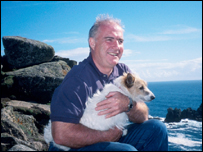 Rick with his beloved Chalkie Most of the telly I do only has one camera and the reason you have to cook it twice is you have a close-up, so you see what is happening really close up and then you have a wide shot, which is like standing back so you see the whole fish and the kitchen and, like it or not, you have to do it twice. NB: So, you end up eating it twice.RS: Well, you do or the crew do. It's funny… I was doing Saturday Kitchen the other day and I was just amazed because all the crew were lined up with all the spoons and forks. They'd got into such a habit of eating what was cooked. NB: I've got to ask you about Chalkie, if you don't mind.RS: Oh right. Oh dear. NB: So many people were upset, as you were obviously, when you lost him. Were you surprised at that - that he'd almost become as big a character as you in your TV series?RS: Not really. He was just a very endearing dog. He was my dog - so I can understand it because when I watched that dog on Frasier, you know - I just thought I like the dog more than Frasier and it's the same with Chalkie. If it's your dog, it's your dog. I miss him dreadfully, but I didn't have that, 'Ah, how cute he is,' because I was with him all the time, except when he jumped up and bit the microphone - that's how he got the job! We were filming the second day of just filming anything in my house and I was sitting on the sofa and he did that and David just said, 'Oh, we've got to have him, haven't we?'. NB: Any thoughts of replacing him or is he irreplaceable?RS: I don't know really because my life has changed a bit. I get around and travel a great deal now and I would feel bad - there are obviously people who would look after him - but I'd just feel bad about leaving him all the time - or her - so I think possibly not. He was 18 when he died, that's 20-odd years of my life where I'll look back and say, 'That was the time of Chalkie'. NB: You say your life has changed: you're book signing, you're in the Mediterranean, you're on canal boats, you've now got a house in Australia. Is the sitting in Cornwall, going to have a look at the fish market every day… have those days gone now?RS: I'm still very attached to what's going on, particularly in fisheries in Cornwall, so not really but I suppose it's that my horizons have broadened a bit, but I'm still happiest in Cornwall, no question about it. last updated: 21/09/07 You are in: Norfolk > Features > General Features > Interview: Rick Stein  Your views, your stories, your life on the BBC.  BBC story-telling and media training centre. |
| | About the BBC | Help | Terms of Use | Privacy & Cookies Policy |
