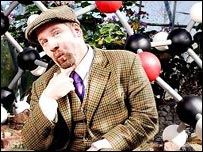
Graeme Jones is a chemical ecologist, but don't hold it against him. He's also a scientist who loves to entertain an audience - he's mad about molecules, the bigger the better. On Saturday, 2 September, we can join his team at Norwich Cathedral to help create a giant double helix - which forms part of a week long exhibition at the cathedral during the BA Festival Of Science. "We've been invited by the Dean and Chapter to build one of the largest models of DNA in the world, hanging from the ceiling of Norwich Cathedral," said Graeme. "To have a DNA model there is just going to be wonderful – it'll be about 15 metres long, which is kind of big – even in the cathedral," he added. DNA record breakerGraeme holds the Guinness World Record for the largest model of DNA in the world and hopes to smash this during the festival. His biggest model to date contains 100 base pairs, but he hopes to create a 300 base pair model in Norwich Cathedral. "Anybody can help. If people want to come along and put what's called a base pair on the DNA model they can come on the Saturday and do that," said Graeme. 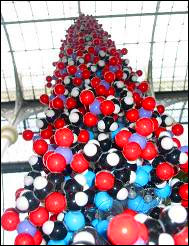 | | Giant DNA model by Graeme Jones (detail) |
"DNA as a molecule is an iconic structure. "Many people know it's the shape of a double helix, but this is built up out of small units called bases and the bases pair up together to make base pairs. "Each unit in the model is a base pair and we've got 300 of these to put on the DNA model. "It's a really nice way of showing people how DNA is made up, what all the atoms are and how they come together to build up the molecule. "You can also use it to explain to people how DNA works and how it replicates itself and does all those wonderful things that allow us to exist along with all the other things on the planet," he added. Sacred MoleculesThe DNA model is part of an exhibition called Sacred Molecules. "I've brought together a lot of iconic molecules – iconic mainly in their structure, their scientific meaning and their religious meaning," said Graeme. "There's a temptation for an 'all things bright and beautiful' world out there – God made all these lovely flowers, people and organisms. "But when it comes down to it, he made atoms and molecules which came together. "I want people to see things at that very small level, so they can get a sense of awe and wonder at that kind of world which is quite incredible. Science and religion"I've always been very interested in this play between religion and science. 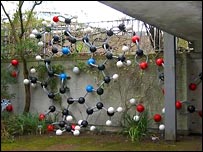 | | Sacred Molecules exhibition |
"A lot of people often feel they are opposed to each other – but I don't feel that. "There's a wonderful guy called George Henri Lemaitre, who came up with the Big Bang theory. "He was a Belgian priest and a physicists – his dictate was there are two ways of explaining the world and he decided to follow them both. "That's how I feel about science and religion. You don't have to consider them being opposed to each other. "These days neither science or religion are very well received by the general public. They are both ways of explaining our world, but people are not interested in that. They are more interested in media and celebrity ways of explaining the world. "Maybe science and religion can work together a lot more to put over their views. That would be interesting." Sacred Molecules can be viewed at Norwich Cathedral from Saturday 2, to Saturday, 9 September, 2006.Building the DNA model takes place on 2 September. Admission is free. | 







 Look East