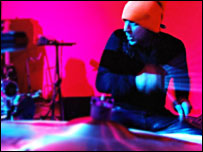
You might have heard your friends raving about The Bays, but if you head to your local record shop to pick up their CDs then you'll come back empty-handed. The Bays don't record any music, don't plan their sets and certainly don't rehearse. You'll only hear their music if you pop along to one of their live gigs or re-live the experience on their website. The Bays' concept is about the moment shared between the band and the audience. Each show is billed as a one-off event where the members come armed with their own ideas, which are unleashed for the first time on the rest of the band and the fans. The Bays perform an unrivalled mix of house, techno, hip-hop, electro and drum 'n' bass which has taken them to the top of the bill at the Big Chill Festival and seen them record three sessions for John Peel on BBC Radio 1. Drummer Andy Gangadeen chatted to Zoe Applegate ahead of the Norwich show about why The Bays have shirked record deals in favour of concentrating on live performances and why nerves do not get the better of the band any more. How did The Bays start up? Friends of mine getting together came up with an idea of improvising different styles of electronic music. We put together a rhythm section and guys who did more noises and science. So we called them the science department, called us the music department and merged the two together. It started about five years ago in a pub in Camberwell and it's grown from there. Were you all friends to start with or did you do a bit of networking? I'm the last man standing from the original line-up and we've had members come in and out. But they're all friends who we've known along the way and like-minded people who have got skills. The Bays requires musicianship as well as an understanding of electronic programs. All of your concerts are improvised, but do you ever rehearse beforehand? No, never. We don't rehearse, we don't speak about it. All the ideas we get individually, so we practise on our own and listen to stuff and get inspired and do different noises and patterns, but then we only ever hear it together when we do a gig. Are there any acts that you're inspired by? I don't think there are many bands doing the electronic improvisation to how we do it. In terms of being inspired by music, then anything on Warp Records is a good reference point for us. Although everything is improvised live, do you have themes or sound loops that you repeat from concert to concert? If we adhered to a genre of music - ie. drum 'n' bass or techno - then there are sounds and beats which are generic to that music. So that's always going to be underlying to that style of music or it would be totally out of the frame of what we're trying to achieve. So we do adhere to certain patterns or sounds which one associates with hip-hop or techno, but then what goes in and around that and inspires the arrangement is made up on the spot. Your performances seem to be characterised by the energy between the band and the audience, so what's the best show you've played? I think some of the best recorded work we've done has been the John Peel Sessions. They've been the most focused and we've been under so much pressure to get it right. Live on Radio 1 on the John Peel Show really put us under it! But we did three Peel Sessions and the last one we're really proud of. We headlined the Big Chill Festival in 2003 on the main stage on the Saturday night and that was a particularly good moment as well. How nervous do you get before a gig? [He laughs] Sometimes 10 minutes before we're about to go on we look at each other and think, 'Why on earth are we doing this!' It can be the most nerve-racking thing ever. We've got it to a point where everyone is so strong in the band that we can lean on each other. But it makes you do things that you wouldn't think of doing. I've been in loads of bands where you've rehearsed the stuff to death and you go out there on auto-pilot and you're reeling off something of a moment past. Has anything ever gone really wrong in a set? We always find our way through it and you can put down any mistake as part of the act but we know when it's not quite reached the mark. How difficult is it to make each performance different? The most important thing that we do individually is to keep refreshed and to keep listening to new stuff and we always use that as an input when it comes to doing the performances. So it's by going out all the time to club nights and checking out the new stuff, so we're always re-energising. You have two guests joining you for the Norwich show, how does that change the dynamics of your performance? With more instrumentation we have to allow more room for that to give more space to the guests. With the new people there's much more of an element of surprise with new sounds. It will force us to do something much different to what maybe we could have done in doing it as The Bays. As the drummer, you set the pace but where do you take your lead from? The tempo of the whole performance is critical because just getting the pace right at the beginning is crucial to how the whole thing ends up. If the tempo is too high at the beginning there's no real place left to go to. If we're playing a club night - and there's been a real intense DJ on before and the audience is really amped up - then I would pitch it slightly higher than I normally would do only just so it's not too much of a massive dip in tension or dynamics. Although everything is improvised, do you tell the other members how you're going to start? [He laughs] I used to do that but I've stopped doing it. The one that everybody knows about is the last John Peel Session because we started off at drum 'n' bass tempo and slowed it down. Had I not forewarned them, it would have been a shock, plus it was going out live on air. That was the one time I did say to everybody, 'I'm going to pitch it up before I pitch it back down again!' Why haven't The Bays released any recordings? It's not some publicity stunt or a contrived way to get more attention. When we started out we were going to purely just improvise a set but we didn't want a situation happening where we record stuff and people play that stuff and then they wanted us to perform that at a gig. Then people would have been disappointed that we didn't do anything from a supposed album. So there seemed little point in releasing anything and because we wanted to keep it pure we thought it was best not to. We've stuck by that and as it turns out, with everything that's happening with downloads and piracy, the band is in a much stronger position by not releasing anything. We record all our live gigs and put them up on our site for people to download for free and we encourage people to swap. The experience is about being at the gig. But hasn't the band ever been tempted to capitalise on what it does by releasing records and merchandising? I think if The Bays was about making money then we would have cashed in long ago. It has much more meaning for me and everybody else in the band because it's something that we do that has a purity about it and we want to keep that intact. It's not swayed by anything. We're doing it purely to make music and if you do anything on that level it has a completely different meaning about it. What impact has the internet had on The Bays? It's been absolutely brilliant because we've been able to use the internet as an interface between us and our audience. We've put together a good database and we keep people informed and it's great having a correspondence like that which is really direct. There have been many examples - Marillion.com, the Big Chill Forum - all those innovations have done really well by mobilising their fan base. You have MP3s available on your website, but would you ever head into the studio to perfect things and bolt it down? We're more looking into the idea of doing webcasts. Our biggest problem is because it's based on live performances we can't play everywhere in the world that we'd like to. We've got fans in Japan and America and we can't access them all of the time, but we're looking to do more of webcam-based stuff because there's an opportunity to tap into it on a visual level as well. With most bands things go in cycles: they release a single, bring out an album and go on tour then disappear for a couple of years only to do the same, so how do you sustain interest when everything is based around your live shows? That's a good question. The thing is that the cycle is set by the industry. Record sales tie in with radio promotion which then tie in with gigs and it's a massive machine which is really well co-ordinated. But that isn't the only way. We're finding now that things don't have to run in a regimented way like that. It's something which is ongoing and developing and we're hoping to sustain that. We're getting better as a band and we're more progressive in the way that we're doing things. As long as we keep pushing the envelope there will always be an interest. It seems the concept of the band is more important than the members. Could you see The Bays going on forever? I would like to think it would go forever but not with the same line-up. You can burn out on something and there is a lot of pressure on us to keep people going in coming up with good stuff. I could definitely see us going on for another three or four years but the band should be a name and it should be a concept which is then passed down and other members should come in and take it over. It's an idealistic way of trying to do something and it's not about the members - it's about the concept of it. Finally, you're known for playing festivals but in Norwich it's a seated venue. Do you think it will change how your performance is received? We've done other seated things and it definitely has a different emphasis. We're a bit more thoughtful with the music and it will probably go a lot deeper than some of it which is a bit more banging just to keep the floor going. That's the only way to describe it! |