
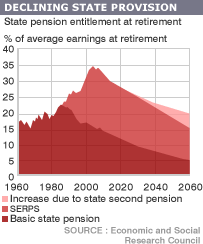
The pensions crisis has brought the issue to the forefront of political debate and public concern.
Confidence has been hit by financial scandals, declining employer provision and worries about long-term funding.
Labour has introduced a safety net for work schemes and introduced the pension credit to help the poorest pensioners.
Both the Conservatives and Liberal Democrats are critical of means testing and say they would increase the basic state pension in line with earnings.
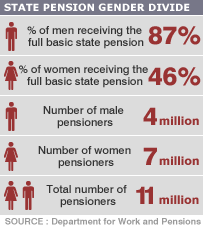
The state pension is paid to women at 60 and men at 65 and is based on National Insurance (NI) contributions.
The full basic state pension is worth �82.05 for a single person and �131.20 for a couple from 6 April 2005.
Many women lack enough contributions to benefit from the current pensions system. Only 46% receive the full state pension.
The Liberal Democrats want a citizens' pension, based on residency, rather than contributions.
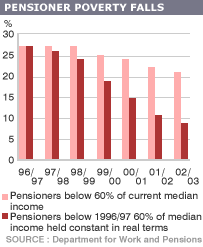
Labour's pension credit, formerly the minimum income guarantee, should ensure UK pensioners receive �109.45 a week.
The credit is a means-tested benefit. Pensioners who qualify for its main element should also get help with council tax and housing costs.
It is paid to 2.65 million households, but many pensioners in need are failing to claim.
Opposition parties have pledged to reduce means-testing of pensioners as they say it is demeaning and discourages saving.

Ageing UK: People will work for longer
By 2020 around 40% of the population will be over 50.
Policy makers are increasingly concerned about how Britons will pay for rising pension and healthcare costs.
The government is offering incentives to people who defer their state pension.
It says a typical person who delays their state pension for five years could receive a �30,000 lump sum or a 50% increase in their pension.
And it will bar mandatory retirement below 65 and encourage people to work longer.
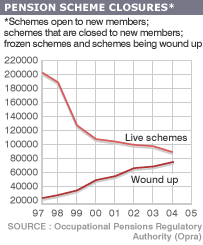
Company pensions are the backbone of many people's retirement savings, but many employers are shutting them down.
In recent years, many firms have switched from final salary to money purchase schemes and cut contributions.
The Conservatives have accused Labour of undermining work schemes through a �5bn a year tax, introduced in 1997.
Labour has so far resisted introducing compulsory work pensions, although some commentators argue this may be the only way out of the crisis.
