
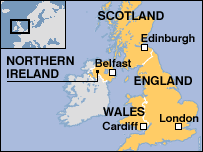
Devolution is the transfer of Whitehall powers in areas like education and health - but not, for example, defence - to the UK's nations and regions.
The scope of those powers differs between each political institution.
Scotland has the most power followed by Northern Ireland, Wales, London and the planned English regional assemblies.
Backers say democracy is improved by devolution as people gain more control of their own affairs, but critics say it is costly and divisive.
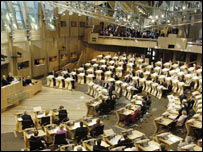
The parliament building cost much more than originally planned
The elected Scottish Parliament and executive have a �30bn annual budget and powers to vary the basic rate of income tax and create new laws.
These have included free long-term care for the elderly and a ban on hunting with dogs.
But controversy over the building of a new home for the parliament in Edinburgh has overshadowed its work.
Critics also say in practice devolution has been "unimaginative", although supporters claim it delivers Scottish solutions to Scottish problems.
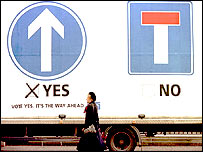
The Good Friday agreement was approved in referendums in Northern Ireland and Ireland
The 1998 Good Friday peace agreement set up an elected assembly and power-sharing executive in Northern Ireland.
Led by a first minister and deputy, the institutions, designed to be cross-community, can create new laws in the areas for which they are responsible.
But their work has been hampered by several suspensions, when the UK's Northern Ireland Secretary takes over assembly and executive functions.
The suspensions were triggered mainly by rows over paramilitary activity.
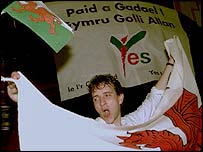
The assembly referendum returned a narrow 'yes' vote on a low turnout
The elected National Assembly for Wales is led by a first minister, voted for by its members, who appoints assembly ministers to oversee policy areas.
The Cardiff-based body cannot create new laws, as in Northern Ireland and Scotland, but can alter existing acts.
Since forming, the assembly government has moved to abolish prescription fees by 2007 and scrap school league tables.
Backers say it is successfully forging a separate path to Westminster-led policy but critics want it to have more power.
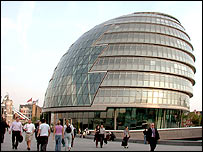
The GLA is based in a distinctive building on the Thames
An elected mayor and assembly form the Greater London Authority (GLA).
Its budget of almost �5bn, along with �50m running costs, is met by central government and a council tax levy.
The mayor sets budgets and strategy in areas for which the GLA is responsible, including transport, police and fire services and economic development.
The assembly monitors the mayor and questions him about his decisions, as well as investigating other issues and making proposals to the mayor.
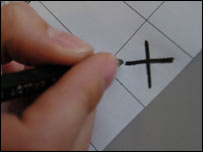
The North East referendum dealt a blow to English regional devolution
After devolution elsewhere, ministers proposed directly elected regional government in England for areas where it was supported in referendums.
With one tier of local government abolished, the new assemblies would have powers and funding similar to that of the Greater London Authority.
But the first referendum, in the North East in November 2004, delivered a resounding "no" to the idea.
Similar votes in Yorkshire and the Humber and the North West were then shelved.
