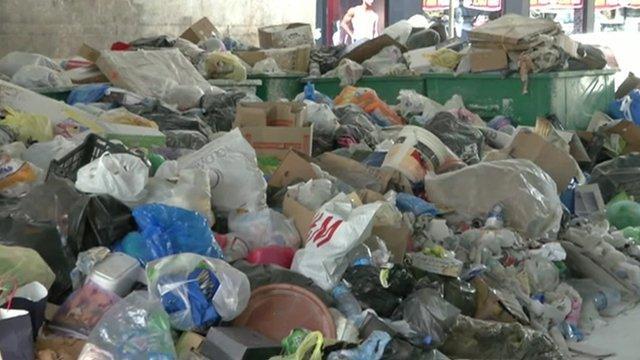
Beirut saw its biggest protest so far over the rubbish crisis
Lebanese protesters demonstrating over a rubbish crisis have clashed with police, leaving at least 15 people injured.
Thousands turned out near parliament in central Beirut, in the biggest protest to date over uncollected rubbish.
Police fired tear gas, rubber bullets and water cannon after some tried to break through a security cordon.
Rubbish has been clogging the streets of Beirut for weeks, as Jim Muir reports.
Protesters blame political paralysis and corruption for the failure to resolve the rubbish crisis.
It started after the closure of Beirut's main landfill site last month, and has spread to other parts of the country.
On Saturday, protesters chanted slogans against the government and politicians. Some threw water bottles and firecrackers.
"Some trash should NOT be recycled," read one placard, above a pictures of Lebanese politicians.

Protesters blame political paralysis for the crisis

Police forced demonstrators back with water cannon

Clashes continued into the evening
At least one of the injured was in critical condition, a spokesman for the Lebanese Red Cross said.
Gunfire could be heard as clashes continued into the night.
In recent weeks - during hot summer weather - piles of rubbish have grown so large that some residents resorted to burning rubbish on the streets, releasing toxic fumes.
Some have worn masks in an attempt to protect themselves from the foul smell, and many have vented their anger on social media using the hashtags #YouStink and #YouReek.
The health minister warned this week that Lebanon could suffer a "major health catastrophe".
- Published28 July 2015
- Published26 July 2015
- Published21 July 2015