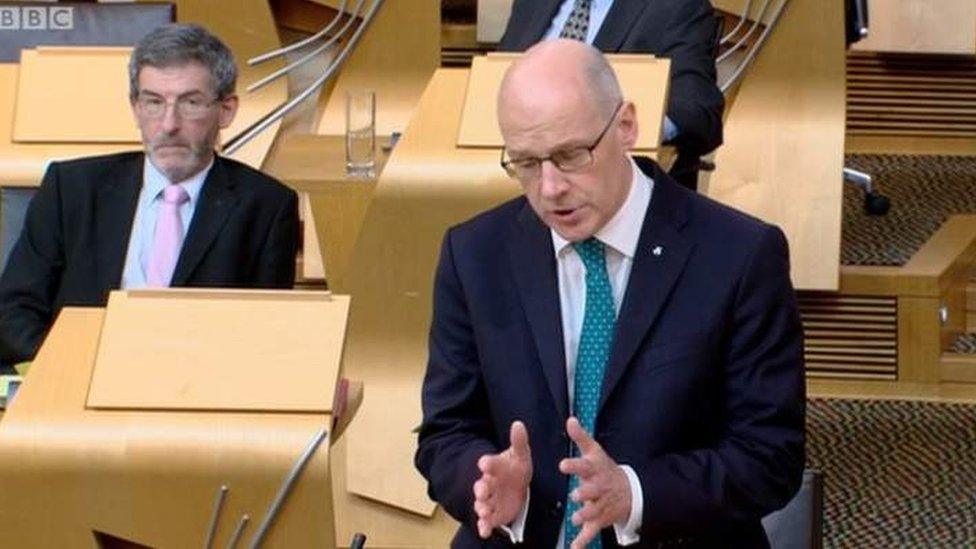
The Scottish Parliament will be given the new income tax powers as part of the Scotland Bill
New income tax powers for Holyrood should come into force in 2017 - a year earlier than expected - according to the Scottish secretary.
The Scotland Bill will devolve control over rates and bands of income tax to the Scottish Parliament.
David Mundell said the UK government was keen to see the new powers transferred by April 2017.
The Scottish government said it would not support a deal that left Scotland worse off.
The Scotland Bill, which is currently before the UK Parliament, is the legislation drawn up as a response to the recommendations made by the Smith Commission following the "No" vote in last year's independence referendum.
The commission recommended devolving the power to set rates and bands of income tax for Scottish taxpayers to Holyrood.

David Mundell said he wanted to see the new powers transferred by April 2017
Talks have been going on between the Scottish and UK governments as to when these powers should be transferred, with the likely date widely expected to have been 2018.
Mr Mundell has now said he wants it to happen in the next 18 months in order to give Holyrood "more power and responsibility".
Such a move could make taxation a major issue in next year's Holyrood election campaign.
Mr Mundell told BBC Radio's Good Morning Scotland programme: "What we're trying to do is ensure that the powers that were recommended by the Smith Commission are in place as soon as is practical.
"That will allow for next year's Scottish Parliament elections, for there actually to be a debate about tax and spending in Scotland.
'Significant power'
Mr Mundell said the new timetable would allow whoever was in power in 2017 to use the new powers when deciding Scotland's tax and spending plans.
He added: "We've set out an offer to them [the SNP] to make these tax powers available from 2017.
"Of course, if they don't want to take that up then that is a matter for them but I think they would have to explain that to the people of Scotland as to why - having consistently argued for powers and having this very significant power to raise £11bn in revenue - they chose not to do it."
A spokesman for Scottish Finance Secretary John Swinney said: "The Tories just need to get on with the job of delivering more powers for Scotland, and a deal which meets the spirit and letter of the Smith Commission recommendations.
"What is currently proposed fails that test, as it limits Scottish ministers' ability to use the new powers and retains vetoes for UK ministers.
"We still need to reach agreement on a fiscal framework that gives the Scottish government flexibility to use the new powers effectively, to boost the economy and create jobs - and we have made it crystal clear that we will not support any proposed deal which risks leaving Scotland worse off."
Labour called for Mr Mundell to accept its amendments to the Scotland Bill to ensure the Smith agreement was "delivered in full".
Shadow Scottish Secretary Ian Murray MP said: "We welcome the news that the tax powers in the Scotland Bill are to be brought forward, and we will look closely at what the government proposes.
"These major new tax powers, whenever they are introduced, will give us the chance to really transform Scotland and give everybody the best chance in life.
"Now the Scottish government need to live up to their word about making our country a fairer place to live."
- Published23 September 2015
- Published16 September 2015