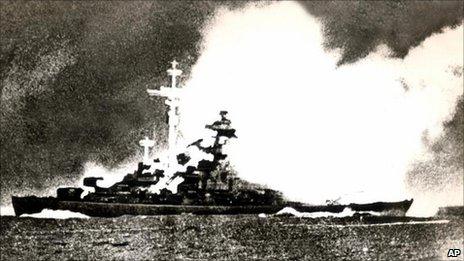
Pilot's pictures 'sank Bismarck'
A pilot who took what Winston Churchill called "the pictures that sank the Bismarck" is being commemorated.
Michael Suckling located the battleship, which was the pride of Nazi Germany's navy and a threat to allied shipping during World War Two.
His images, taken from a long-range Spitfire and returned to commanders in a daredevil night-time dash, led to a major propaganda coup for Britain.
A Bramley apple tree is being planted at the National Memorial Arboretum.
PO Suckling's unheated, unarmed and unpressurised Spitfire took off from RAF Wick in Caithness just before noon on 18 May 1941.

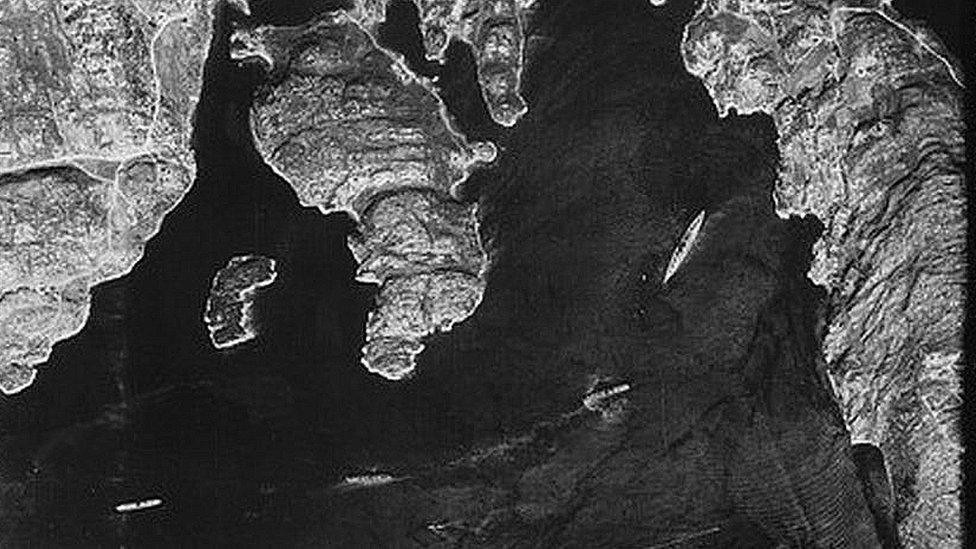
One of the images that located Bismarck with supply ships indicating she was about to sail
Twenty years old and with boyish looks, "Babe" Suckling, from Southwell in Nottinghamshire, was a relative veteran, having completed 19 such missions.
His plane groped through the skies above Norway, photographing ports, fjords and secluded inlets but finding little of interest.
Nearing the end of its fuel range, he took an unauthorised detour and at Grimstadfjord, near Bergen, finally spotted the huge ship with a cluster of support vessels.

Battling the Bismarck

Bismarck proved a formidable foe for the Royal Navy
In the run-up to World War Two, Britain was acutely aware of its dependence on imported food and raw materials to survive.
Newly built German battleships Bismarck and her sister ship Tirpitz and their terrorisation of vital shipping routes obsessed the naval-minded Winston Churchill.
A giant game of hide and seek began in May 1941 when Bismarck left port in Poland and sailed north.
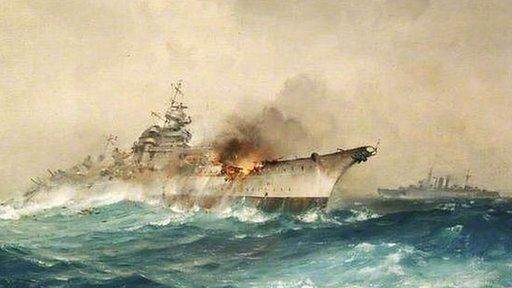
After being discovered in the Norwegian fjord, Bismarck blasted two Royal Navy ships out of the way before being damaged by torpedoes.
Unable to manoeuvre, it was surrounded by enemy ships and battered into a flaming wreck before its crew scuttled it.
His nephew, Mike Yates, described the story which followed PO Suckling's return to Wick with the highly coveted pictures.
"He burst into the officers' mess and told everyone what had happened - a terrible breach of regulations.
"Coastal Command in Northwood, north London, told him in no uncertain terms they wanted to see the pictures yesterday as Bismarck could sail at any minute.
"So despite his long mission, he got back into his plane and flew south.

Michael Suckling was awarded the DFC for his success in finding Bismarck
"But with daylight fading and fuel low he realised he was close to home in Nottinghamshire and thought of another option.
"He put the Spitfire down in a field, tucked the pictures under his arm and ran to a friend's house. He owned a garage and with one of the cars, they roared down to London."
The images prompted a massive naval operation which culminated in Bismarck being destroyed on 27 May.
Churchill ordered the photographs taken by Pilot Officer Suckling to be published under the title: "The pictures that sank the Bismarck."

Aerial images were analysed by experts to interpret the details
PO Suckling did not get to enjoy his success for long.
On 21 July his plane went missing while he was on a mission to photograph another ship in a French port.
Mr Yates said: "Mike Suckling's great-grandfather, Henry Merryweather, first marketed the Bramley apple and the firm stayed in the family for generations.
"So it is immensely appropriate to commemorate him in this way."
- Published27 May 2016
- Published17 January 2015
- Published25 May 2011