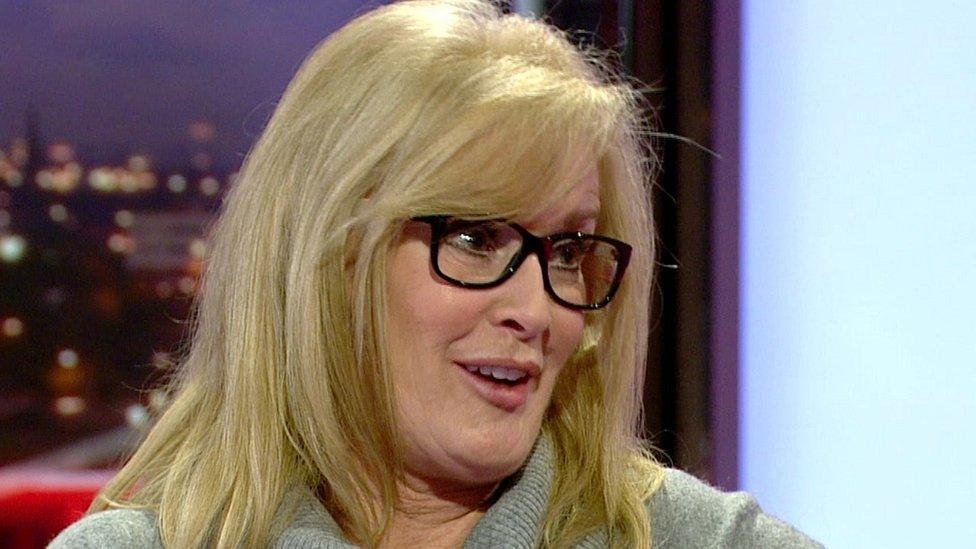
Beverley Callard and her husband Jon spoke to BBC North West Tonight
Coronation Street actress Beverley Callard is taking "time off" from the ITV soap, saying she is "battling the demons of depression".
She has had the condition for about seven years and took a break after a collapse on the Manchester set in 2009.
The 59-year-old actress said on Twitter, external that one of her medications had been discontinued by its makers because "apparently it doesn't make money".
An ITV source said her doctors were looking "for a suitable alternative".
'Curse of the strong'
In response to messages from well-wishers, she tweeted: "I'm getting there!!!! Thanks so much for all your good wishes."
The Morley-born actress, who plays pub landlady Liz McDonald, recently described the illness as the "curse of the strong" in an interview with BBC North West Tonight.
"I just didn't think anyone like me would have [depression] because I'm a strong, feisty female."
She ended up in nearly £150,000 of debt when two pubs she ran with her partner went bust in 2008.

Callard showed the Duchess of Cornwall around the Coronation Street set in 2010
The actress first collapsed while driving to the Coronation Street studios in 2009 but said she "waited till I felt better, didn't tell anyone - then got back in my car".
"I drove to work at 6.30am and filmed till 8.20pm that night, and then I collapsed."
In an interview with the broadcaster Piers Morgan in 2014, she recalled trying to take her life "maybe half a dozen times".
Callard, an ambassador for the mental health charity Mind, said: in February: "I occasionally fight the demons but, more often than not, I'm doing very well."

Depression
It is estimated that one in six people will experience depression at some point
The condition affects everyone differently, but common symptoms include feeling irritable, numb and disconnected from other people, losing interest in sex and gaining no pleasure from things usually enjoyed
Antidepressants can be effective for some people, while others may find treatments such as counselling and cognitive behavioural therapy are more appropriate
Stephen Buckley, head of information for Mind, says it is important for people with depression to visit their GP, who can talk about available support
Source: Mind
- Published18 February 2016
- Published12 February 2016

- Published2 February 2016