Voyager's epic journey: How long would it take you?

This page is best viewed on a smart phone, tablet, laptop or desktop. Please make sure you have JavaScript turned on, check your browser for details.

Nasa's Voyager 1 spacecraft will soon become the first human-made object to leave our Solar System. It has taken it 36 years to reach the edge of interstellar space.

Below, you can see some of the steps it has taken along the way.

Nasa's Voyager 1 spacecraft has become the first man-made object to leave the Solar System. It has taken it 36 years to get that far - how long would it take you?

Timeline

  1. EarthThe Mission

    • Click to watchVoyager's launch

      Voyager 1 and 2's original mission was to explore Jupiter, Saturn, Uranus and Neptune. Launched in 1977, scientists did not imagine that the twin spacecraft would continue their journey for more than three and a half decades.

  2. Jupiter, the first gas giant

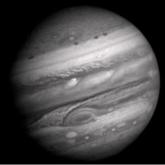
    • Click to watchJupiter

      The spacecraft reached Jupiter in 1979. Their fly-by enabled scientists to bolster our understanding of the planet's Great Red Spot; a series of intense storms. While passing Io, one of Jupiter's moons, Voyager had first sight of volcanic activity beyond Earth.

  3. Saturn, Voyagers part ways

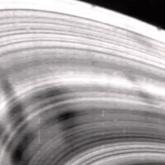
    • Click to watchSaturn's rings

      Voyager 1 discovered that Saturn's atmosphere was almost entirely made of hydrogen and helium gas, making it the only planet less dense than water. The spacecraft was then diverted towards Titan, one of the planet's moons. After its fly-by of Saturn, Voyager 2 headed for Uranus and Neptune.

  4. Uranus, new moons

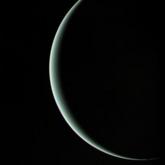
    • Click to enlargeUranus

      In January 1986, nine years after its launch, Voyager 2 came within 81,500km (50,600 miles) of Uranus, revealing unknown details of the planet's rings and taking pictures of 10 previously unseen moons.

  5. Deep spaceCalling Voyager

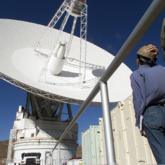
    • Click to enlargeOne of the dishes of the Deep Space Network

      As it became clear that Voyager would travel beyond the outer planets to the farthest reaches of the Solar System, preparations were made to keep scientists in touch with the probes. As a result, the Deep Space Network upgraded its antennas during the 1980s.

  6. Neptune, the other blue planet

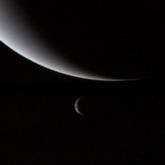
    • Click to enlargeNeptune, and its moon Triton

      In 1989 Voyager 2 became the first spacecraft to observe Neptune. Like Jupiter, Saturn and Uranus before it, Neptune was also observed to be a giant planet made of gas. Voyager took striking images of Neptune's rings. Neptune was the final planet that Voyager visited.

  7. Pale Blue Dot

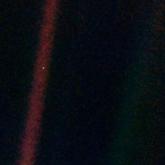
    • Click to watchThe Pale Blue Dot, Earth seen from six billion kilometres

      After passing Neptune, scientists turned Voyager 1's cameras back toward Earth. The result was a humbling image of our planet, taken from more than six billion kilometres (four billion miles) away - a picture that astronomer Carl Sagan referred to as "The Pale Blue Dot".

  8. Decades in spaceGrowing old with Voyager

    • Click to watchEd Stone

      Over the decades, since the mission's inception, Dr Ed Stone has coordinated the Voyagers' study of Jupiter, Saturn, Uranus, Neptune, the outer heliosphere and the search for the edge of interstellar space.

  9. Epic journeyRecord-breaking journey

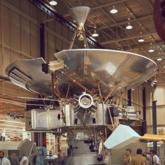
    • Click to enlargePioneer 10

      In February 1998, Voyager 1 set the record for the most distant human-made object in space, passing its predecessor Pioneer 10.

  10. Gold discMessage in a bottle

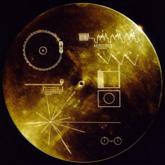
    • Click to enlargeThe gold disc

      In the hope of communicating with extra-terrestrials, each Voyager was fitted with a golden disc. The discs carry a record of Earth's location along with sounds and images that portray the diversity of life on Earth.

  11. Termination Shock

    • Click to watchThe Sun

      In December 2004 Voyager 1 crossed the termination shock, a region of extreme turbulence where opposing solar and interstellar winds collide. Crossing this threshold signalled that Voyager had taken a significant step towards leaving the Solar System.

  12. Catching Voyager 2

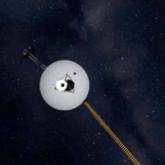
    • Click to watchVoyager

      Voyager 2 is now approximately 15 billion kilometres from Earth (9 billion miles) and heading in a different direction to Voyager 1. It crossed the termination shock in 2007. However, Voyager 1 is billions of kilometres further from Earth than its twin.

  13. You've reached Voyager 1's current location

    Voyager took 36 years to travel 18.7 billion km
Voyager probe 'leaves Solar System'

FAQ: How was this graphic made?

BBC Blogs, an epic journey for UX&D

By John Walton, Helene Sears, Steven Connor, Josephine Lie, Christi Sodano, Tom Maslen, Steven Atherton and Martyn Rees

More Science & Environment stories

RSS