When Neil Armstrong set foot on the Moon's surface in 1969, he was wearing a space suit developed by the US company ILC Dover, which is based in Delaware.
Space suit technology has continued to evolve over the decades since, with ILC Dover at the forefront.
The suit below is designed for use by astronauts at the International Space Station.
It weighs 280lb (127kg), and on Earth astronauts struggle to support the weight of the suit on their own.
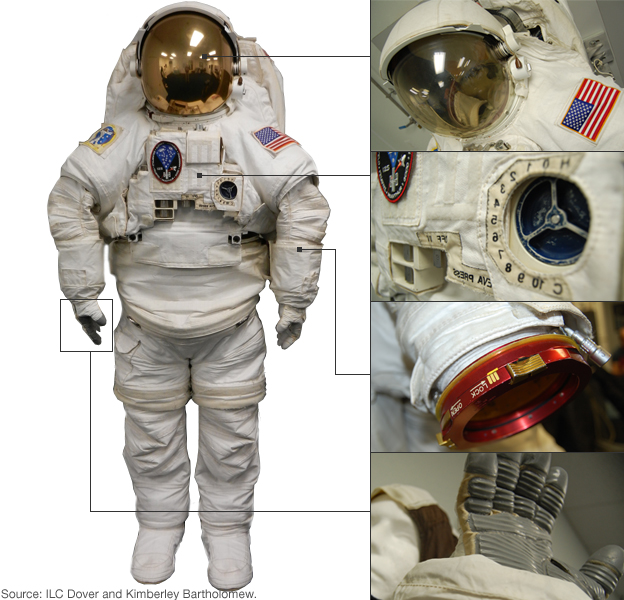
Extravehicular visor assembly
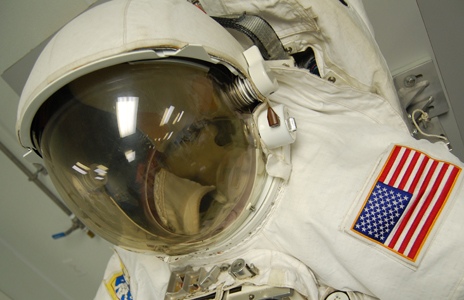
A helmet made from polycarbonate sits on the top of the pressurised suit. A reflective visor can be pulled down to protect astronauts from the Sun’s rays. A light and camera can also be added.
Display control module
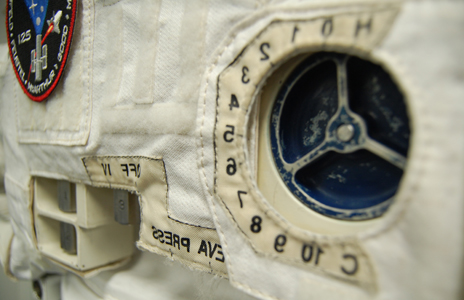
This is the suit’s dashboard. Astronauts wear a mirror on their left wrist, allowing them to read the panel whilst adjusting the dials with their right hand. The dial on the right changes the temperature of the liquid cooling suit worn underneath the outer suit.
Glove connector
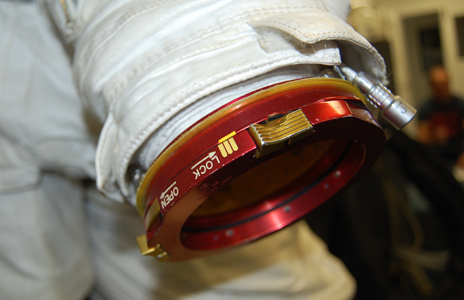
This connector is designed so that gloves cannot be accidentally released as a significant loss of pressure in the suit would be catastrophic.
Phase VI glove
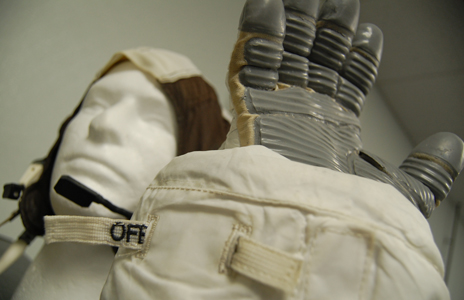
By pulling the tag marked ‘on’ or ‘off’, astronauts can apply heat to the end of their fingertips. This is necessary because in the shadow of the Earth objects can reach temperatures as low as -129C (-200F).
But because of the weightlessness experienced in orbit, it can be comfortably used for space walks.
It performs a number of functions.
One is to protect astronauts from extreme temperatures. In Earth's orbit, a surface in the shade can get as low as -129C (-200F) and, in sunlight, as high as 121C (250F).
Space suits provide a supply of oxygen, but they also replace the pressure experienced at low altitude.
Above 63,000ft (19km), exposed human tissue swells and bodily fluids like mouth saliva and water in the eyes start to boil.
Suits like the one above are pressurised to 4.3 pounds per square inch (30 kilopascals).
Bill Ayrey, a tester for ILC Dover, says the company is now working on advanced suit designs for Nasa, using new materials.
He said that should Nasa ever try to send astronauts to Mars, the suit requirements would be completely different from anything they had designed previously.
