

Mars Rover: Explore the Red Planet with Nasa's robot
Journey to Mars (1 of 10)
Nasa's Curiosity rover has been on the Red Planet now for more than six months.
The six-wheeled vehicle is 2.9m (9.5ft) long and stands as high as an average man. It can roam around the surface and roll over obstacles up to 75cm (29in) high.
Curiosity is using its 10 instruments to survey Mars' Gale Crater, a deep equatorial bowl. If it finds rocks or soils of high interest, it can pick up samples with its robotic arm and deliver them to on-board labs to analyse their chemical make-up. Curiosity's mission is to try to establish if Mars has ever had, or still has, the environmental conditions to support simple lifeforms.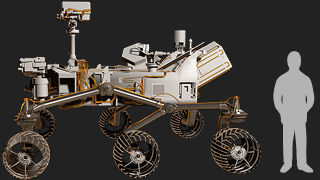
Gigantic crater (2 of 10)
The Mars Science Laboratory (MSL), as it is also known, was launched into space in November 2011.
Its destination was a 154km (96 mile)-wide equatorial depression gouged out of the ground by an impacting meteorite billions of years ago.
Gale Crater was chosen after a rigorous investigation of some 60 competing sites. The selection process took five years and involved about 150 researchers.
Gale has many signs that water was present in its past. It has a variety of clays and other water-related minerals present that Curiosity can study.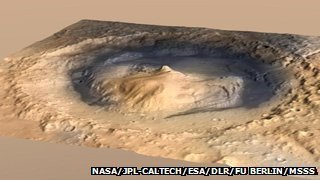
Was there water? (3 of 10)
Today the surface of Mars is bleak and desolate. Temperatures at Gale Crater are expected to get down to -90C. However, data from earlier Mars missions suggests that the planet once hosted vast lakes and flowing rivers.
Nasa scientists believe they will find evidence for this watery past in the rock sediments at the base of Mount Sharp, a peak that rises in the centre of Gale Crater.
Since Curiosity can travel at just a few tens of metres per day, it will take some months for it to reach Mount Sharp and begin the exploration of the clays that are expected to record a fascinating period in Mars's geological history.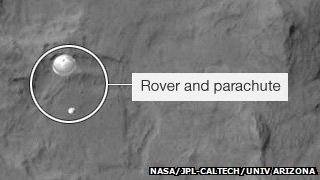
Touchdown (4 of 10)
The 900kg (2,000lb) Curiosity is the heaviest rover to go to the Red Planet.
The robot used a parachute followed by an innovative rocket-powered "skycrane" to get down to the surface safely.
Since its landing on 6 August 2012 (GMT), Curiosity has driven off in search of rocks that could reveal some of the history of Gale Crater.
This has taken it to a location called Glenelg where satellite pictures had revealed the intersection of different types of terrain.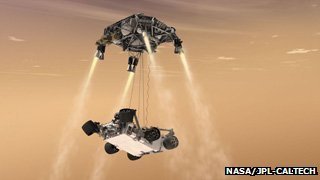
Search begins (5 of 10)
Once initial checks had been performed on Curiosity, the rover made its first foray in search of something interesting to observe.
The vehicle is equipped with two pairs of navigation cameras, Navcams, that scan the territory ahead and help Nasa operators back on Earth to point the rover in the right direction. It also has hazard avoidance cameras mounted lower down, so the rover can steer clear of dangerous obstacles.
The MastCams are the science cameras. They are able to take colour stereo images, and even video footage of the Martian terrain. One of the cameras has a wide-angle lens; the other has a telephoto lens.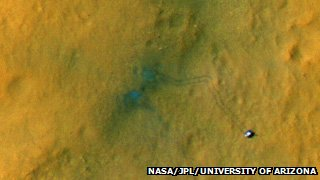
Laser beam (6 of 10)
Curiosity's Chemistry and Camera (ChemCam) instrument is capable of firing a laser from a distance of 7m (23ft) at an area on the surface of a rock smaller than a millimetre across.
The beam produces a plasma - an extremely hot gas. ChemCam observes that spark with a telescope and analyses the light to identify the chemical elements present in the target rock.
ChemCam is a survey instrument; it is at the start of the process of selecting interesting rocks that might merit further study. ChemCam will probably be the most used instrument in the course of Curiosity's mission.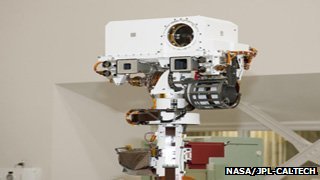
Interesting rock? (7 of 10)
Curiosity has a 'hand' at the end of its arm, called a turret.
The turret carries a drill, a brush to remove dust, a soil scoop, a camera for close-up views, and a science tool to get further detail on the chemistry of rocks.
The camera - the Mars hand lens imager (Mahli) - is akin to the magnifier carried by every field geologist, and provides detailed information on the crystal shapes and mineral layers in rocks.
The Alpha Particle X-Ray Spectrometer (APXS) lays bare the chemical elements in a rock, and informs any decision to drill a sample for further study.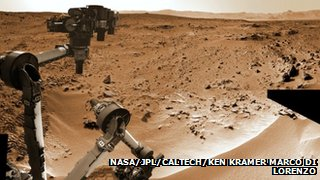
Drill (8 of 10)
Curiosity uses its drill system to collect rock samples for in-depth analysis by the laboratories inside the rover body.
The drill can collect a sample from up to 5cm (2in) beneath a rock's surface.
It penetrates the rock and powders the sample to the appropriate grain size. The powder travels up an auger in the drill for transfer to the sample processing mechanisms.
If the drill bit becomes stuck in a rock, the drill can disengage from that bit and replace it with a spare.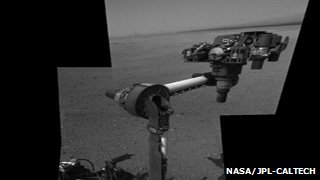
On-board lab (9 of 10)
Curiosity carries two big on-board laboratories. The Sam (Sample Analysis at Mars) is a three-in-one instrument: a mass spectrometer, a gas chromatograph, and a tunable laser spectrometer.
A key quest for Sam will be to try to identify carbon-rich (organic) compounds that would support life; and to measure the presence of hydrogen, oxygen and nitrogen, elements also associated with biology.
The Chemistry and Mineralogy instrument, or CheMin, will give the definitive account of the minerals in a rock, revealing how it formed. It might also indicate if that formation took place in a potentially life-supporting environment.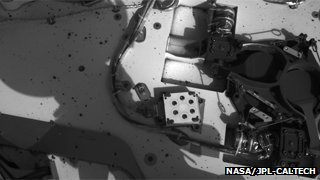
Ongoing mission (10 of 10)
Curiosity is funded to keep working on Mars for at least two years.
In that time, it is expected to analyse dozens of samples drilled from rocks or scooped up from the surface of Gale Crater.
At the end of the primary mission, it should have rolled a short way up the base of Mount Sharp.
But the robot is equipped with a plutonium battery, and so has the power to keep moving for more than 10 years - time enough to scout the crater floor and climb to the very top of the mountain.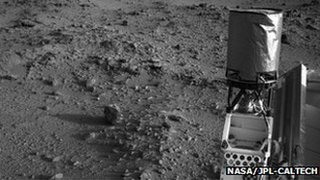
Image credits: Google Earth, Nasa, USGS, Esa, DLR, FU Berlin, (G. Neukum), JPL, University of Arizona
By Jonathan Amos, John Walton, George Spencer, Marina Shchukina and Salim Qurashi
More Science & Environment stories
RSS Drones bounce back from collisions
Researchers in the US copy bird and bat wings to build a drone that can rebound and recover from mid-air collisions.
Bloodhound car has engine fitting
Getting ready for the mission to hell
 Drones bounce back from collisions
Features
IS in Europe: The race to the death
Tuesday's devastating attacks in Brussels show IS's European network is still at large, despite a year of intensive efforts by security forces to close it down.
Project Greenglow and the battle with gravity
Scientists are debating whether it's possible to harness the power of gravity for interstellar space travel.
The boy who refused to leave police custody
The four-year-old boy who has become the centre of a controversy between India and Pakistan - and between his father and mother.
The mirth and misogyny of Andy Capp
Why, almost 60 years after he first appeared in the Daily Mirror, is a layabout lout from north-east England still so loved around the world?
