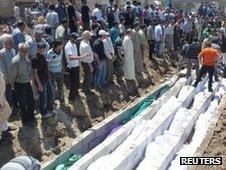
At least 109 people killed in a massacre in Houla
A UN official now says Syria is officially in full-scale civil war.
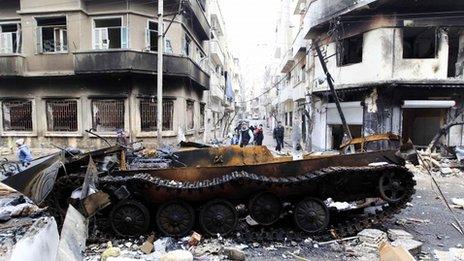
The violence started in the country in January 2011. It's now believed the government there has lost control of major cities to rebel fighters.
UN observers have now started filming some of the violence for themselves.
There are claims from the US that Russia is sending helicopter gunships to the aid of the Syrian regime.
Below we explain the background to this conflict and why foreign military intervention is being avoided.
Ceasefire
A ceasefire to end the violence in Syria started on 12 April.
Syria says it will keep to the ceasefire but reserved the right to respond to attacks. The main armed rebel group also said it would respond to any government attacks.
There's been no fighting so far but America says it doubts the Syrian government will stick to its promise.
The ceasefire was arranged by former UN chief Kofi Annan.
Anti-government activists in Syria claim at least 30 people were killed the day before the ceasefire started.
The UN says more than 9,000 people have been killed in the uprising against President Assad's rule, which began more than a year ago.
The Syrian government says 2,000 security personnel have been killed and blames the violence on "armed gangs" and "terrorists".
What do the protesters want?
The demonstrations began shortly after anti-government uprisings in Tunisia and Egypt in mid-March last year.
A group of teenagers spray-painted a revolutionary slogan on a wall in the southern city of Deraa.
They were arrested and soon the unrest spread to other areas.
Protesters started by calling for democracy and freedom in what is one of the most repressive countries in the Arab world.
For example, there are emergency laws which allow people to be arrested without warrants and imprisoned without trials.
Syria's president has promised some changes but protesters say the killing is continuing so they want him to step down.
Mr Assad has described protesters as terrorists who need to be removed.
Why is there no foreign military action as in Libya?
For decades Syria has been among the most stable countries in the Middle East.
It is a major player in the region because of where it's positioned, unlike Libya which is more isolated.
A military attack on Syria would cause knock-on effects in neighbouring countries.
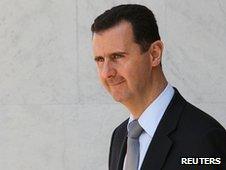
President Assad has promised changes but protesters don't believe him
It may mobilise militant groups like Hezbollah in Lebanon, Hamas in the Gaza Strip and other more radical Palestinian groups opposed to peace with Israel.
Syria is also strongly supported by Iran - a country considered hostile by the US, Israel and Saudi Arabia - which could potentially draw those powers into a dangerous Middle Eastern conflict.
President Bashar al-Assad has warned any foreign military action will turn Syria "into another Afghanistan".
Is there any support for the president inside Syria?
Syria is a mixed country of 21 million people with a large Sunni Muslim majority and minorities of Christians, Alawites and Jewish people.
Mr Assad belongs to the Alawaite sect.
He's supported by many people from the upper classes and minority groups.
The protests against him have mainly been in Sunni populated areas.
- Published24 January 2012
- Published26 July 2010