Summary

  • Five new meningitis cases have been found in Kent, taking the total number of confirmed and suspected cases to 20 - here's what we know about the outbreak so far

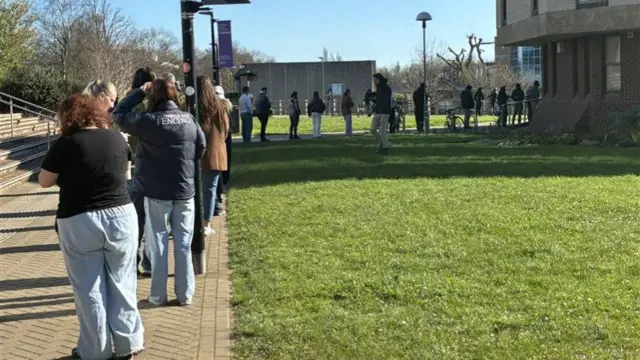
  • A student at the University of Kent tells the BBC there's "a lot of anxiety" on campus, with a long line of people queuing up for antibiotics - a targeted vaccine programme for 5,000 students there is also being set up

  • This meningitis outbreak is unusual because of the large number of cases in a short time, and the big unknown is why that's happened, our health correspondent writes

  • Two people have died in the outbreak - a 21-year-old university student and a sixth form pupil

  • Health Secretary Wes Streeting tells the BBC officials are "proactively managing" the spread of the infection, adding the "general risk is low, even if the disease itself is extremely serious" - what are the symptoms?

  • Streeting says the UK would normally see around one case of the disease per day; while the pace of the spread in Kent has "worried" health officials, he stresses it's only passed on via close personal contact

  1. 'I haven't been out since Sunday', says University of Kent studentpublished at 11:58 GMT

    Simon Jones
    Reporting from the University of Kent

    A student stands on the campus of University of Kent

    There is a strange atmosphere again today on the university campus - it’s a bit like a ghost town.

    There are very few students here, apart from people coming to pick up antibiotics, wearing masks. It feels like the Covid era.

    The university says it’s doing all it can to support its students.

    One who does remain on site is Kwatng. He tells me: "It’s really quiet. I haven’t been out since Sunday. I’ve been locked in my room. This is my first time going out."

    Many students have left the site and headed home. This should be exam season, a stressful time already. But people here are feeling stressed here for very different reasons.
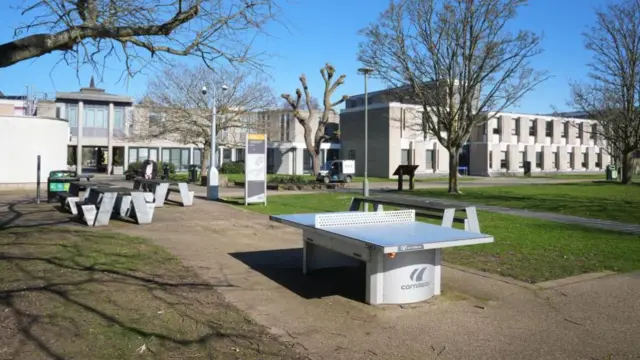
    A deserted campusImage source, PA Media
  2. Analysis

    Why is this outbreak 'unprecedented'?published at 11:46 GMT

    James Gallagher
    Health and science correspondent

    This meningitis outbreak is unusual because of the large number of cases occurring in such a short period of time.

    The big unknown is why it's happened.

    Answers are not obvious. Meningitis B is the most common type in the UK, students go to clubs up and down the country - nothing is overtly unusual.

    We know people regularly catch Meningitis B bacteria and they usually live harmlessly in the nose. But in rare cases the bacteria can invade the body and cause meningitis.

    So has there been an exceptional amount of spread of the bacteria or has it become more likely to cause invasive disease?

    There is speculation about vaping - could sharing a vape in groups accelerate spread or could vaping itself making it easier for meningitis bacteria to invade the body.

    But it still asks the question what could cause such an explosive outbreak as vaping is not new or rare.

    Is there something different about the meningitis bacteria this time? Is there some unusual environmental or behavioural factor - we know smoking increases the risk of invasive disease - that is different this time.

    There are so many questions. We're still waiting for answers.

  3. Health agency says there's 'sufficient vaccine stocks' as pharmacies warn of surge in demandpublished at 11:32 GMT

    A UK Health Security Agency (UKHSA) spokeswoman says that "there are sufficient MenB vaccine stocks".

    The UKHSA "will work with local resilience partners to ensure effective distribution", a spokeswoman tells news agency PA.

    It comes as high street pharmacies warn of a surge in demand for the vaccine.

    Speaking to the Today programme on Wednesday morning, Olivier Picard - chair of the National Pharmacy Association - says that "most of our distributors and wholesalers have no stock".

    He says the association is "hearing that there may be some stock in the system" but "it is taking its time to come into our fridges".

  4. Vaccinations at University of Kent expected this afternoon, but still awaiting details of rolloutpublished at 11:16 GMT

    Simon Jones
    Reporting from the University of Kent

    We’re still awaiting firm details of where and when the vaccination programme for 5,000 students who live on the University of Kent will begin.

    Jabs are expected to start being given some time this afternoon.

    It is a big logistical operation getting hold of the vaccines and finding the staff to administer them, but it is being treated as an urgent matter.

    That’s why this outbreak is being classed as one requiring a national response, so resources can be brought in from elsewhere.

    Students queue up at the University of KentImage source, Simon Jones / BBC
  5. Meningitis patient who returned to France from England in stable condition - health ministrypublished at 11:07 GMT

    French authorities say a person who was admitted to hospital with meningitis, after returning from England, is now in a stable condition.

    On Saturday, French authorities alerted UKHSA to a second confirmed case in France linked to the University of Kent.

    In a statement today, the French health ministry says "no other cases linked with the situation across the Channel" have been reported.

    "All possible measures have been taken to limit the spread of the infection. People who were in risky contact with the patient have been informed and an antibiotic treatment has been offered to them," the ministry says.

    "The situation is being monitored by French authorities, with their British counterparts," it adds.

  6. What we know about the meningitis outbreak so farpublished at 10:45 GMT

    • With five additional cases announced by the UKHSA this morning, a total of nine meningitis cases have now been confirmed, and 11 are under investigation
    • Two young people have died - an 18-year-old sixth form student called Juliette, and a University of Kent student whose identity has not been released
    • Six cases are known to be Meningitis B - a bacterial form of the disease
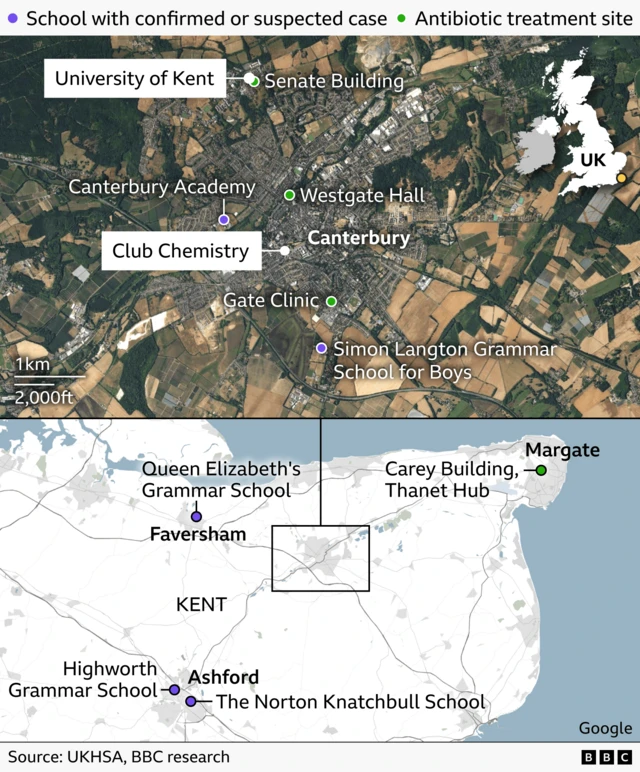
    • Five schools in the Kent area have so far confirmed cases among their students
    • All cases are currently being treated as linked to Kent. Anyone who visited Canterbury nightclub Club Chemistry on 5, 6 or 7 March is being urged to pick up preventative antibiotics from clinics in the Kent area, or from their GP - more information on those services can be found on the NHS website, external
    • Close contacts of cases are being traced, and advised to take antibiotics too - the health secretary said earlier that 2,500 people have been given medication
    • Meanwhile a targeted vaccination programme is expected to roll out later today, which will aim to give MenB jabs to around 5,000 students at the University of Kent
    A two‑part map showing five schools with confirmed and suspected meningitis cases and four antibiotic treatment sites in Kent, UK. The top map focuses on Canterbury, marking schools, clinics, treatment locations, Club Chemistry and the University of Kent. The bottom map shows the wider Kent area, including Faversham, Ashford, Margate and additional schools. Coloured dots indicate confirmed and suspected cases (purple), and treatment sites (green).
  7. 'The mood just shifted completely': University of Kent student tells BBC about anxiety on campuspublished at 10:35 GMT

    "Everyone's just feeling a lot of anxiety at the moment," says Izzy Kenny, who is in her fourth year at the University of Kent.

    She tells BBC Radio 5 Live Breakfast that she was with friends when she first heard about the meningitis outbreak and "the mood just shifted completely."

    Kenny says she received an email from the university "explaining the situation, the symptoms to look out for, also explaining that unfortunately one of the students has passed away".

    Since then, she says she's had "a few small updates through things like Instagram" laying out when people should get antibiotics but "that's been about it, to be honest."

    Having been told she was a close contact of a meningitis case, Kenny says she picked up antibiotics on Monday.

    "It was a long line, a lot of people going even if they haven't been in contact with somebody, just to get it for the sake of it, which I do think is a good thing," she says.

    Izzy KennyImage source, Izzy Kenny
  8. Postpublished at 10:19 GMT

    This Flourish post cannot be displayed in your browser. Please enable Javascript or try a different browser.

  9. How long does it take for MenB jabs to provide protection?published at 10:09 GMT

    Dr Simon Clarke, associate professor in cellular microbiology at the University of Reading, says MenB vaccination doesn't provide a "huge immediate effect".

    Speaking to BBC Radio 5 Live, Clarke says: "Protection from [the jab] will take a couple of months to come on full strength. It requires a couple of doses and then the protection comes about two weeks after the second dose, the full protection."

    "It won't have a huge immediate effect, even if people start having it today," he adds.

    As a reminder, a targeted vaccination programme for 5,000 students on the University of Kent campus in Canterbury is expected to begin later on Wednesday.

  10. High street pharmacies warn of high demand for jabpublished at 09:52 GMT

    High street retailer Boots says it has implemented a queuing system for customers who are trying to enter the vaccination service page of its website, warning that demand for its MenB jab is currently high.

    Similarly Superdrug has also created a waiting list for the vaccine, with a note on its website informing customers of a "national shortage".

    It says it is "working with suppliers to secure more doses."

  11. Am I eligible for the MenB vaccine?published at 09:45 GMT

    A targeted vaccination programme for 5,000 students is expected to begin on the University of Kent campus in Canterbury later today. They'll be given a jab for Meningitis B - the strain confirmed in six cases so far.

    Who is the MenB vaccine offered to normally?

    Since 2015, babies have been given vaccinations on the NHS for Meningitis B, or MenB.

    The vaccine is recommended for babies aged eight weeks. It's followed up with a second dose at 12 weeks, then a booster when they turn one.

    It protects against the most common, but not all, group B bacteria.

    Long-term health conditions

    People with certain long-term health conditions are also recommended to get the MenB vaccine, and can be referred on the NHS by their GP.

    This includes people with no spleen, sickle cell anaemia, coeliac disease or complement disorders (an immune disorder), according to Meningitis Now.

    Can I pay for a vaccine?

    The MenB vaccine is available through pharmacies, travel clinics and private GP practices.

    The cost varies from place to place, but Meningitis Now says to expect to pay at least £110 for the two doses required.

    Speaking to BBC Breakfast earlier this morning, Health Secretary Wes Streeting said it is "not necessary" for people to purchase vaccines privately as a result of the outbreak.

  12. University students queue up for antibioticspublished at 09:34 GMT

    Simon Jones
    Reporting from the University of Kent

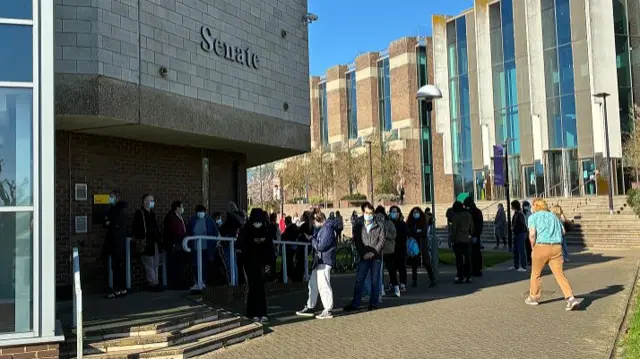
    University of Kent students queuing up to get antibioticsImage source, Simon Jones/BBC

    People are queuing for antibiotics at the University of Kent again today.

    News of an increase in cases in the county is causing renewed concern, and the health secretary has described the outbreak here as "unprecedented".

    Later today, we’re expecting the start of a vaccination programme aimed at 5,000 students who live on the campus.

    But some parents of school pupils are asking why their children are not being offered jabs. Five schools in the county have been linked to the outbreak.

    The vaccination programme is being kept under review by health bosses, but at the moment the priority is university students.

  13. How meningitis is tested for, and how it's treatedpublished at 09:27 GMT

    If doctors suspect that someone has meningitis, they usually test them to see if it's been caused by a bacterial or viral infection.

    The NHS says some of these tests are:

    • A physical examination, to look for symptoms such as a rash
    • A blood test
    • Taking a sample of fluid from the spine, called a lumbar puncture
    • A CT scan, to look for any brain issues like swelling

    Treatment

    Six of the confirmed cases are Meningitis B, the UK Health Security Agency has said. This is a bacterial form of the disease.

    Bacterial meningitis can be very serious, and it's recommended that all cases are treated in hospital so someone can be closely monitored. According to the NHS, hospital treatments include:

    • Antibiotics, given into a vein
    • Fluids, also given into a vein
    • If someone has breathing difficulties, oxygen is administered through a face mask
    • Steroid medication, if the person has any brain swelling
  14. Officials believe there could be more cases to comepublished at 09:16 GMT

    Nick Triggle
    Health correspondent

    Confirmation of five more suspected cases is not surprising - and health officials believe there could be more.

    The incubation period is up to 14 days so they believe so there is still scope the mixing at the Canterbury club on the 5, 6 and 7 March, which experts believe may have acted as a superspreader event, will result in even more cases.

    What is more, often outbreaks have a tail - subsequent close contacts of those infected could develop invasive meningitis.

    That is why there has been such a push to give students and others antibiotics - to stop the infection in its tracks.

    The vaccine programme starting later on Wednesday is about offering longer-term protection. It will be several weeks before immunity full kicks in.

    But it is worth remembering meningitis is not like flu or measles. It is not that easy to pass on.

    It requires prolonged close contact, like kissing, sharing drinks or vapes. Simply sitting next to someone on the bus is not considered a risk, for example.

  15. BBC Radio 5 Live taking your calls - watch livepublished at 09:15 GMT

    A panel of experts is currently taking your calls on the meningitis outbreak on BBC Radio 5 Live.

    You can watch live at the top of the page.

  16. UKHSA declared a national incident - but that's an operational tool and not a sign outbreak spreadingpublished at 09:02 GMT

    Nick Triggle
    Health correspondent

    There has been reports the authorities have declared the meningitis outbreak a national incident.

    This is true - it happened on Sunday and was declared by the UK Health Security Agency - but it's not a sign that the outbreak is spreading beyond Kent.

    That is not currently considered a concern - as Health Secretary Wes Streeting made clear in his interview with BBC Breakfast.

    Instead, it is an operational tool to allow the authorities to flex national resources.

    It means they can acquire antibiotics from the rest of the country and bring in staff to help with the targeted vaccination programme that is due to start on Wednesday afternoon.

  17. What we just heard from the health secretarypublished at 09:00 GMT

    We've just heard from Health Secretary Wes Streeting, who spoke to BBC Breakfast shortly after the UK Health Security Agency confirmed five new cases of meningitis in Kent. Here's what he said:

    • The health secretary said while contracting meningitis is "extremely serious", the general risk from this outbreak is "very low"
    • He called the Kent outbreak "unprecedented" in terms of spread. In a normal year the UK would see around 350 cases of meningitis, he said, so he expects to see unconnected cases in other parts of the country
    • Asked if there is a concern this might spread geographically, Streeting said "no" - and added that it's "OK" that some students in Kent have decided to return to their hometowns
    • The outbreak is not being treated as a national incident, he said, but the response is being managed on a national level
    • A targeted vaccination programme for 5,000 students in Kent starts today, while 2,500 doses of antibiotics have been given out so far, he said - and it's "not necessary" for people elsewhere to buy vaccines privately
  18. Health secretary says 'not necessary' to purchase vaccination privatelypublished at 08:49 GMT

    The health secretary is asked about vaccinations - whether people should be looking to purchase them privately, or if guidance should be changed for those who didn't get vaccinated when they were babies.

    Streeting says he has asked the JCVI – the independent group of scientists who advise the government on vaccinations – to revisit their advice.

    They will advise him on whether they need to go further with widespread catch-up vaccination, he says, adding that he will follow the clinical advice.

    On whether people should purchase the vaccine privately, Streeting says "it's not a surprise" that people are choosing to - but it's "not necessary".

    While some pharmacies have run out following increased demand, the health secretary says "we have plenty of supply" for those that need it.

  19. 'This is not a national incident like we saw in the Covid pandemic'published at 08:44 GMT

    Wes Streeting

    Streeting is asked about the declaration of a national incident, and what that means.

    As a reminder, the UKHSA declared a national incident on Sunday to help ensure supplies of antibiotics. Last night UKHSA chief executive Susan Hopkins said the incident was receiving "national-level oversight" in the NHS.

    Speaking to BBC Breakfast, Streeting says: "So we're managing this nationally, it's not the same as a national incident of the type we saw in the Covid pandemic."

    He says a national incident is declared when a health emergency puts "critical stress and pressure on the health system" - enabling them to take measures as part of the emergency response.

    "That in no way applies here," Streeting says. He says what's been confused is that the response to the outbreak is being "managed nationally" - with teams in government, the UKHSA and NHS England.

  20. Could the outbreak spread further?published at 08:34 GMT

    Asked if there is a concern this might spread geographically, Streeting says "no", although lots of students from Kent have already returned home, because it's exam week there are many still on campus.

    He says it's "okay" that lots of students will have gone home, but adds that if they were at Club Chemistry on the 5, 6, or 7 March, they need to seek antibiotics - which they can do in their hometown.

    Media caption,

    Watch: Health secretary says "people can and should" still go to school and college