Summary

  1. Yunnan's famed wild mushrooms on last night's menupublished at 02:08 GMT

    Before we kick off the day of meetings, here's a look at the feast the UK delegation had last night at In & Out (not the fast food chain), a restaurant offering Yunnan cuisine.

    A video shared by the restaurant owner show patrons and staff approaching Starmer for photographs.

    "The young staff were all thrilled. It felt like we were celebrating Chinese New Year," the owner said.

    You'll see in this menu that several of the dishes are cooked with wild mushrooms the southern province is known for.
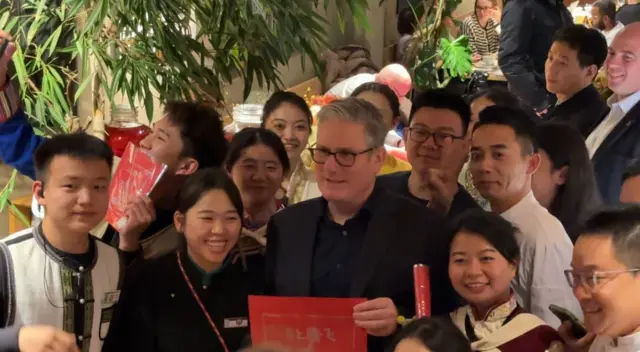
    Keir StarmerImage source, Supplied

    These mushrooms packed with umami flavour are sold in markets and appear on restaurant menus throughout Yunnan, especially during peak mushroom season between June and August. If not cooked properly, however, they can cause hallucinations.

    Former US treasury secretary Janet Yellen had similar dishes at In & Out when she visited Beijing in 2023, where she said she learnt about the fungi's hallucinogenic properties only after.

    Wild mushroom dish from In & OutImage source, In & Out
    Image caption,

    If not cooked properly, these mushrooms can cause hallucinations
  2. Starmer visit a chance to 'enhance trust', says Chinapublished at 02:00 GMT

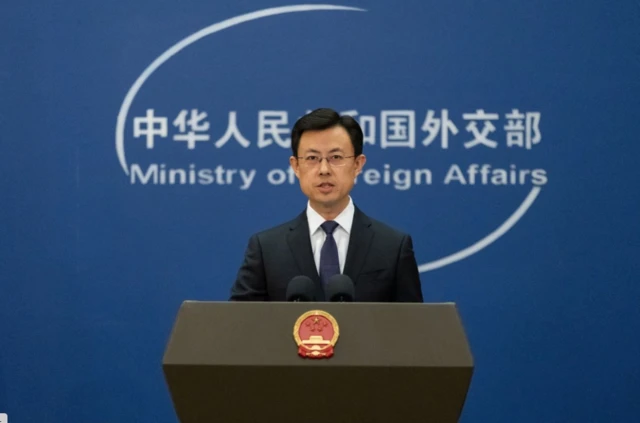
    Chinese foreign ministry spokesperson Guo Jiakun behind a lectern delivering a speech. Behind him, a blue wall with the words Ministry of Foreign Affairs in English and Mandarin in white.Image source, EPA

    Keir Starmer's visit offers an opportunity "to enhance political mutual trust with the UK [and] deepen practical co-operation", a Chinese foreign ministry spokesperson had said earlier on Wednesday.

    Sokesperson Guo Jiakun says London has "expressed clear willingness" to strengthen ties with Beijing in a "consistent, long-term and strategic way".

    "To strengthen exchanges and mutual trust, develop bilateral relations, and advance mutually beneficial cooperation is in the interest of both countries and the rest of the world," Guo adds.

  3. What's on the schedule today?published at 01:43 GMT

    It's looking like a busy day of meetings for Starmer. Here are some things the prime minister has lined up for today:

    • First up is a bilateral with National People’s Congress Chairman, Zhao Leji
    • Next - and arguably most important on the list, is a bilateral meeting with China's President Xi Jinping
    • After that it's off to a quick cultural reception before a tour of the Forbidden City
    • Then on to a ceremonial welcome ceremony and talks with Premier Li Qiang
    • The day will wrap up with a ceremony where both Starmer and Li are expected to witness the signing of a series of agreements, before heading off to dinner
  4. UK and China call for a reset in trade tiespublished at 01:28 GMT

    Suranjana Tewari
    Asia business correspondent

    Keir Starmer’s visit is aimed at resetting economic and business ties between the two countries after years of strained relations.

    His delegation includes more than 50 companies across pharmaceuticals, finance, energy, automotive and services, with major names such as AstraZeneca, HSBC, BP, Jaguar Land Rover, Rolls-Royce and Octopus Energy taking part.

    For the UK, the visit offers the prospect of improved market access for British financial services firms, as well as Chinese investment into UK energy and manufacturing and potential collaboration on green technology.

    China, meanwhile, stands to gain closer links with a major European economy at a time of mounting pressure from the United States, alongside expanded market access for its own companies.

    Significant challenges remain though. The UK imports far more Chinese goods than it exports to China, making trade imbalanced. Geopolitical tensions and domestic political scrutiny will continue to shape the relationship too.

    Still, the trip is likely to lay important groundwork for deeper economic cooperation in the future.

  5. Deal to thwart migrant smuggling networks on the cardspublished at 01:17 GMT

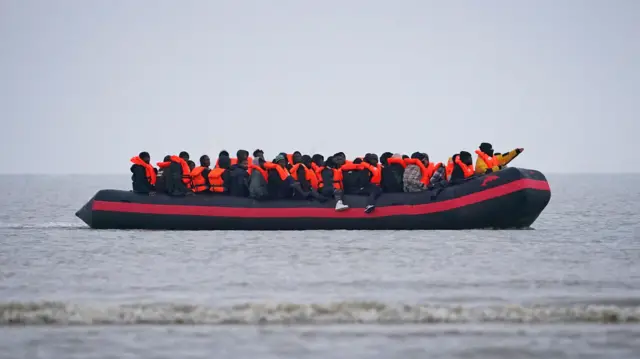
    A small boat carrying migrantsImage source, PA Media

    Starmer and Xi are expected to sign off on a "border security pact" when they meet for talks in Beijing today, to disrupt the supply of small boat engines.

    Downing Street says the deal will "scale up" removals of migrants with no right to be in the UK, and target Chinese gangs producing synthetic opioids.

    The agreement is also aimed at stopping boats and engines from reaching people-smuggling gangs, who pack migrants on small vessels bound for the UK.

    This comes after more than 60% of small boat engines seized from smuggling gangs last year were found to be manufactured in Chinese, according to Downing Street.

  6. China views the UK visit as part of something biggerpublished at 01:08 GMT

    Laura Bicker
    China correspondent

    Keir Starmer is just the latest in a flurry of western leaders making a beeline for Beijing.

    Despite the frigid winter cold, leaders of France, South Korea, Ireland, Canada and Finland have accepted invitations to the Chinese capital, and the German chancellor is due next month.

    For the UK, dozens of new deals are on the line to boost the country's economy.

    For China, this is part of a charm offensive in the hope that some will now look at Beijing as a stable, predictable partner, in contrast to the US.

    What was once dubbed a "golden age" for UK-Chinese relations has changed, into what Starmer has called an "ice age". With many difficulties to navigate, a full rekindling of the old relationship is unlikely – although this could mark the start of a slow diplomatic thaw.

    Read more of my analysis here.

  7. A recap of yesterdaypublished at 01:00 GMT

    Brian Wheeler
    Political reporter

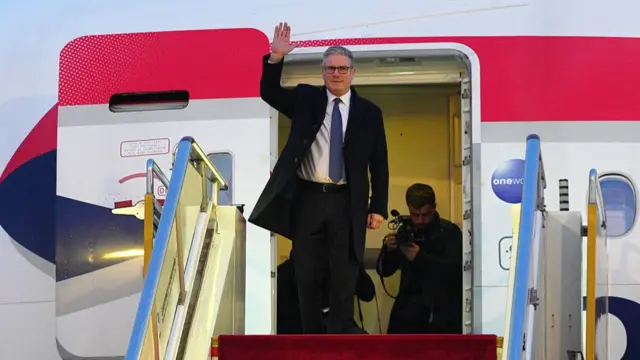
    Keir Starmer waving as he steps out of an aeroplaneImage source, Getty Images

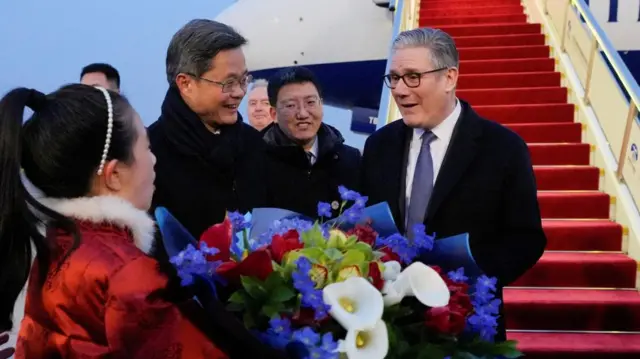
    When he touched down at the airport on Wednesday evening, Starmer was greeted by a delegation of Chinese officials and a bouquet of flowers.

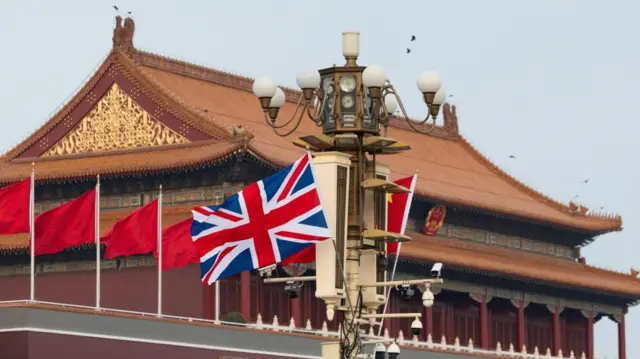
    Union flags were seen flying in Beijing's Tiananmen Square.

    Addressing some 60 British business delegates in the lobby of their hotel, the PM said: "On this delegation, you're making history. You're part of the change that we're bringing about.

    "We are resolute about being outward-looking, about taking opportunities, about building relationships...and always being absolutely focused on our national interest."

    He would not be drawn on what he would raise with Chinese leaders, saying only that he's "always raised issues that need to be raised" on his trips.

    "I don't want to get ahead of myself on the specifics until I've had the opportunity," he told reporters travelling with him.

    His visit has attracted fierce criticism from his political opponents in the UK, with conservative leader Kemi Badenoch saying the UK should "be talking more to those countries who are aligned with our interests, not the country that is doing everything it can to undermine our economy".

    Here's more on what went down on day one of Starmer's visit.

  8. Keir Starmer to discuss trade, security with Xi Jinpingpublished at 00:56 GMT

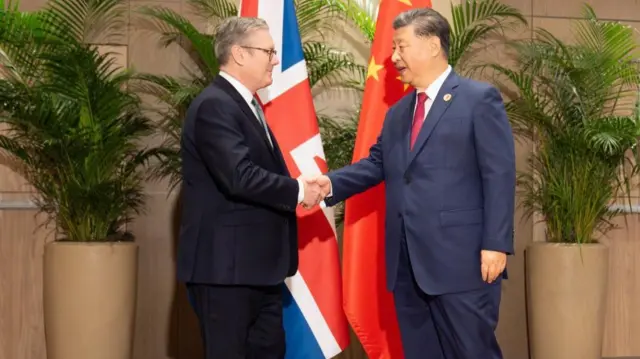
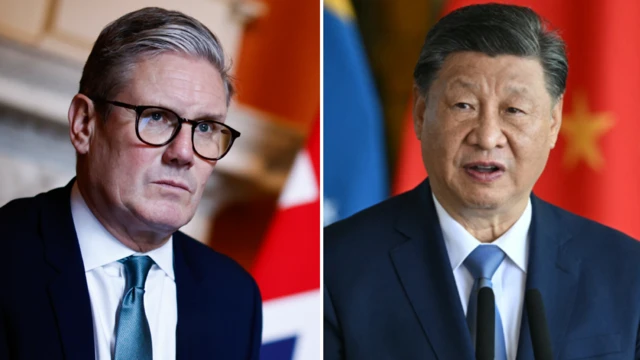
    Starmer last met Xi in 2024 on the sidelines of the G20 Summit in BrazilImage source, PA
    Image caption,

    Starmer last met Xi in 2024 on the sidelines of the G20 Summit in Brazil

    We're resuming our coverage of Keir Starmer's visit to China – the first by a UK prime minister since 2018.

    "I'm here to deliver for the British people," Starmer wrote on X when he arrived on Wednesday evening.

    Later this morning, he will meet President Xi Jinping in Beijing for talks on trade, investment and national security. He will then head to Shanghai for a range of engagements with Chinese and British businesses.

    Starmer is the latest in a beeline of Western leaders to call on China, and he hopes this visit will mend relations with the world's second-largest economy.

    But his visit has also attracted fierce criticism from political opponents in the UK, especially after the government green lit controversial plans for a Chinese mega-embassy in London.

    Stay with us as we bring you the latest updates and analyses.

  9. Analysis

    China wants to rebuild UK relationship as Trump tensions mountpublished at 13:11 GMT 28 January

    Stephen McDonell
    China correspondent

    starmer is presented with a bouquet of flowers by a woman in a red coat. he stands in front of the red carpeted steps of his plane.Image source, Reuters
    Image caption,

    The PM was greeted by delegates earlier Wednesday

    Before Keir Starmer arrived in Beijing, an official question and answer document was released including this statement from China’s commerce ministry spokesperson:

    "Amidst escalating global trade protectionism, both China and the UK uphold free trade and the multilateral trading system."

    So, if China and the UK uphold free trade, who doesn’t, according to Beijing? Although he wasn't named, it’s pretty clear - Donald Trump.

    China’s ambassador to the UK, Zheng Zeguang, has also written in The Times newspaper, external that "China and the UK do not see eye to eye on every issue".

    Given the tensions between Beijing and London in recent years that would be putting it mildly.

    Only a few years ago, Chinese staff were being condemned in Britain for dragging a protester inside the grounds of the consulate in Manchester; Hong Kong human rights abuses have generated ongoing tensions; China’s tech giant Huawei was banned from building the UK’s 5G network over security concerns; and on the list goes.

    However, this is a different time – after a period in the deep freeze, the Communist Party wants to rebuild links with the likes of Australia, Canada and Britain and the ambassador’s piece reflects this.

    He also wrote that "countries with a sense of responsibility should discern right from wrong and stand in solidarity to uphold the post-Second World War international order… the UN charter… multilateral trading system… the WTO".

    The simple message: the UK and China are the adults in the room in contrast to, you know who.

    We're now pausing our live coverage - thanks for joining us. For more on this story, take a look at analysis from China correspondent Laura Bicker.

  10. Recap: Starmer arrives in Beijing for first PM visit since 2018published at 13:05 GMT 28 January

    Katie Williams
    Live reporter

    Keir starmer speaks in the lobby of a beijing hotel.Image source, PA Media
    Image caption,

    Starmer has pushed to thaw icy relations with China, calling for a 'consistent approach' to the country

    Prime Minister Keir Starmer has arrived in Beijing - the first visit to China by a UK prime minister in eight years.

    Tomorrow, he will meet with Chinese President Xi Jinping for talks on trade, investment and national security. Later on, the trip will take him to Shanghai for business engagements - here's the itinerary.

    Starmer says he wants to achieve a "comprehensive and consistent approach to China", rather than veering "from golden age to ice age". And the mood has appeared jovial so far, with the PM even cracking a joke over his plane's tannoy before the delegation landed in Beijing.

    But the trip is far from straightforward - highlighted by the fact that the UK team is using "burner" phones and temporary email addresses due to spying fears.

    Tory leader Kemi Badenoch has said she would not be going to Beijing if she were prime minister today, and has called Starmer "too weak". But the PM's argument is that the trip will lead to financial benefits "back at home".

  11. Analysis

    The tricky politics of working with Beijingpublished at 12:53 GMT 28 January

    Damian Grammaticas
    Political correspondent

    The National flag of China and the British Union Jack flutter next to the Tiananmen GateImage source, Reuters
    Image caption,

    The Union Jack was pictured flying in Tiananmen Square earlier today as Starmer's visit kicks off

    For a UK prime minister, the politics of engaging with China is tricky.

    The Conservatives trumpeted their "Golden Age" when David Cameron was prime minister. But China’s crackdown in Hong Kong, its growing repressions in Xinjiang and Tibet, and its targeting of critics at home and abroad all cemented the perception of China as a rival and threat.

    The pandemic stopped many face-to-face contacts. But so too did the politics inside the Conservative party, and the churn of its leaders.

    A significant faction of ‘China hawks’ among Tory MPs meant ministers, even when they felt inclined to, decided against meetings with Chinese counterparts.

    Keir Starmer’s trip is, in his words, about ending this "Ice Age", having regular contact and building a more pragmatic policy.

    His critics say it is tantamount to caving to Beijing. But, in security terms, Labour hasn’t lowered the perception of the risks China poses. If anything, there is an even more acute awareness now.

    The government’s view is that China can’t be ignored. So, the new approach is driven by the belief that only by sitting across the table can the challenges be confronted, the problems raised, the opportunities grasped.

  12. Analysis

    China has economic challenges - but its GDP growth outstrips the UK'spublished at 12:44 GMT 28 January

    Stephen McDonell
    China correspondent

    As Keir Starmer rallies British business leaders in Beijing, we can say China’s economy remains amazingly resilient in some areas - but, in others, stuck in a rut.

    The country’s exports have surprised most observers. Even the chaos of Donald Trump’s tariff war could not put a dent into the volume of stuff China is selling to the rest of the world.

    But when it comes to domestic consumption, the word most often used here to describe it is sluggish.

    Chinese people are known to be very cautious with spending when financial strains start to build on the household, and that is what we are seeing now, especially with the property crisis eating into the value of their home.

    There are more university graduates than good jobs to accommodate them and studies have shown that the number of delivery drivers with a master’s degree has escalated dramatically. Over recent years, youth unemployment has been around 20%, more recently dropping to around 17%, which is still high.

    In addition, local government debt remains stubbornly high. And yet, with all its challenges, China recorded an official GDP growth rate of 5% for last year (compared to forecast UK growth of 1.5% for 2025, external).

    Analysts have questioned the veracity of this country’s statistics - given that the annual GDP has a habit of coming in bang on what the government predicted it would - but you can see with your own eyes that the economy is not about to fall over, despite the considerable pressures on it.

    As for companies wanting to sell into this huge market, they know that even the smallest percentage uptick in Chinese sales can mean moving a lot of goods because of the size of the population.

    British businesses realise this - and that is why they are accompanying UK Prime Minister Keir Starmer on his visit in such big numbers.

  13. Starmer tells delegates they are 'making history' on China trippublished at 12:18 GMT 28 January

    Media caption,

    'It's in our national interest to engage with China', says Starmer

    We have just had the first comments from the prime minister after his delegation landed in Beijing.

    Addressing business delegates in the lobby of their hotel in Beijing, the PM says that "on this delegation, you're making history. You're part of the change that we're bringing about".

    Starmer continues: "We are resolute about being outward-looking, about taking opportunities, about building relationships ... and always being absolutely focused on our national interest."

  14. Starmer says Minnesota shootings 'concerning'published at 12:00 GMT 28 January
    Breaking

    While travelling to China by plane earlier, Keir Starmer spoke about the recent fatal shootings by federal agents in Minnesota, in the US.

    Speaking to reporters, he said the incidents were "obviously concerning," but added: "I'm not going to give a running commentary on what's happening in other countries."

    The PM continued: "I don't think anybody could see some of the footage and not say it's concerning, but I'm not claiming to have seen all the footage and all the detail, but of what I have seen, I'd say it's concerning."

  15. Analysis

    A constant tug-of-warpublished at 11:46 GMT 28 January

    Frank Gardner
    Security correspondent

    Prime minister Keir Starmer and Chinse President Xi JinpingImage source, Getty Images

    Britain’s relationship with China can be characterised as a constant but behind-the-scenes tug of war.

    It is between, on the one hand, the enormous economic benefits of trading with the world’s second largest economy and, on the other, the profound concerns over Beijing’s espionage, human rights record and intellectual property theft.

    No government has yet been able to find the magic formula for getting this right.

    While Europe is slowly weaning itself off Russia’s oil and gas supplies, China is simply too big and too important a market to ignore.

    Yet at the same time China remains the No.1 priority for MI6, Britain’s Secret Intelligence Service, taking up more of its officers’ time than any other nation, even Russia.

    There are the obvious concerns – the parts of the ‘iceberg’ above the waterline that are visible to everyone – such as the suppression of democracy in Hong Kong, the oppression of the Uighurs in Xinjiang province, the takeover and colonisation of reefs in the South China Sea.

    Then there are the less visible but no less concerning issues such as the alleged hacking of British politicians’ phones, the targeting of Chinese democracy activists living in the UK and perhaps above all, Beijing’s insatiable appetite for acquiring quite staggering amounts of data from around the world.

    Much of this is encrypted, only to eventually be decrypted by quantum computing at a future date.

  16. Starmer should not be visiting China, says former Tory leaderpublished at 11:44 GMT 28 January

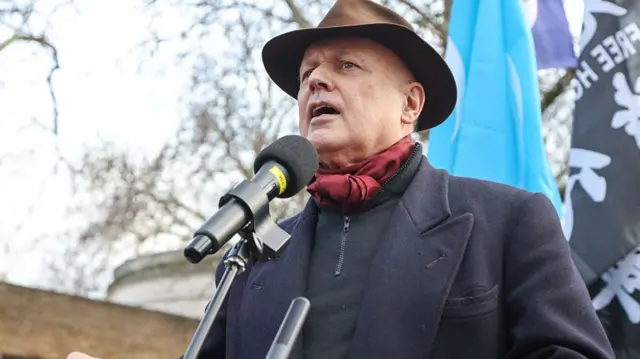
    Ian Duncan Smith giving a speech at an outdoor rallyImage source, Getty Images

    Iain Duncan Smith, former Conservative leader, says the prime minister should not be visiting China given their recent actions.

    He says China is carrying out a “real crackdown” on Hong Kong dissidents living within the UK “without apology”.

    These dissidents are being threatened in the UK and facing demands to return to China or face "punishment", he tells the BBC's Politics Live.

    “This is the ground level we are at at the moment - do you trust a government like that to ever stick to an agreement?” he asks.

  17. Xi recently struck a tariff deal with Canada's PM Mark Carneypublished at 11:30 GMT 28 January

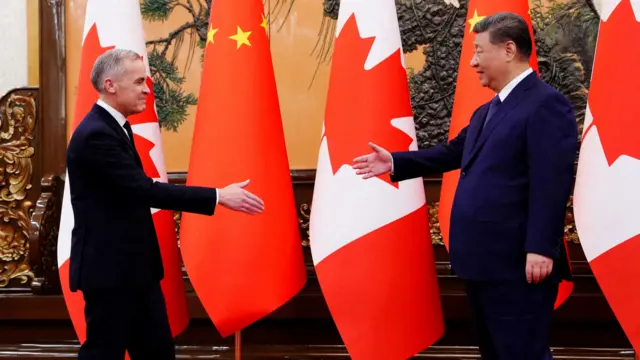
    Canadian PM Mark Carney extends his arm to shake hands with Chinese leader Xi Jinping, both wearing suits and standing in front of large flags of their countriesImage source, Reuters

    China's leader Xi Jinping has in recent weeks received various heads of government, who, like Keir Starmer, are seeking to strengthen trade ties with Beijing.

    Over a week ago, Xi struck a deal with Canadian Prime Minister Mark Carney to lower tariffs. Carney was the first Canadian leader to visit China in nearly a decade.

    China is expected to lower levies on Canadian canola oil from 85% to 15% by 1 March, while Ottawa has agreed to tax Chinese electric vehicles at the most-favoured-nation rate, 6.1%.

    The deal could also see more Chinese investments in Canada, right on US President Donald Trump's doorstep.

  18. Starmer walking a 'diplomatic tightrope' on Chinapublished at 11:17 GMT 28 January

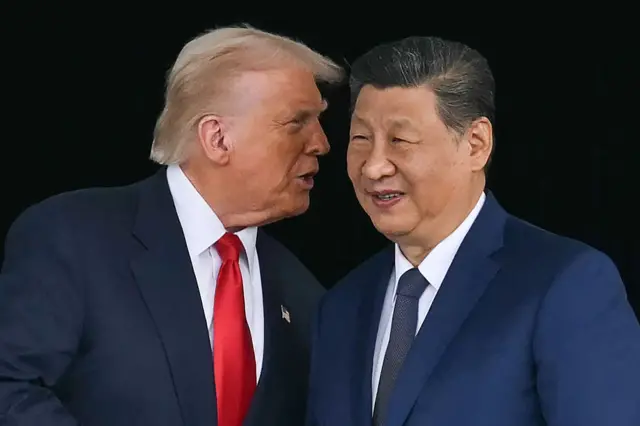
    Donald Trumo (L) shakes hands with Chinese President Xi Jinping (R) as he whispers in his earImage source, AFP via Getty Images

    Starmer's three-day visit to China comes with the additional challenge of keeping the US on side.

    Last week, US President Donald Trump threatened to impose 100% tariffs on Canadian goods if the country struck a trade deal with Beijing.

    That was days after Canadian Prime Minister Mark Carney visited China himself and announced he had agreed a "strategic partnership" with the country - and to reduce tariffs.

    Starmer has insisted the UK will not be forced to "choose between" China and the US, amid rising trade tensions between the two superpowers in recent years.

    The UK would maintain "close ties" with the US on business, security and defence, he said, but added that "sticking your head in the sand and ignoring China... wouldn't be sensible".

    Former Foreign Secretary Jeremy Hunt, however, has told the BBC the prime minister is facing "a real diplomatic tightrope".

    "There will be some benefits of course from more trade with China, but there's also a huge amount of risk," he says.

  19. I would not be going to China as PM, says Badenochpublished at 11:04 GMT 28 January

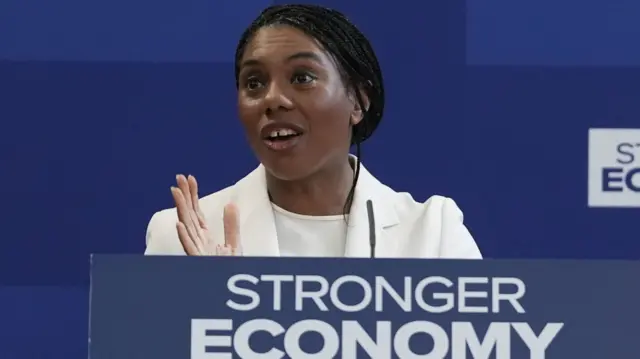
    Conservative Party leader Kemi Badenoch delivers a speech at Church House in London. Picture date: Wednesday January 28,Image source, PA Media

    Back in the UK, Conservative leader Kemi Badenoch says she would not be going to Beijing if she were prime minister today.

    "I don't think that this is the time to do that. We need to be talking to those other countries who are worried about the threat China is posing to them," she says in a speech in Westminster.

    She highlights Japan, Australia, Brazil and European countries as those the UK should be talking more to, not the country that is "doing everything it can to undermine our economy".

    She calls on the prime minister to "show strength" and suggests he should not be approving a "super embassy" which she says many people think would become a "spy hub".

  20. The UK's economy vs China'spublished at 10:50 GMT 28 January

    Peter Hoskins
    Business reporter, Singapore

    What are the differences between the economies of the UK and China?

    For starters let's look at their relative sizes. Last year, the UK's gross domestic product (GDP) stood at about $4tn (£2.9tn). That's dwarfed by around $20tn for China.

    They're also growing at very different rates. The UK expanded by roughly 1.5% in 2025. Meanwhile, Beijing says its economy grew 5%. But to be fair, that kind of gap is not unusual when comparing a highly-developed economy like the UK with one that's still developing.

    Those differences go on, from China's vast manufacturing base to its domination of the world's rare earths market.

    And then there's the small matter of China operating a socialist market economy - a hybrid system that blends centralised state planning with market forces, whereas Britain is a far more liberal market economy.