Summary

Media caption,

BBC Verify's Ben Chu examines claims Venezuela "stole" US oil

  1. Our coverage after seizure of Maduro by US forcespublished at 17:56 GMT 5 January

    Thomas Copeland
    BBC Verify Live journalist

    We’ve spent much of the day focused on the aftermath of the US strikes on Venezuela and the seizure of President Nicolás Maduro, who appeared in court today. Here’s a quick recap of our coverage:

    We’ve also debunked viral AI images of Maduro in US custody and misleading videos claiming to show celebrations inside Venezuela.

    Plus, want to know if wages have risen more under Labour, as Keir Starmer claims? Click here to read more.

    We’ll be back tomorrow morning with more, so do join us then.

  2. Verified images show smoke near Russian military factorypublished at 17:20 GMT 5 January

    Richard Irvine-Brown
    BBC Verify journalist

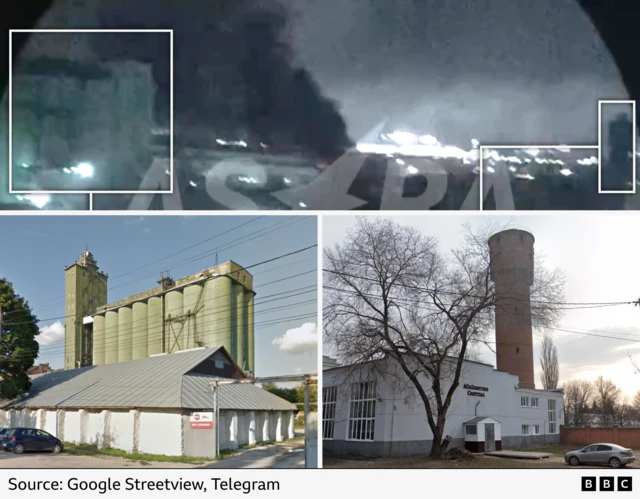
    We’ve been looking at a reported Ukranian drone attack on a factory in the Lipetsk region in the south west of Russia.

    Verified images shared on social media yesterday show smoke rising near a facility run by Russian aerospace firm Energia in the city of Yelets, about 155 miles (250km) from the border with Ukraine.

    According to OpenSanctions.org, the company is sanctioned by several European nations as a manufacturer of batteries for military applications.

    There are two key landmarks to help identify where the video was filmed:

    • A large industrial building to the left of the rising smoke
    • A chimney to the right, which matches one close to the Energia site

    Both can be seen on public satellite and the street view images available on Google and Russian search engine Yandex.

    There’s also a dark streak across the image where the railway passes through the south-west of Yelets. The layout of roofs and windows of the buildings in the foreground can be matched to those on the near side of the rails.

    One final element is a light covering of snow, which matches weather reports for the area over the weekend.

    A graphic with a screengrab from a video, highlighting two buildings that are visible and comparing them to google streetview images
  3. Iran protests turn increasingly violent, verified footage showspublished at 17:06 GMT 5 January

    Shayan Sardarizadeh and Ghoncheh Habibiazad
    BBC Verify and BBC Persian

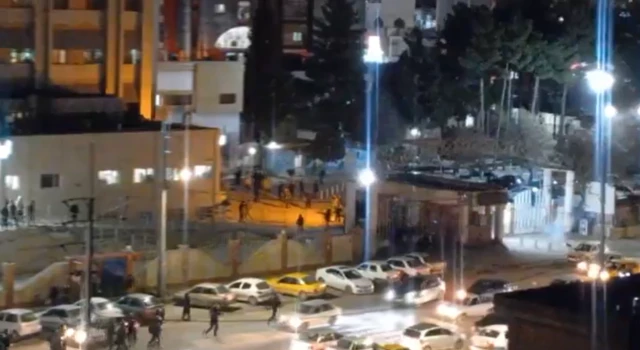
    Security forces outside a hospital in Ilam, where a rally took placeImage source, X/@Vahid

    Footage examined by BBC Verify and BBC Persian indicate that a recent wave of protests in Iran have increasingly turned violent, with security forces ramping up the use of force to quell the unrest this weekend.

    Multiple verified videos filmed in Ilam in western Iran on Sunday night show security forces firing shots towards Imam Khomeini Hospital in the centre of the city, where a group of protesters held a rally.

    Another clip, filmed from inside the hospital, shows a number of protesters asking for protection from police and security forces, who can be seen on the other side of a glass door. A number of shots are then fired, leading to crowds running away.

    Fars news agency, which is close to the powerful Revolutionary Guards branch of Iran’s military, said the hospital had become a "base for rioters".

    Iranian human rights groups have said some of those in the hospital were protesters who had been injured after being targeted by security forces at a rally earlier on Sunday.

    A video of the incident, which occured in front of a local government building in the nearby town of Malekshahi, has been verified by BBC Persian.

    The protests began on 28 December when a group of shopkeepers and traders in the capital Tehran held a rally over soaring inflation and the value of the Iranian rial plummeting.

    Demonstrations have since spread to dozens of towns and cities, with protesters chanting slogans against Supreme Leader Ayatollah Ali Khamenei and the clerical establishment that rules the country. At least 12 people have been reported killed across Iran.

  4. Have wages gone up more under Labour?published at 16:03 GMT 5 January

    Anthony Reuben and Lucy Dady
    BBC Verify

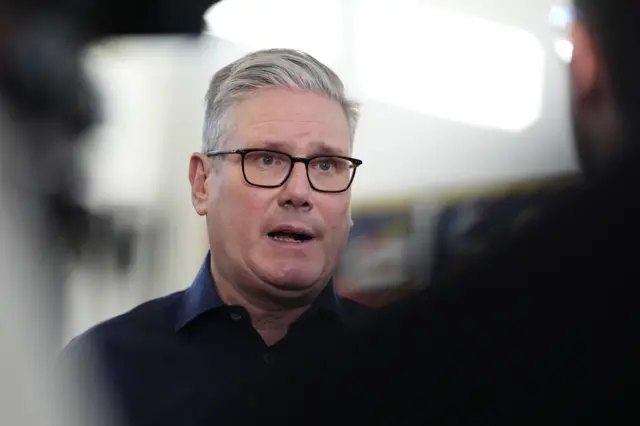
    Speaking to Laura Kuenssberg about his government’s achievements yesterday, Keir Starmer said: “Wages have gone up more quickly in the first year under this government than in the first 10 years under the previous government.”

    We asked Downing Street which measure of wages the prime minister was referring to and it said it was average weekly earnings adjusted for rising prices and pointed us towards figures published by the Office for National Statistics, external, external(ONS)., external, external

    The ONS spreadsheet says total pay rose £5 a week in the first year under Labour:

    • July 2024 - £520
    • July 2025 - £525
    Britain's Prime Minister Keir StarmerImage source, Reuters

    That compares with the first 10 years of the Coalition and Conservative governments when earnings fell £5 a week:

    • May 2010 - £499
    • May 2020 - £494

    The figure for May 2020 will have been impacted Covid, when many workers were furloughed and not receiving their full salaries.

    It is fair to say that wage growth was relatively slow under governments going back to 2010, with weekly earnings rising £2 to £501 between May 2010 and May 2019.

    But the first year under Labour did not see as much growth in wages as the previous year under the Conservatives, when weekly earnings went up by £11 a week:

    • July 2023 - £509
    • July 2024 - £520
  5. Sanctioned tankers seen departing Venezuela after Maduro seizurepublished at 15:48 GMT 5 January

    Alex Murray and Kayleen Devlin
    BBC Verify

    On 17 December, more than two weeks before the US attack on Venezuela, President Donald Trump ordered a "blockade" of sanctioned oil tankers entering.

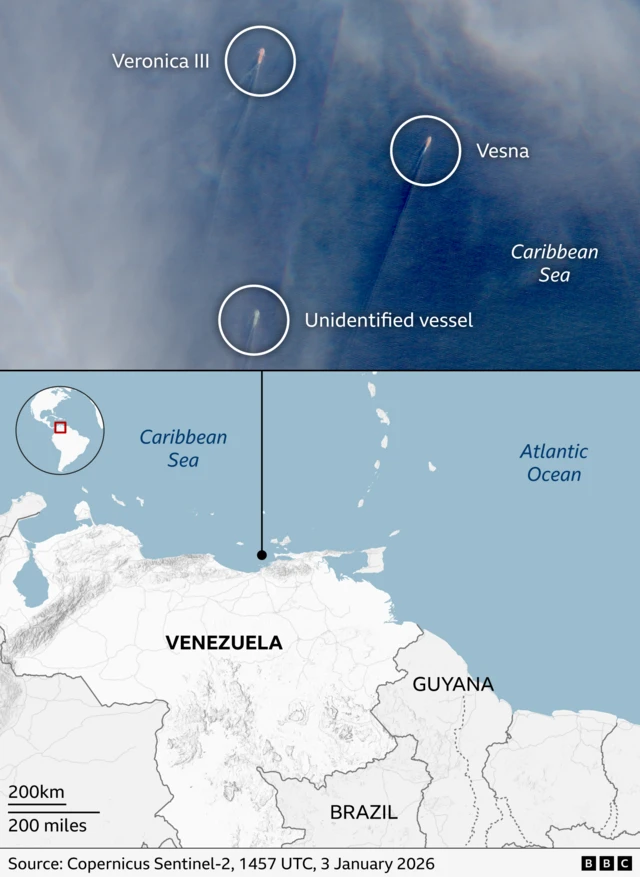
    We’ve been looking at three vessels seen in an image taken by the Copernicus Sentinel-2 satellite on 3 January 2025.

    The picture, first reported on by the New York Times, has a timestamp saying it was taken at 14:57 GMT, shortly after the pre-dawn raid in which President Nicolás Maduro was seized in a US military operation.

    We can see the three vessels heading away from one of the country’s main oil terminal areas, Puerto Jose, where we have previously identified sanctioned vessels loading oil.

    The features and dimensions of one of them are consistent with those of the Vesna, which is listed by the US as a sanctioned oil tanker. The features of the second vessel are consistent with Veronica III - also under US sanctions.

    A map showing the location of the three vessels seen in a satellite image

    Vesna last transmitted its location more than eight months ago in China, while the Veronica III recently reported its position off the coast of Nigeria. This suggests both vessels are engaged in a deceptive practice known as “spoofing”, frequently done by sanctioned vessels, to avoid revealing their true location.

    We are working to identify the third vessel as its dimensions do not appear to match the name reported elsewhere.

  6. Legal experts challenge Trump’s ‘stolen’ oil claimpublished at 15:00 GMT 5 January

    Tom Edgington
    BBC Verify senior journalist

    BBC Verify has consulted several international energy law experts to assess Donald Trump’s claim that Venezuela “unilaterally seized and stole American oil”.

    Their opinion was that there was no legal basis for Trump’s remarks.

    Eddy Wifa, co-director of the Aberdeen University Centre for Energy Law, said any oil found in Venezuela was owned by the Venezuelan government.

    “In America if you find oil in your backyard it belongs to you. In other parts of the world, including the UK, Nigeria and Venezuela, oil belongs to the government”.

    Ignacio Herrera Anchustegui from the University of Bergen in Norway agreed. He told us it had not been stolen as “Venezuela’s constitution makes clear the oil and gas assets belong to the nation”.

    “Petroleum companies have a right to extract it and commercialise it under a license/concession agreement.”

    Both experts explained that Venezuela's gas and oil industry was partially nationalised in 2007. Under the changes, international companies were forced to team up with firms that are at least 50% owned by the Venezuelan state.

    This arrangement is why US oil company Chevron still has a presence in Venezuela.

    Anchustegui explained the move “triggered a series of international arbitration procedures” and led to Venezuela being told to pay compensation to US firms, some of which is “still unpaid”.

  7. Has Venezuela ‘stolen’ US oil?published at 14:28 GMT 5 January

    Ben Chu
    BBC Verify policy and analysis correspondent

    President Donald Trump has said the US built the oil industry in Venezuela, who then “stole it through force”.

    In 1976 the Venezuelan government nationalised the oil industry, effectively revoking operating concessions granted to foreign oil companies, including those from the US, in the 1920s and 1930s.

    These concessions didn’t mean these companies owned the oil in Venezuelan territory, but it gave them the valuable right to pump it and to sell it for a fixed period of time in return for paying royalties on sales to the Venezuelan government.

    Around $1 billion in compensation was agreed for the US oil companies which lost their concessions in 1976, external, including Exxon, Mobil (which have since merged into one company) and Gulf Oil (now known as Chevron).

    In 2007, former Venezuelan president Hugo Chavez exerted further state control over the remaining foreign-owned assets of US oil firms operating in the country.

    In 2019, a World Bank tribunal ordered Venezuela to pay $8.7 billion to ConocoPhillips in compensation for this 2007 move. , external

    That sum has not been paid by Venezuela, so at least one US oil company has outstanding compensation which is owed to it.

    Yet the claim the country has “stolen” American oil is too simplistic, as experts say the oil itself was never actually owned by anyone except Venezuela.

  8. Misleading videos claim to show celebrations from inside Venezuelapublished at 13:26 GMT 5 January

    Shayan Sardarizadeh
    BBC Verify senior journalist

    A number of misleading videos have been posted online claiming to show people flooding the streets in Caracas, waving flags and dancing in celebration after the US seized President Nicolás Maduro.

    While many celebrations did break out this weekend over Maduro’s deposition, they were in Latin American countries such as Argentina and Chile, and other countries with Venezuelan diaspora such as Spain and the US.

    We have not seen visual evidence of large celebrations inside Venezuela so far.

    But a video shared on X by right-wing conspiracy theorist Alex Jones claims to show people on the streets of Caracas this weekend. It has been viewed more than two million times and shows an aerial shot of a large crowd with vehicles attempting to move through it.

    Jones claimed: “Millions of Venezuelans flooded the streets of Caracas and other major cities in celebration of the ouster of Communist dictator Nicholas Maduro.”

    However, by reverse searching frames from the video and finding the original version, we were able to confirm that it instead shows opposition protests in Caracas in July 2024 after Maduro’s disputed presidential win.

    A screenshot from the misleading video alongside a picture of its real location in Florida on Google Maps

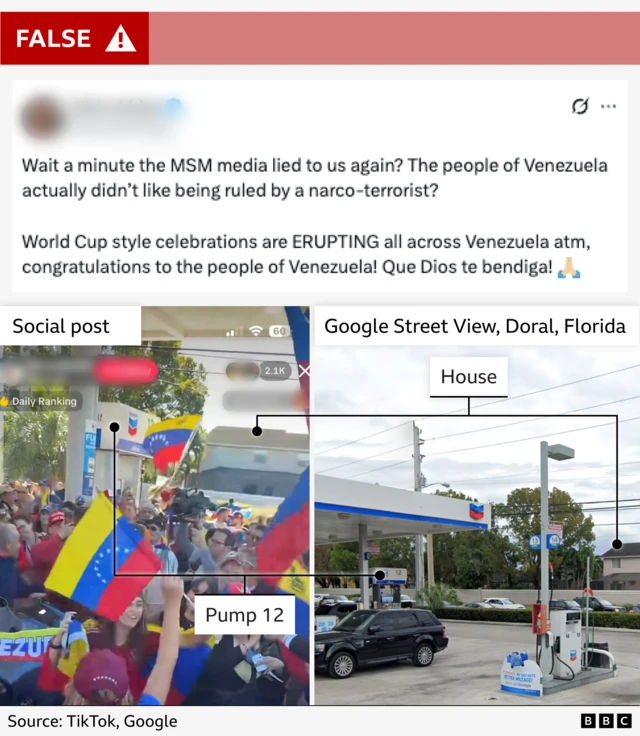
    Another post by a pro-Trump journalist that has been viewed nearly four million times shows a group of people with Venezuelan flags dancing to music. “World Cup style celebrations are erupting all across Venezuela,” the user said.

    While the video is recent, by checking the details in the background and corroborating it with other videos of the same event, we confirmed that it was actually filmed at a Chevron petrol station in Doral, Florida, which is home to a large number of Venezuelan-Americans.

    A similar video claimed to show a jubilant crowd in Venezuela, but by checking the landmarks seen in the clip we confirmed that it was instead filmed in Panama City.

    One Venezuelan who lives in the UK told the BBC that people inside the country were “very quiet” about Maduro’s seizure because they couldn’t "freely voice our feelings about what has happened".

  9. Real Venezuela footage manipulated with new AI toolpublished at 13:08 GMT 5 January

    Thomas Copeland
    BBC Verify Live journalist

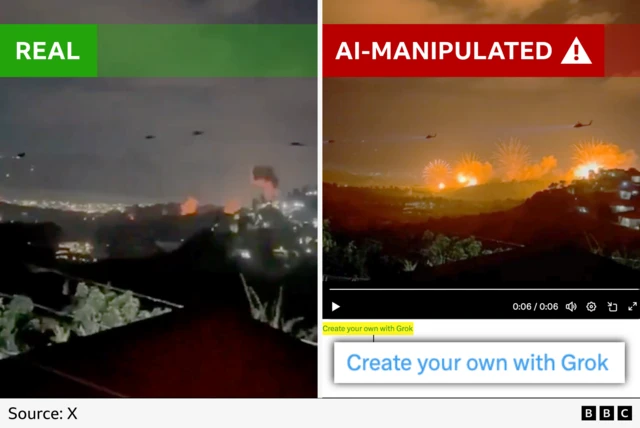
    We’ve been telling you today about real videos we’ve verified of US helicopters flying over Caracas on Saturday, but we’ve also seen footage that has been altered using a AI generator on X.

    One post that gathered hundreds of thousands of views appeared to show a series of helicopters flying over the Venezuelan capital as explosions erupt beneath them, some of which look very similar to fireworks.

    This AI-manipulated video has been made using real footage of the helicopters’ operation and of some of the US strikes to appear as though there are many dramatic explosions with multiple eruptions in different directions.

    A screenshot of the real footage beside a screenshot of the AI-manipulated post highlighting the words 'Create your own with Grok' at the bottom

    In the corner of the post we can see the words “Create your own with Grok”, which tells us that the video was edited using Grok Imagine, X’s in-built AI image and video generator, which now allows users to directly edit some content posted in their feed.

    This may help explain why the AI-manipulated explosions look a bit like fireworks. When asked to enhance the original video, Grok Imagine is likely to have searched its training data to find more videos of explosions, and it’s possible some of those may have been of fireworks.

  10. Verified videos show US helicopters firing in Caracaspublished at 12:38 GMT 5 January

    Benedict Garman
    BBC Verify senior journalist

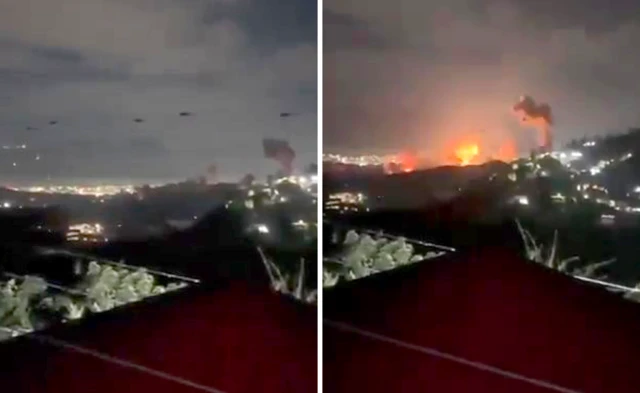
    The Verify team has analysed and verified dozens of videos from Venezuela showing the US strikes on the country over the weekend. It meant we were quickly able to establish what parts of Caracas and nearby areas were hit.

    The US military said more than 150 aircraft were involved in the operation, which targeted military areas of the city, an airport, and a port. One verified video shows nine helicopters flying low over an area of Caracas on Saturday. Explosions can be seen in the hillside against the dark sky with plumes of smoke rising from fires.

    Two screenshots from the video showing helicopter and explosionsImage source, X

    Another video shows several helicopters flying towards a military stronghold in central Caracas, Fuerte Tiuna, approaching from the west and moving in a semi-circle towards the northern side before heading south towards the complex as smoke rises from fires on the ground.

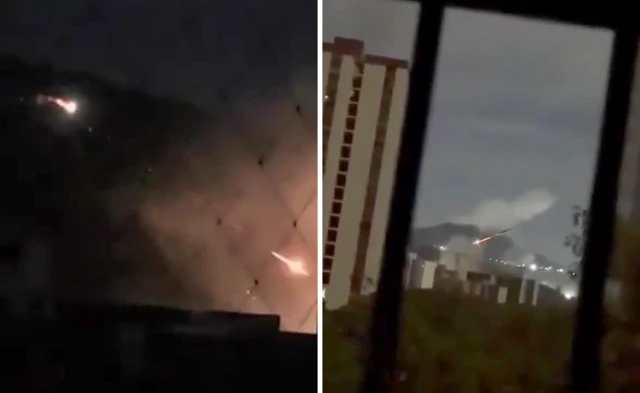
    Two more videos, geolocated to a spot just west of the fortress show US helicopters firing at targets on the ground. A blackened, damaged residential building can be seen in satellite imagery provided by Vantor at this location.

    Two screenshots from two videos showing helicopter strikesImage source, X
  11. Watch: Key questions on Trump's actions on Venezuelapublished at 12:21 GMT 5 January

    Our Analysis Editor Ros Atkins has looked at the key questions that have arisen following the seizing of President Maduro and his wife, including who is running Venezuela, who is in charge of its security, and what happens to its oil.

    Media caption,

    Ros Atkins on the key questions on Venezuela

  12. How AI images of Maduro emerged within hours of his seizurepublished at 11:20 GMT 5 January

    Thomas Copeland
    BBC Verify Live journalist

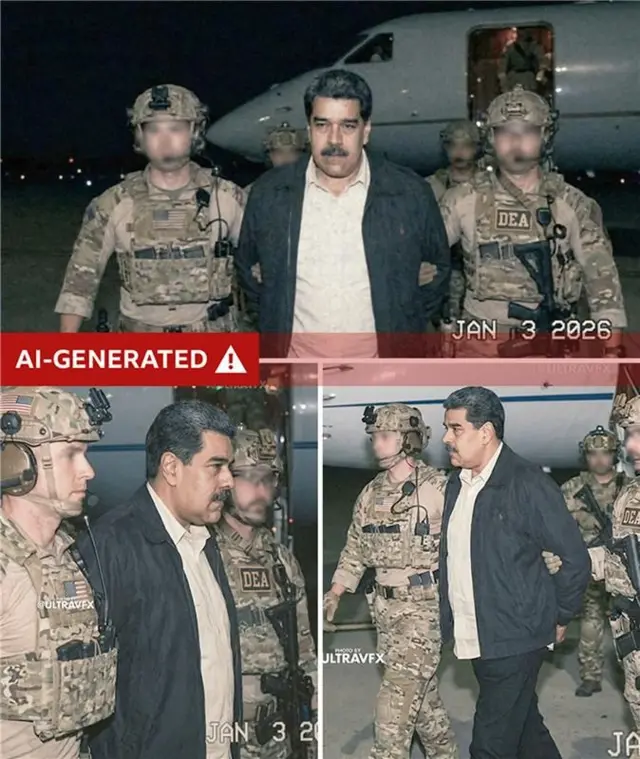
    AI images claiming to show Nicolás Maduro in custody after his seizure by the US have gained tens of millions of views online.

    Maduro was seized by the US in the early hours of Saturday morning. The first fake AI image apparently showing him being escorted off a plane emerging within hours.

    The image was not shared by any official US channels, it was instead posted on X by an “AI video art enthusiast” account.We’ve checked it using Google’s SynthID AI-watermark detector, which found it was generated or edited with Google AI.

    Three of the fake images with a red AI-generated label

    More AI-generated pictures began to spread in the ensuing hours appearing to show more angles of Maduro in custody. Visible watermarks on these images show they originated from an Instagram account called ultravfx, whose profile describes it as being run by a “Professional in artificial intelligence”.

    SynthID says all of these further images were generated or edited with Google AI.

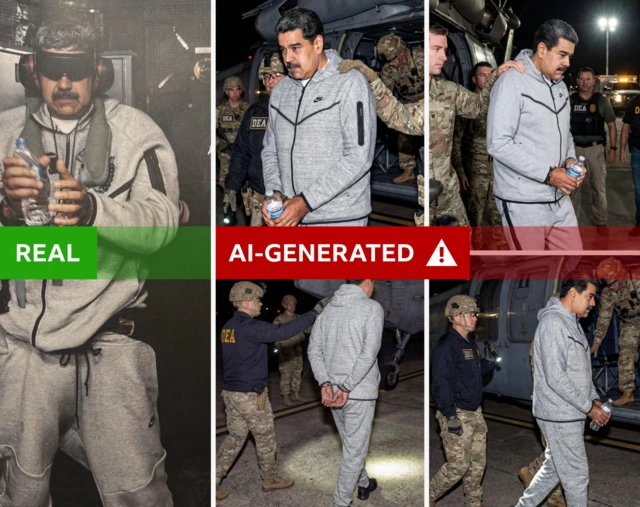
    Donald Trump posted the first real photo of Maduro handcuffed aboard the USS Iwo Jima ship on Saturday morning. But even after this real photo was published AI-generated images continued to spread but were updated to include the grey tracksuit worn by Maduro.

    Reverse image searches show these updated fakes were first posted on TikTok by a graphic design account. Once again, SynthID AI-watermark detector says these further images were generated or edited with Google AI.

    The real image shared by Trump on the left and four AI-generated images with a red label on the right
  13. Monday on BBC Verify Livepublished at 11:20 GMT 5 January

    Adam Durbin
    BBC Verify Live senior journalist

    Good morning, it’s BBC Verify Live’s first full week back after the new year and we’re already off to a busy start.

    The news agenda over the weekend has been dominated by the US attack on Venezuela and the seizure of President Nicolás Maduro. Videos claiming to show people inside Venezuela celebrating his seizure have been widely circulating online, but our team has found the footage is from old events or Venezuelans living abroad. We’ve also been analysing AI images supposedly showing Maduro in US custody, and verifying videos of US strikes on Caracas over the weekend.

    The team are also monitoring the anti-government demonstrations in Iran where at least 12 people are reported to have been killed in the past week. We’re verifying videos and images from this morning and the weekend as clashes between protesters and Iran’s security forces continue.

    We’re also looking into new footage reportedly showing a Ukranian attack on a battery factory used by the Russian military. The facility hit is said to be in the city of Yelets, around 170 miles (275 km) from Ukraine’s border in Russia’s western Lipetsk region.

    BBC Verify Banner