Hwyl fawrpublished at 14:25 GMT 10 March
Eluned Morgan’s fifty-fifth session as first minister comes to a close.
 Image source, Senedd Cymru
Eluned Morgan
Eluned Morgan is quizzed by opposition party leaders and other MSs during First Minister's Questions.
Eluned Morgan’s fifty-fifth session as first minister comes to a close.
Image source, Senedd CymruEluned Morgan
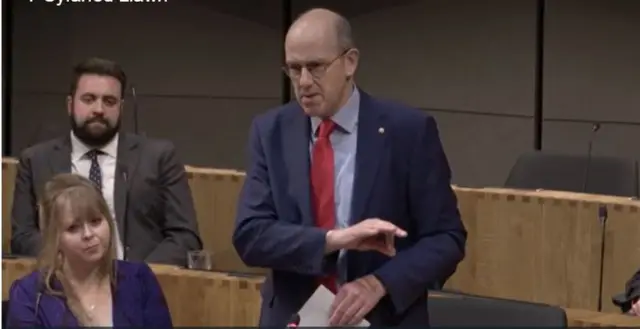 Image source, Senedd Cymru
Llyr Gruffydd
Plaid Cymru MS Llyr Gruffydd asks "what discussions has the Welsh government had with the UK government and Ofgem regarding electricity standing charges for households in north Wales?"
Eluned Morgan replies, "standing charges should be fair, transparent and they shouldn't disproportionately impact low-income households. I'm aware that people in north Wales face some of the highest standing charges in the country. This is unfair, particularly as they live close to large affordable renewable energy sources."
She adds that the matter has been raised consistently with both the UK government and Ofgem and she says she welcomes Ofgem’s plans to introduce a pilot to lower standing charges.
Ofgem has engaged with major energy suppliers to test reducing standing charges by at least £150 annually for 150,000 customers.
Llyr Gruffydd says "historically they told us, ‘well, because you're rural and because you're at the end of the line it costs more’, but what that ignores, of course, is that Wales is a net exporter of electricity for the rest of the UK. Wales powers other parts of the UK, but it appears that we are paying an unfair price for that."
Figures by price comparison sites show that the rates paid in north Wales remain the highest in the country - around eight pence more expensive per day than northern Scotland which is the second most expensive area for electricity bills.
 Image source, Getty Images
Conservative Altaf Hussain, previously a consultant orthopaedic surgeon, asks "how is the Welsh government speeding up patient flow through hospitals?"
Eluned Morgan replies, "we know that one of the greatest challenges in the NHS today is to improve patient flow and to ensure that there are alternatives to admission, and that we have national discharge standards. Health boards have introduced methods to discharge, to recover, and to assess, and we've introduced trusted-assessor models. We have better clarity when it comes to shared accountability across health and social care. £30 million has been provided to increase social care capacity and to support discharge. Now, that's on top of the regional integration fund, which also supports this effort and has a budget of £146 million."
Altaf Hussain says "while addressing delayed discharge is vital to patient flow, we must also address delays at the front door. We still see patients waiting at the back of ambulances or receiving treatment in chairs within A&E waiting areas. We have seen the tragic consequences of this. People have died waiting for emergency responses, to say nothing of other significant morbidities. Currently, there's a lack of transparency regarding the medical staffing levels in A&E at any given time."
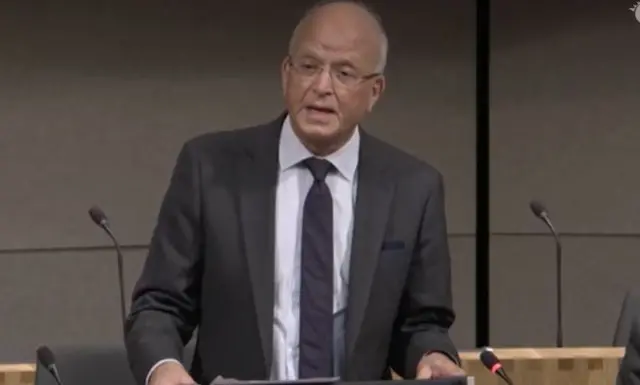 Image source, Senedd Cymru
Altaf Hussain
Plaid Cymru MS Heledd Fychan asks "what steps is the Welsh government taking to bring to an end the dispute between health visitors and Cwm Taf Morgannwg University Health Board?"
Eluned Morgan replies, "this is a local dispute between the union and the health board, not a national issue. Unite is leading this dispute, and I want to declare that I'm a member of Unite. I want to see both parties finding a resolution to this dispute that is fair to health visitors, to patients and to the NHS."
This morning, health visitors and trade union activists marched from the Wales Millennium Centre to the Senedd as part of their “campaign for fair pay”. The health visitors are currently on strike until 20 March.
Heledd Fychan says, "the reason for the dispute is that the university health board are refusing to adhere to the national job evaluation system - a system that is used in determining the remuneration for every job in the NHS in the UK. Every step of the process has been followed correctly, and the result was that health visitors in Cwm Taf Morgannwg should be band 7, not band 6. The ACAS [Advisory, Conciliation and Arbitration Service] process has failed, the health board seem unwilling to compromise, and we are in a position where we are no closer to a resolution, with strike action potentially being extended beyond the initial four weeks. An all-female workforce are being denied the pay they deserve, and new mothers, parents and babies are facing uncertainty over access to vital support. This cannot continue." She calls on the Welsh government to intervene.
Eluned Morgan says "I think it's quite notable that the issue has not been brought to the Social Partnership Council because it is still recognised as a local dispute between Unite and Cwm Taf Morgannwg. Other health unions are not pursuing this issue. This is something that needs to be addressed locally."
 Image source, Senedd Cymru
Heledd Fychan
 Image source, Senedd Cymru
Rhun ap Iorwerth
Plaid Cymru leader Rhun ap Iorwerth says they have obtained a copy of a letter from Sir Keir Starmer to UK cabinet colleagues in which the prime minister says the UK government should be prepared to go against the wishes of the Welsh government (and the Scottish and Northern Ireland governments) when taking decisions about both countries.
The leaked memo seen by BBC Wales follows a row last year about the UK government spending money in devolved areas against the wishes of Labour's politicians in Cardiff Bay.
The prime minister's letter says "we should be confident in our ability to deliver in those nations including through direct spending even when devolved governments may oppose this".
Rhun ap Iorwerth says, "there we have it in black and white: Keir Starmer's own version of Boris Johnson's muscular unionism, not only dealing with devolution in bad faith, but undertaking a direct assault on the democratic views of devolved governments. By staying ever loyal to him, the first minister is aligning herself with efforts to undermine her own government".
He asks, "why has the Labour Party turned against devolution to this extent, and why has the first minister allowed the UK's Labour prime minister to treat our parliament, our government, and the people of Wales with such contempt?"
Eluned Morgan replies, "devolution must be respected, and I've always been very clear with the prime minister on that issue. It is a respectful relationship, and there are times, of course, when the UK government should be working directly within Wales. Just take Wylfa as an example, where we want to see that development... My loyalty will always be to the Welsh people first and to their concerns, and that is why, when we came out with our key pledges recently, they were responding to the things that people in this country are concerned with on a day‑to‑day basis."
 Image source, Senedd Cymru
Darren Millar
Following the sacking in January by Conservative group leader Darren Millar of his shadow health secretary James Evans for talking to Reform - a party he has since joined - the Conservatives and Plaid Cymru have 13 members each in the Senedd.
So the two parties now take turns to ask the first leader's questions to the first minister.
The Conservatives go first today.
Darren Millar refers to the fact that three men with connections to Welsh Labour were detained on Wednesday on suspicion of spying for China, before being released on bail.
David Taylor, 39, is a former adviser to the Wales Office and married to a Labour MP. Steve Jones, 68, is a former Welsh government special adviser and Matthew Aplin, 43, is a former Labour press officer and an ex-member of Reform.
The three were arrested at addresses in Wales and London as part of a counter-terrorism policing investigation under the National Security Act.
Darren Millar asks, "given the seriousness of this situation and the fact that three people - not just one - have been arrested, can you tell us when did you become aware of the national security concerns? And, can you also tell us whether you've initiated an urgent review of the vetting and security arrangements for staff employed by your government and party?"
First Minister Eluned Morgan says "it's got to be made absolutely clear that this is a live investigation. Therefore, it would be inappropriate for me to comment on any detail affecting this issue. This is a serious issue. There are serious allegations being laid down. Therefore, I want to respect that legal process, and I will not be commenting on the details of any of this case."
Darren Millar also asks "what you are doing to ensure that our national security is not being compromised by the Labour Party or the Welsh Labour government in either Wales or China, and what meetings have taken place in those overseas offices in China over the past five years?"
The Welsh government has three offices in China.
Eluned Morgan replies, "I don't know what would compromise this investigation. You have made some assumptions there that my answering these questions doesn't make a difference. I just want to be clear: I don't know. I don't know the details of this investigation. This is a live investigation. It's inappropriate for me to comment further on it. National security will always be our priority. Anything that the police need from us in the Welsh government, they will get, and we'll always support the work of the police and the security services to keep people safe."
Police have said all three had been arrested on suspicion of assisting a foreign intelligence service under section three of the National Security Act, which was introduced in 2023 to target suspects accused of working against UK interests.
They have been bailed until mid-May, so after the Senedd election, and enquiries remain ongoing.
 Image source, PA Media/Asia House
Scottish Labour MP Joani Reid and her husband David Taylor
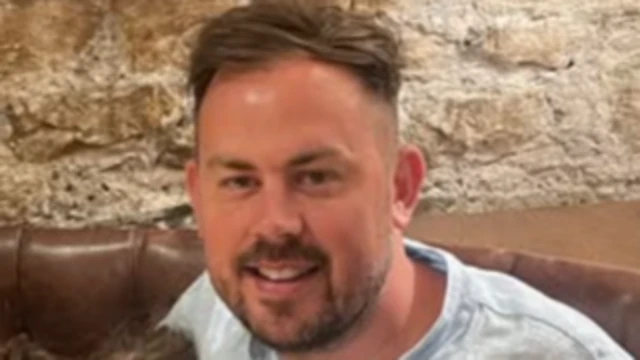 Image source, Facebook
Matthew Aplin is a former Labour press officer
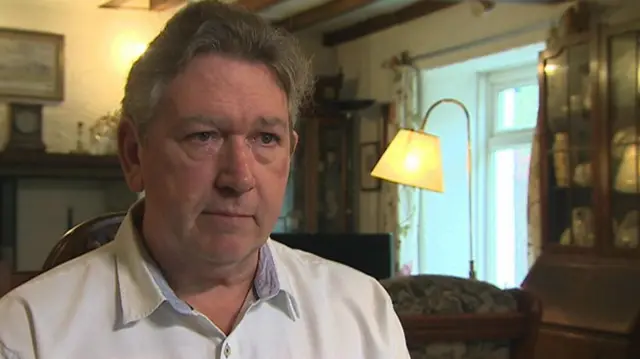
Steve Jones was political adviser to former Welsh Labour first minister Carwyn Jones
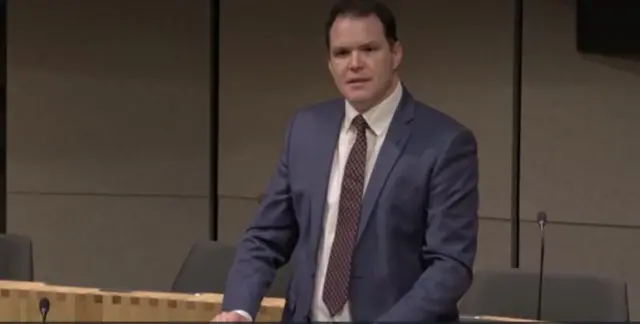 Image source, Senedd Cymru
Lee Waters
Lee Waters, the former Labour deputy minister for economy and transport who masterminded the introduction of the law that required a default 20mph limit in built-up areas, asks for "the estimated cost of reversing the default 20mph speed limit on restricted roads".
Eluned Morgan replies, "we recognise this has been a controversial policy, but there's no question that the policy has saved lives and reduced casualties on our roads, saving significant funding for the NHS and suffering for hundreds of families around Wales. There are children walking around Wales today who would not have been if it weren't for this policy. Now, we've not estimated the cost of reversing the 20 mph speed limit, but it's clear that, if other parties had intentions to reverse this decision, it would incur significant costs, not just financially, but in terms of lives lost and injuries caused."
Lee Waters says, "the first two years of evidence from the speed limit change shows that there were 1,270 fewer casualties on Welsh roads - 1,270 fewer casualties because of the change we brought in. This is the most significant achievement in road safety in decades, and should be celebrated. The evidence is clear that increasing speed limits will lead to more deaths and more serious injuries every single year, but that's what Reform UK and the Welsh Conservatives want to do. They want to raise speed limits to 30 mph on streets where children play and where people live. That will lead to more deaths. It will lead to more life-changing injuries, and it would cost millions."
Both the Conservatives and Reform have promised to reverse the 20mph default speed limit in built-up areas if they are in power after the Senedd election.
Reform MS Laura Anne Jones says, "road casualties have gone down right across the United Kingdom because cars are getting safer. It's a known fact. It needs to be asked: has this ill-thought-out policy already cost our country a lot of money? Yes. Will it cost an awful lot more to reverse? Yes. But, how much has it cost our Welsh economy? By the government's own calculations, this has cost £9 billion. So, you cannot say it has been a good policy. It's been a disaster from start to finish."
 Image source, Getty Images
 Image source, Senedd Cymru
Eluned Morgan
Y Llywydd Elin Jones conducts a ballot to determine the names of members who may table questions to the first minister.
Conservative Peter Fox asks what is the Welsh government doing to support hospice charities.
First Minister Eluned Morgan replies, "the Welsh Labour government, over this Senedd term [since 2021], has provided over £20 million to support hospices, including increased recurrent funding and targeted grants to help manage rising costs and demand. We are working closely with the sector and NHS partners to develop a more sustainable and equitable commissioning approach, ensuring people across Wales can continue to access high-quality, compassionate end-of-life care."
Peter Fox says he recently visited St David's Hospice Care in Newport, and their 15-bed respite and end-of-life unit. He says "they are under real strain, as I learnt. Labour's increase to the national insurance is costing St David's £310,000 - a charity providing complex and end-of-life care, yet completely missing out on the Welsh government's mitigation measures. To meet these costs, they're being forced to cut back. They're closing charity shops, reconsidering their sites. And this will be replicated across hospices in Wales. Now, this cannot be right, as they are fundamental to our health system. So, first minister, can you explain why hospices are being forced to pay for Labour's decisions, instead of being protected from them?"
Eluned Morgan replies, "I recognise what you say about the pressures that they're under, and that is precisely why there has been an extra £5.2 million additional money given to them per annum. They've also been given £9.5 million in one-off grants to manage cost pressures, and there's been an additional £3 million additional recurrent funding, which should help to take the pressure off in relation to those national insurance increases."
Nine of the 14 hospices in Wales have said they face a financial deficit in 2025-26.
Some 20,000 adults and children affected by terminal illness receive support from hospices each year and Welsh hospices have 95 inpatient beds, although some might not be in use because of funding and staffing.
About 60% of hospice services are delivered in the community.
The charity that represents hospices in Wales has called on Welsh government and health leaders to urgently protect services by updating the current funding model. Hospice UK has said adult hospice inpatient and community services were likely to reduce unless things changed.
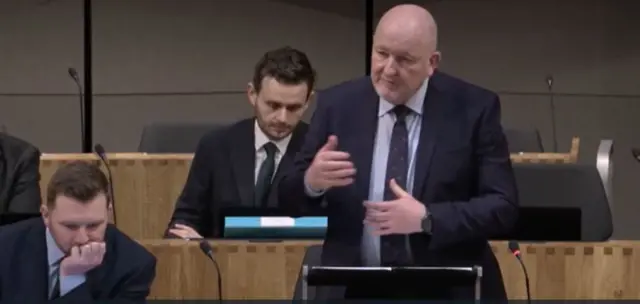 Image source, Senedd Cymru
Peter Fox
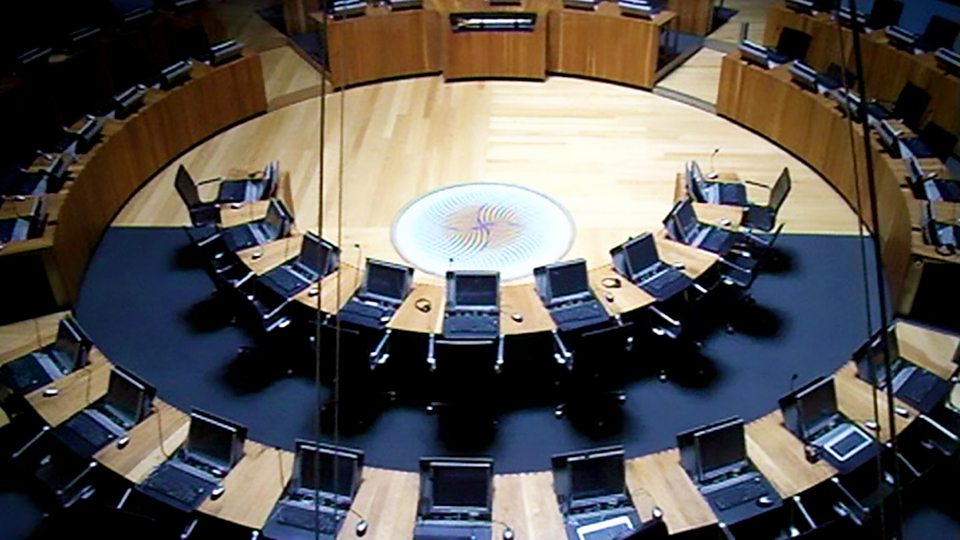
Hello and welcome to our live coverage of Eluned Morgan’s fifty-fifth session of First Minister's Questions.
The meeting is held in a hybrid format, with some members in the Siambr and others joining by video-conference.
You can click on the play button above to watch the proceedings from 1.30pm.