Summary

  • US civil rights leader Jesse Jackson has died at the age of 84

  • Jackson died peacefully on Tuesday morning surrounded by his family, they say in a statement

  • "Our father was a servant leader - not only to our family, but to the oppressed, the voiceless, and the overlooked around the world," the Jackson family say

  • Jackson fought for civil rights alongside Martin Luther King Jr in the 1960s and was twice a candidate for the Democratic Party's presidential nomination in 1984 and 1988

  • A protege of King's, Jackson built a career around working to politically organise and improve the lives of African-Americans, and became a national force during his two White House campaigns, writes Anthony Zurcher

  • He was diagnosed with Parkinson's disease in 2017 and was hospitalised for observation last November after being diagnosed with a degenerative condition

  1. Diane Abbott says Jackson was a 'huge influence' on herpublished at 12:03 GMT
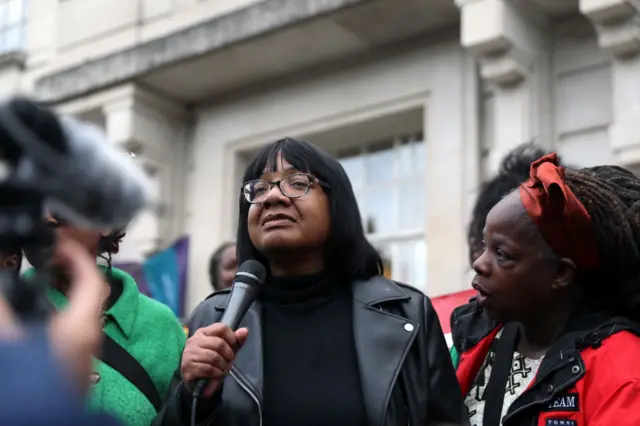
    Diane Abbott addresses a crowd of supporters on May 29, 2024 in London.Image source, Getty Images

    Diane Abbott, the first black woman elected to the UK Parliament, says Jesse Jackson was a "huge influence" on her.

    "I first met him in 1987 when I'd first been elected. We kept in touch down the years," she tells BBC News.

    "He was so principled. He never stopped for fighting for and caring about ordinary black people," she says, adding that he was "a link to the Martin Luther King era".

    "He was a fantastic speaker, he was also charismatic. He was the sort of man you'd be walking down the street with him and people who didn't know who he was would turn and stare because he had such presence and such charisma."

    Abbott, who sits as the independent MP for Hackney North and Stoke Newington, says his legacy "will be a whole generation of black politicians".
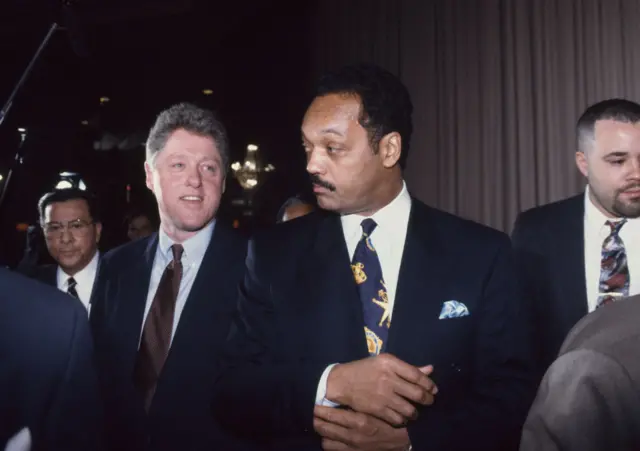
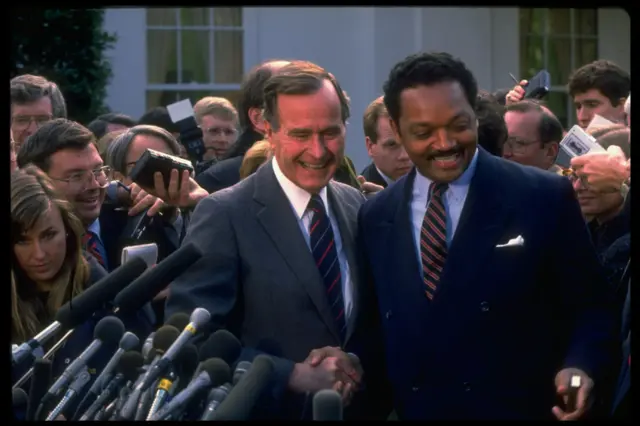
  2. Jesse Jackson and US presidents - in picturespublished at 11:52 GMT

    As a civil rights activist, Jackson was an influential figure in American politics.

    Here he is pictured rubbing shoulders with a number of US presidents - both Republican and Democrat - from Jimmy Carter to Barack Obama.

    Jesse Jackson and Bill Clinton pictured in Washington in 1992.Image source, Getty Images
    Image caption,

    Jackson pictured with Bill Clinton in Washington, January 1992

    Jesse Jackson and George Bush pictured in front of a crowd of reporters with microphones in November 1988Image source, Getty Images
    Image caption,

    Jesse Jackson with George Bush in November 1988

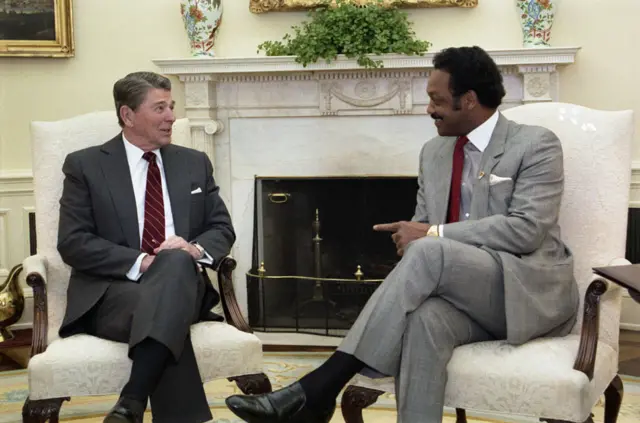
    Jackson with Ronald Reagan in the Oval Office, February 25, 1987Image source, Getty Images
    Image caption,

    Jackson with Ronald Reagan in the Oval Office, February 25, 1987

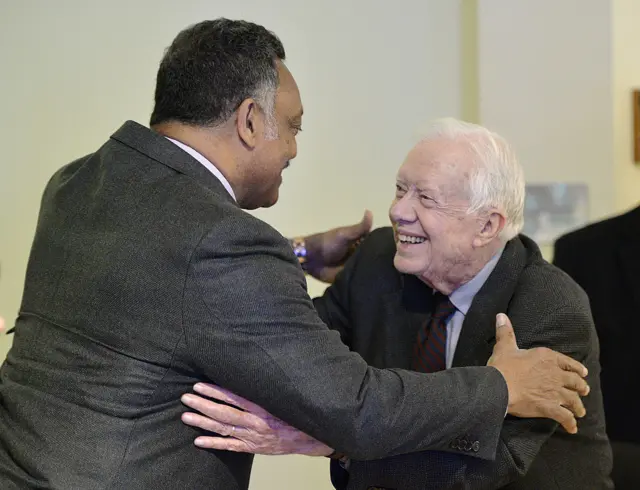
    Former US President Jimmy Carter hugs Jackson at a signing for his book on March 27, 2014 in Chicago, Illinois.Image source, Getty Images
    Image caption,

    Jimmy Carter hugs Jackson at a signing for his book on March 27, 2014 in Chicago, Illinois.

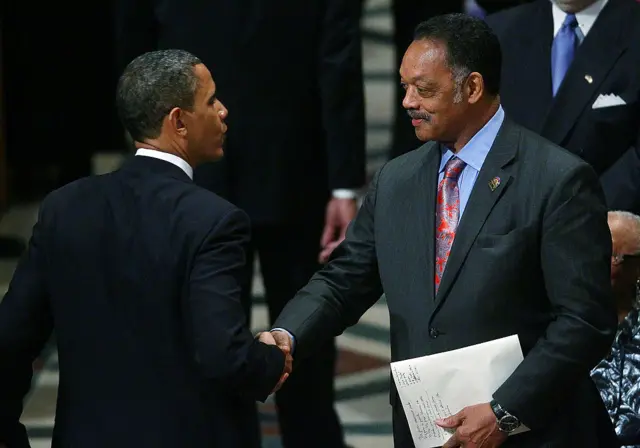
    Former US President Barack Obama greets Jackson at the funeral service for civil rights leader Dorothy Height at the Washington National Cathedral April 29, 2010 in Washington, DCImage source, Getty Images
    Image caption,

    Barack Obama greets Jackson at the funeral service for civil rights leader Dorothy Height at the Washington National Cathedral April 29, 2010 in Washington, DC

  3. Jackson described Obama's win as the culmination of a 60-year racepublished at 11:42 GMT

    Nomia Iqbal
    North America correspondent

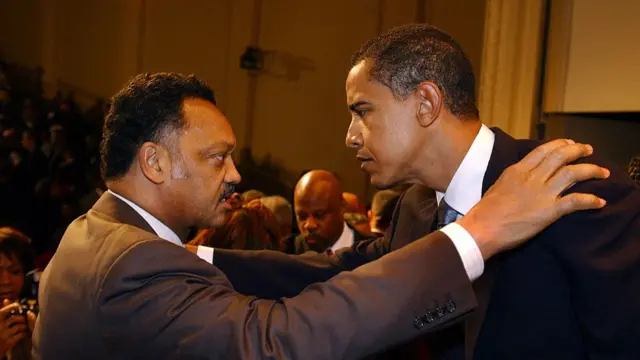
    Rev. Jesse Jackson has a word with Sen. Barack ObamaImage source, Getty Images

    If Barack Obama shattered the glass ceiling when he became America’s first black president, Jesse Jackson created the cracks.

    Jackson himself had run to secure the presidential nomination more than 20 years before Obama, but had failed to win over Democrats.

    There were lots of reasons for that, particularly the different political eras the men ran in.

    But their styles were notably different: Jackson was rhetorically fiery and entirely shaped by protest and the civil rights movement. Obama was post civil rights, and adopted a much cooler strategy, endeavouring to work within the system not rail against it.

    Jackson denied he held any resentment, but had to apologise during Obama’s campaign in 2008 when a hot mic caught him making crude comments. He had also accused Obama of talking down to black people.

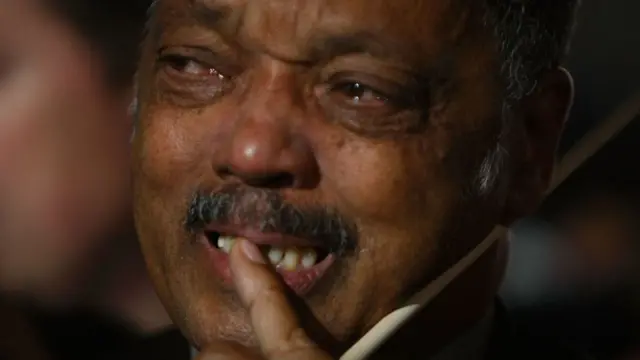
    Jackson was hugely supportive in the end, and was famously seen in tears in Grant Park, Chicago, on the night Obama won.

    He went on to describe Obama’s win as the culmination of a 60-year race by black people for full political inclusion.

  4. 'A consequential and transformative leader' - Reverend Al Sharptonpublished at 11:30 GMT

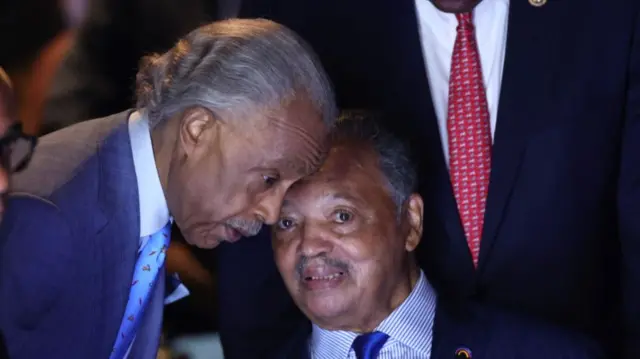
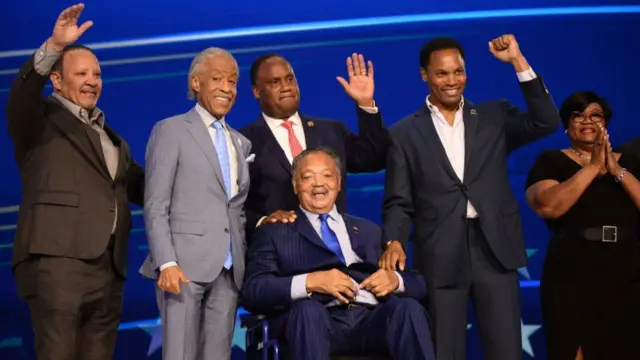
    Reverend Al Sharpton and Jesse Jackson at the Democratic National Convention in 2024Image source, Getty Images
    Image caption,

    Reverend Al Sharpton and Jesse Jackson at the Democratic National Convention in 2024

    Civil rights leader Reverend Al Sharpton, who worked closely with Jackson during the civil rights movement, describes him as his mentor and says he has just "prayed with his family by phone".

    Jackson was a "consequential and transformative leader who changed this nation and the world", Sharpton says in a statement on X.

    "He shaped public policy and changed laws. He kept the dream alive and taught young children from broken homes, like me, that we don’t have broken spirits," Sharpton says.

    "He told us we were somebody and made us believe. I will always cherish him taking me under his wing, and I will forever try to do my part to keep hope alive.

    "A giant has gone home. Sending prayers, so many prayers, love, and heartfelt condolences to the Jackson family and to every person around the world whose life he touched and who loved him."

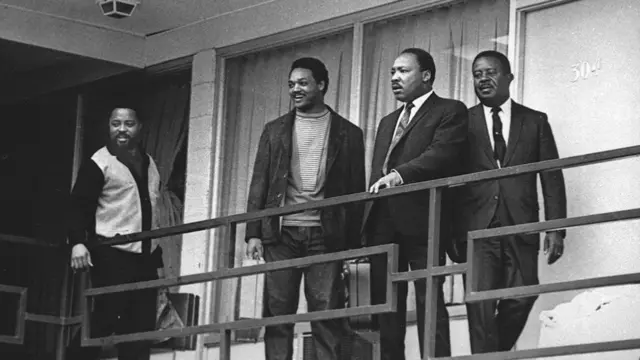
  5. Jackson pictured with Martin Luther King the day before his assassinationpublished at 11:16 GMT

    Rev. Martin Luther King Jr., second from right, stands with Hosea Williams, left, Jesse Jackson, second from left, and Ralph Abernathy, right, on the balcony of the Lorraine Motel in Memphis, Tenn., a day before he was assassinated at approximately the same place, April 3, 1968Image source, AP Photo/Charles Kelly
    Image caption,

    Martin Luther King Jr (second R) stands with Hosea Williams (L), Jesse Jackson (second L), and Ralph Abernathy (R) on the balcony of a Memphis hotel on 3 April 1968

    Jesse Jackson was present with Martin Luther King Jr when he was assassinated in Memphis, Tennessee, in 1968.

    The now-famous image above, taken the day before King was shot dead, shows the pair alongside Hosea Williams and Ralph Abernathy on the balcony of the Lorraine Motel - almost the exact spot where King would be killed.

    They had been in Memphis for a civil rights protest.

    Jackson told reporters that he cradled King's head as he died - although other witnesses did not confirm that account. The next day, Jackson controversially appeared on television with his clothes still stained with King's blood, assuming the mantle of civil rights leadership.

  6. Jackson was like a big brother to my generation - Bonnie Greerpublished at 10:59 GMT

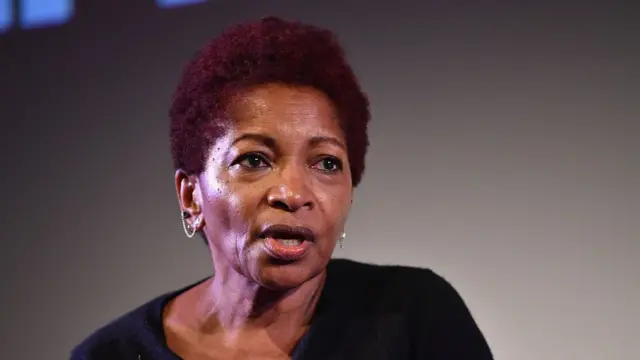
    Bonnie GreerImage source, Getty Images

    Bonnie Greer, the American-British playwright and author, has called Jesse Jackson "a great man".

    "The ranks are dwindling, unfortunately," she tells BBC News.

    "He was like a big brother to my generation. We were the children of the civil rights generation," she says.

    Greer says Jackson acted as a "bridge" between generations of the civil rights movement.

    "He kind of interpreted us to them," she says, adding that "he was a figure that we don't have any more".

    "He was a man who was able to see the big picture, he was able to see the little picture, he was able to put them together to make the idea of America and the world into what he saw - a world where people can not only be equal, they can get better at being equal."

  7. The Martin Luther King protege who helped reshape Americapublished at 10:40 GMT

    Anthony Zurcher
    North America correspondent

    Jesse Jackson, a key figure during the US civil rights movement of the 1960s, was known for being the first African-American to make the jump from activism to major-party presidential politics.

    A protege of Martin Luther King Jr, Jackson built a career around working to politically organise and improve the lives of African-Americans, and became a national force during his two White House campaigns.

    While other African Americans sought the US presidency, Jackson was the first to find significant success at the ballot box – which would pave the way for those who came after, including Barack Obama and Kamala Harris.

    Over the course of his career, Jackson built a movement to bring America's increasingly diverse population together, with a message that centred on poor and working-class Americans.

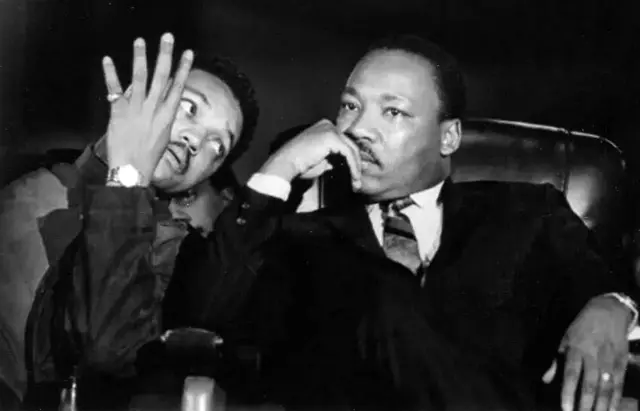
    Jesse Jackson with Dr Martin Luther King in 1966Image source, Universal Images Group via Getty Images
    Image caption,

    Jesse Jackson with Dr Martin Luther King in 1966

    A gifted orator, Jackson articulated the frustrations of those who felt like second-class citizens in the world's most prosperous democracy. His speech to the 1988 Democratic National Convention, which ended with the refrain "keep hope alive", would be echoed decades later in the "hope and change" slogan of Obama's successful 2008 presidential campaign.

    After his historic run of presidential campaigns, Jackson went on to position himself as an elder statesman within the Democratic Party.

    However, Jackson's later years would be punctuated by scandal, including revelations of marital infidelity and financial impropriety involving his son and political heir, Jesse Jackson Jr, who served as a congressman from Illinois.

    In 2017, the elder Jackson was diagnosed with Parkinson's disease and largely withdrew from public life. That diagnosis was subsequently changed to one of progressive supranuclear palsy, a degenerative brain disease with similar symptoms.

  8. In pictures: From civil rights activism to party politicspublished at 10:25 GMT

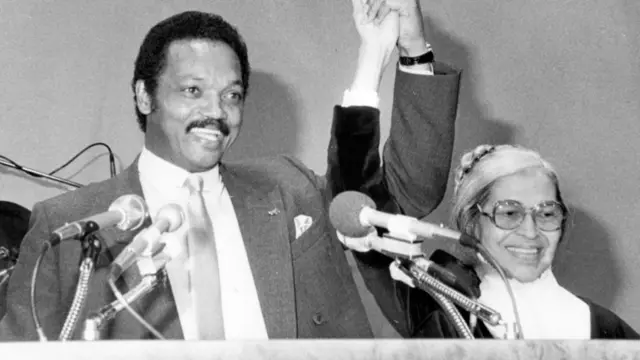
    A black-and-white image of Jesse Jackson Sr and activist Rosa Parks raising their hands triumphantly during a speech, 1965.Image source, Getty Images
    Image caption,

    Jesse Jackson pictured in 1965 with Rosa Parks, whose arrest 10 years prior sparked the Montgomery bus boycott

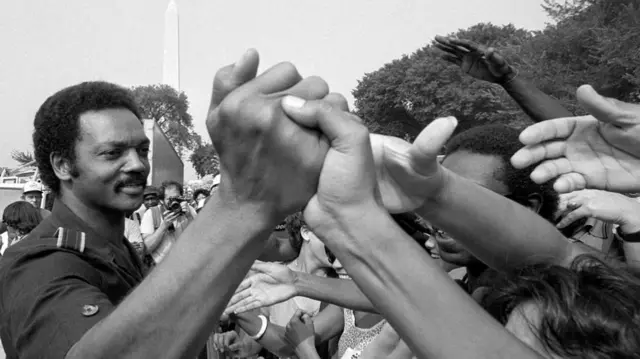
    Rev. Jesse Jackson shakes hands at the 20th anniversary commemoration of the Martin Luther King, Jr.'s Freedom March, also known as the "March on Washington".Image source, Getty Images
    Image caption,

    He shakes hands here at the 20th anniversary of the March on Washington, where Martin Luther King Jr had delivered his 'I Have a Dream' speech in 1963

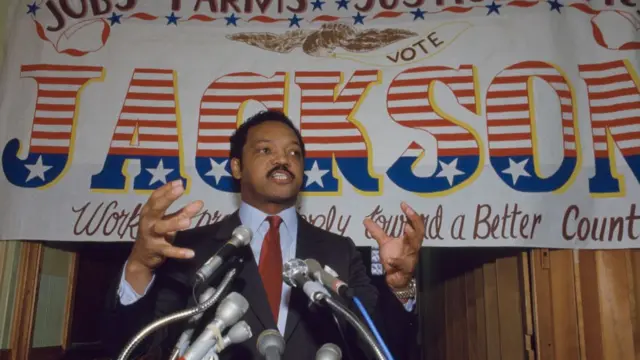
    Reverend Jesse Jackson campaigning in Winterset, Iowa, on February 3, 1988.Image source, Getty Images
    Image caption,

    Jackson pictured campaigning in Iowa during his second presidential campaign in 1988

    A close-up shot of Rev. Jesse Jackson reacting tearfully after projections showed that Sen. Barack Obama would be elected the next President of the United States of America during an election night gathering in Grant Park on November 4, 2008 in Chicago, IllinoisImage source, Getty Images
    Image caption,

    His reaction was captured on election night in 2008, as projections showed Barack Obama was set to be elected president of the United States

    Reverend Jesse Jackson (C) attends during the first day of the Democratic National Convention (DNC) at the United Center in Chicago, Illinois, on August 19, 2024Image source, Getty Images
    Image caption,

    Jackson (centre) appeared on stage during the first day of the Democratic National Convention in Chicago in August 2024, where Kamala Harris was to formally accept the party's presidential nomination

  9. Jesse Jackson: Dedicated civil rights activist and presidential candidatepublished at 10:09 GMT

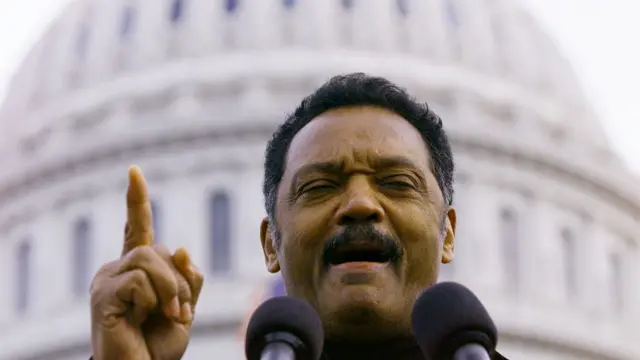
    The Rev. Jesse Jackson speaking at pro-Clinton rally on the West Front of the Capitol.Image source, Getty Images

    Jesse Jackson was a prominent civil rights campaigner who ran twice for the Democratic Party's nomination for president in 1984 and 1988.

    Born on 8 October 1941 in Greenville, South Carolina, Jackson became involved in politics at an early age.

    He rose to prominence in the 1960s as a leader in Martin Luther King's Southern Christian Leadership Conference.

    He was present with King when he was assassinated in Memphis, Tennessee, in 1968.

    He launched two social justice and activism organisations: Operation PUSH in 1971, and the National Rainbow Coalition a dozen years later.

    Jackson remained an activist into later life, pursuing civil rights for disenfranchised groups both in the United States and abroad.

  10. Jackson hospitalised with neurological disorder in Novemberpublished at 10:01 GMT

    Jesse Jackson's cause of death has not yet been confirmed, but he was hospitalised in November, and doctors said he'd been diagnosed with a degenerative condition called progressive supranuclear palsy.

    In 2017, Jackson announced that he had been diagnosed with Parkinson's disease, a progressive disorder which affects the brain, nervous system, and muscle control.

    Jackson called it a "physical challenge" but continued his civil rights advocacy.

    His father, Noah Lewis Robinson Sr, also had Parkinson's and died of the disease in 1997 at the age of 88.

  11. 'Our father left an indelible mark on history' - Jackson family statement in fullpublished at 09:52 GMT

    "It is with profound sadness that we announce the passing of Civil Rights leader and founder of the Rainbow PUSH Coalition, the Honorable Reverend Jesse Louis Jackson, Sr.

    "He died peacefully on Tuesday morning, surrounded by his family.

    "His unwavering commitment to justice, equality, and human rights helped shape a global movement for freedom and dignity. A tireless change agent, he elevated the voices of the voiceless from his Presidential campaigns in the 1980s to mobilising millions to register to vote - leaving an indelible mark on history.

    "Reverend Jackson is survived by his wife, Jacqueline; their children - Santita, Jesse Jr., Jonathan, Yusef, Jacqueline; daughter Ashley Jackson, and grandchildren. He was preceded in death by his mother, Helen Burns Jackson; father, Noah Louis Robinson; and stepfather, Charles Henry Jackson.

    '"Our father was a servant leader - not only to our family, but to the oppressed, the voiceless, and the overlooked around the world. We shared him with the world, and in return, the world became part of our extended family. His unwavering belief in justice, equality, and love uplifted millions, and we ask you to honour his memory by continuing the fight for the values he lived by.

    "Public observances will be held in Chicago. Final arrangements for Reverend Jackson's celebration of life services, including all public events, will be released by the Rainbow PUSH Coalition."

  12. Jackson died peacefully on Tuesday morning, his family saypublished at 09:46 GMT

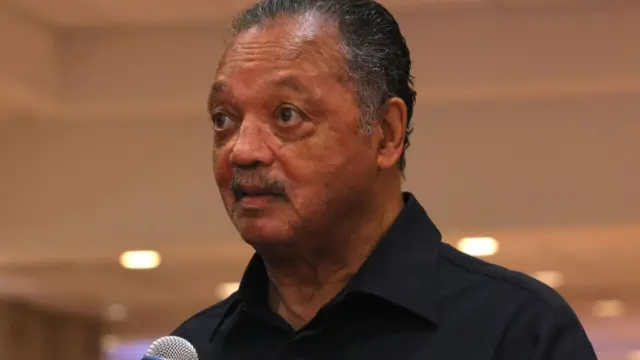
    Jesse Jackson speaks during the 2022 National Action Network's Annual Convention at the Times Square Sheraton hotel on April 06, 2022 in New York CityImage source, Getty Images

    The Jackson family's statement says the 84-year-old "died peacefully on Tuesday morning, surrounded by his family".

    "His unwavering commitment to justice, equality, and human rights helped shake a global movement for freedom and dignity," the statement goes on.

    We'll bring you the statement in full shortly.

  13. Jesse Jackson dies aged 84published at 09:40 GMT
    Breaking

    Jesse Jackson, the US civil rights leader who later ran for president, has died aged 84.

    This is a breaking news story and we'll bring you more updates shortly.