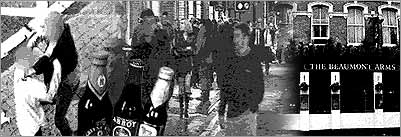
The usual suspects include lager louts, soccer hooligans, and teenagers who hang out on street corners. In fact any young person who displays a disregard for orderly behaviour, and a disrespect for their elders, is likely to be labelled a yob.
While it may be identified with the young, yob culture is not confined to one age group, or indeed one class. It's a form of behaviour that has been observed among a wide range of social groups.
Restaurant owners say too many customers - including professionals like bankers and lawyers - indulge in drunken behaviour, and make racist and sexist remarks to waiters. It may once have been excused as high spirits, but yobbish behaviour has become a symbol for a decline in respect for law and order.
In Ireland, Judge Mary Martin has become so fed up with drunken youths causing mayhem in the early hours of the morning that she has started refusing late night bar extensions. Her analysis of the problem is one that is shared by many.
There is a total disregard for common decency In the UK, much of the debate has focused on how to deal with youngsters who are out on the streets at night, getting up to mischief. One of the measures in the new Criminal Justice and Police Bill, now before Parliament, will make it possible to impose a night-time curfew on children under the age of 16.
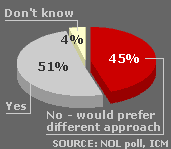
This could be enforced in areas with a reputation for juvenile crime and disorder, and would mean a ban on children being out on certain streets after 9pm, unless they have adult supervision. The Prime Minister, Tony Blair, wants it to become part of the government's "zero tolerance" approach to yob culture.
Curfew plan under fire
The idea has already come under fire. The Tories think that local curfews are impractical, while the Liberal Democrats believe they will lead to resentment of the police among young people who are not troublemakers.
The National Association for the Care and Resettlement of Offenders warns that it could deprive young people of the opportunity to take part in activities such as sport and music. "Curfews like this are almost impossible to police," says the head of NACRO's youth crime section, Chris Stanley.
"It's unfair because it will penalise the law-abiding young who legitimately can be allowed on the streets, and who will have to stay at home. What's needed is a structured response that provides resources for young people. Youth clubs, sporting activities - all those things in the sort of areas we're talking about would help get children off the streets, and prevent them getting into trouble."
Teenage curfews have been widely used in the United States, often during school hours as a means of countering truancy. But according to a study carried out for the Justice Policy Institute, a US-based public policy research organisation, curfews do not stop youngsters getting into trouble.
The report concludes: "On virtually every measure, no discernible effect on juvenile crime was observed. In fact, in many jurisdictions serious juvenile crime increased at the very time officials were toting the crime reduction effects of strict curfew enforcement." Here, there are claims that imposing a blanket curfew could breach the human rights of young people.
"Children have a right to be on the streets," says Deborah Clarke of Liberty. "If they are not causing any trouble then that is absolutely fine. If they are causing trouble, the police should be stopping them with the powers they have already." Liberty says it is prepared to challenge the legality of such curfews in the courts.
On the spot fines
Another of Tony Blair's ideas - marching drunken louts off to cash machines to pay instant fines - has been dropped.
But the government wants to make it possible for the police to impose a fixed penalty fine for acts of drunkenness and disorder in public places. There will also be restrictions on drinking alcohol in certain public places, and the police will be given the power to close rowdy pubs and bars.
Home Office minister Charles Clarke says: "The government is determined to tackle the problem of alcohol-related crime by giving the police and local authorities the support and powers they need to deal with unacceptable, loutish behaviour. This includes introducing legislation where necessary."
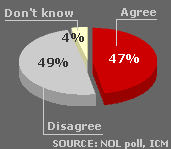
There's little doubt that excessive drinking is at the root of much violent behaviour, and televised images of young people brawling in the streets have caused public alarm. If the government's proposals become law young people are likely to come under closer scrutiny and, in future, misbehaviour on our streets is less likely to be tolerated.