Mountain specialists 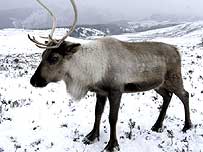 | The Cairngorms is one of the most mountainous landscapes in the UK, characterised by broad granite plateaux, steep sided glens and deep corries. This is the largest area of high ground in Britain, and, as a result, it has one of the most severe climates. | | The Cairngorms - winter wildlife haven for hardy mountain specialists |
The mountains have a strong Arctic character and are great places to watch hardy wildlife which flourishes in harsh conditions.
The animals on the Cairngorms are mountain specialists, and many have adapted to the cold climate.
Survival of the fittest  Reindeer are one of the Cairngorms hardy settlers and a herd live freely on the mountain. Reindeer are one of the Cairngorms hardy settlers and a herd live freely on the mountain.
These animals were once common across the UK but they died out about 8,500 years ago. The Cairngorm Reindeer are the descendants of a herd reintroduced in 1952 from Lapland so they're not truly wild, but it's thought they could survive in this mountainous area if left to their own devices. The Reindeer are highly adapted for winter life - during the cold season they have a low metabolic rate which means they have less appetite and conserve their energy effectively. Out on their mountains the animals feed themselves, grazing mainly on low growing plants. They are particularly keen on a lichen called cladonia rangifer, better known as 'reindeer moss'. The Cairngorms' wildlife rangers also help to supplement the Reindeer's diet with barley and sugar beet. As well as their diet, the Reindeer have also adapted their fur to the winter conditions. Their fantastic thick coats have a woolly under-layer and a thick guard layer which is very dense and keeps the heat in. From the tips of the Reindeer's noses to the bottom of their feet, the animals' eyeballs are the only bare part of their bodies. The animals' extra wide splayed hooves enable them to spread their weight on soft snow to prevent them sinking in snowy conditions. Ptarmigan spotting  The Ptarmigan is another Alpine creature adapted perfectly for winter conditions on the Cairngorms. The Ptarmigan is another Alpine creature adapted perfectly for winter conditions on the Cairngorms.
This bird rarely lives below 2,000 feet which means that the only way to spot it is to take the funicular ride to the top of the mountain.
The Ptarmigan is an Ice Age survivor with a very hardy constitution, a high altitude Grouse which is confined just to the Scottish Highlands within Britain. Its name comes from the Gaelic 'tarmachan' meaning croaker, a reference to the bird's dry, rattling call which is said to be like the winding of a clock. During winter the bird's coat turns pure white, except for black around eye and tail, so it blends into drifts of snow. By crouching low the Ptarmigan can often escape they eye of the Peregrine Falcon or Golden Eagle sweeping over head. Its dense plumage provides added insulation whilst the thick feathering on its feet acts like snowshoes. In winter the Ptarmigans survive by burrowing into the snow to find shoots. Also look out for Snow Buntings on the mountain - quite often these can be seen from the car park, feeding on food dropped by skiers. These robust birds come to the Cairngorms every year from Iceland for their winter holidays. The glory of Glenlivet  Another creature that turns white in winter which is also found on the Cairngorm range is the Mountain Hare which lives on the Glenlivet estate. Another creature that turns white in winter which is also found on the Cairngorm range is the Mountain Hare which lives on the Glenlivet estate.
These hares have been living in Britain for about 12,000 years, but when the brown hares arrived, most of them were driven were driven up to high ground. They are characterised by their white coat and black ear tips. Their winter coat turns white to protect them from airborne predators. Normally nocturnal, these animals hide among the heather during the day, but in the winter they are forced to look for food during the day. The Mountain Hare is difficult to spot because it is generally a solitary and timid creature which often sits motionless with its back to the wind. But these hares often feed in groups early in the morning and at dusk, which is the best time to see them.
|