Conservation in action 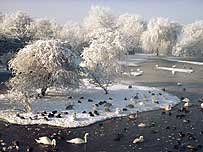 | Slimbridge Wildfowl and Wetlands Trust is located on the edge of the River Severn estuary and provides an ideal location to watch winter bird life.
Don't forget your binoculars for a bird's eye view! | Swan lake at Slimbridge.
Photo - Wetlands and Wildlife Trust |
The River Severn is the longest river in the UK, winding its way for 220 miles from its source in the Welsh Cambrian mountains before finally emptying into the sea in the Bristol Channel.
The Severn estuary and its surrounding flood plain is a mixture of mud flats and lush wet grassland which provide ideal wetland habitats for a vast diversity of wildfowl and wading birds. Wildlife conservation  Slimbridge was one of the first major wildlife conservation centres in the United Kingdom, and is currently celebrating its 60th anniversary. Slimbridge was one of the first major wildlife conservation centres in the United Kingdom, and is currently celebrating its 60th anniversary.
The Wildfowl and Wetlands Trust was founded at Slimbridge in 1946 by wildlife artist and naturalist Sir Peter Scott. Today there are a huge number of resident birds within this 'avian Serengeti' including Flamingos, Red-Breasted Geese and Mandarin Ducks, as well as many British species. At Slimbridge, the pathways leading to the hides are hidden behind grassy banks cloaked in thick hawthorn bushes, so you can easily reach the hides without scaring the birds. Look out for Wigeon, Lapwing and Grey Plover amongst a whole host of other species including predators - birds of prey like Peregrine Falcons, Merlin, Buzzards and Sparrowhawks. Swan Lake  One of the highlights of a winter visit to Slimbridge is watching the Bewick's Swans with their distinctive bright yellow bills. One of the highlights of a winter visit to Slimbridge is watching the Bewick's Swans with their distinctive bright yellow bills.
These magnificent birds migrate to the Severn estuary every winter, making a 2,500 mile journey from Arctic Russia where they breed and raise their young during the summer months. The Arctic winters are ferocious with temperatures as low as -30c so the British Winter is mild in comparison. These birds are amazing because they find their way back to exactly the same spot year after year. Researchers at Slimbridge know this because the black and yellow bill markings on each individual bird are totally unique, allowing scientists to tell them apart and keep records of when they are sighted. Starling spectacle  Just a few miles down the road from Slimbridge are reed beds where a daily spectacle takes place. Just a few miles down the road from Slimbridge are reed beds where a daily spectacle takes place.
As the sun begins to set, as many as a million starlings gather together and the skies go black with swirling mass of birds preparing to roost for the night in the reeds. In common with many of the ducks and swans at Slimbridge, a lot of these starlings will have migrated from eastern Europe and Russia to escape to a milder winter. Nobody knows exactly why they perform this 'smoking' or 'morphing' manoeuvre, although some experts believe that it may be to confuse predators such As Sparrow Hawks. Credits All Slimbridge photographs courtesy of Slimbridge Wetlands and Wildlife Trust. |