Man-made haven 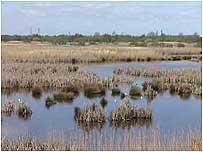 | Woolston Eyes is a superb wetland habitat which lies next to the Manchester Ship Canal and is virtually right underneath the M6 motorway.
This relatively new reserve was created in the early 1980's. | | Woolston Eyes - under visited reserve in North West England |
Known locally as 'The Eyes', the area comprises a small series of islands and reed beds that have become a man-made haven for wildlife.
The area is known to have Saxon origins - 'Ees' is Saxon for land near a looping river.
Canal building  The land was originally used for sheep grazing but became industrialised during the Industrial Revolution when powder mills and workers cottages were built. The land was originally used for sheep grazing but became industrialised during the Industrial Revolution when powder mills and workers cottages were built.
This resulted in a period of canal building - Woolston Old Cut was one of the first navigational improvements carried out in the late 18th Century.
New Cut, a short canal, further shortened the journey down the river by cutting out a further section of the loop.
In 1896 the area was radically affected by the building of the Manchester Ship Canal, which altered the landscape beyond recognition.
The long meanders of the Mersey through Statham were cut off together with the old canals to the north. Work on the canal inadvertently created a superb wetland habitat. The four wetland areas or beds at the reserve are managed by the Woolston Eyes Conservation Group. The beds are surrounded by steep embankments with grassland and scrubby areas, and all are rich in wildlife. Bird watching
 This is a top spot for bird watching - around 220 species have bee recorded on the reserve including waders, raptors and five species of owl. This is a top spot for bird watching - around 220 species have bee recorded on the reserve including waders, raptors and five species of owl. The bed to the east of the motorway consists of rough grassland and willow scrub with reedy pools which are attractive to birds such as Snipe. Also look out for Chiffchaffs, Blackcaps, Little Grebe, the Grasshopper Warbler, Reed and Sedge Warblers, and the rare Grasshopper Warbler. One of the rarest birds on the reserve is the elusive Black necked Grebe which is characterised by its dark neck, fiery red eyes and golden plumage. Woolston Eyes is a stronghold for this springtime stunner with about 14 birds, about one third of the British population. The Grebe likes shallow water and habitats rich in invertebrates and fringe vegetation on which to breed. Above all, this shy likes as little human disturbance as possible. The number three bed provides a fantastic habitat for Black-necked Grebe, Little Grebe and Great Crested Grebe. This area lies west of the reserve lies between the river and canal comprises a large area of willow scrub, grasses and dense vegetation. There is also a Black-headed Gull colony on the peripheral of this area. Woolston makes for a great day out with some great rarities and elusive birds for birding enthusiasts. |