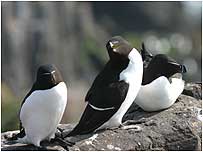
 | Rocky coasts offer great opportunities for wildlife watching. Why not take a few tips from the Nature's Calendar team? Try your hand at bird watching and plant identification. | | Outstanding coastal wildlife on the UK's rocky shores and cliffs |
Why not visit three of the UK's top coastal spots for nature watching this spring?
* Flower carpets in Cornwall
* Birding off Portland Bill, Southern England
* Sea birds at Bempton, Yorkshire
Nature watching in Cornwall  One of the best ways to explore the peninsula is on foot walking along the South Coast Path down to Lizard Point. One of the best ways to explore the peninsula is on foot walking along the South Coast Path down to Lizard Point.
Leave your car behind at Mullion Cove where the Serpentine rock joins the mainland and the Lizard starts.
The walk takes about four hours, but if you love plants, it might find it takes a little longer as you won't be able to resist stopping and admiring the scenery. The Lizard is a great place for Orchids - there are over 20,000 in just a few hectares.
Look out for the Green-winged Orchid which is quite purpley in colour. Its name actually comes from the parts of the plant known as sepals which are green and stick out over the petals more than other orchids. Make sure you have a good field guide to help you spot the different wild flowers. At the end of the day, there is a bus at Lizard Point that will take you back to your car at Mullion Cove at the end of the day. Chough watching  At Lizard Point there's a special view point from which visitors can watch one of the most unusual and best loved birds on the Lizard coast - the Chough. At Lizard Point there's a special view point from which visitors can watch one of the most unusual and best loved birds on the Lizard coast - the Chough.
The Chough Watch Point is manned throughout the breeding season of April to June and the RSPB has telescopes on hand to help you watch the birds. If you want to see the birds a little closer without telescopes, a short walk along the cliffs can pay off. It's relatively easy to see the birds close up as they're quite tolerant of humans as the coastal path is always busy. The Choughs will also fly out from the nest below in the cliffs and fly right past your nose along the cliff edge - a spectacular sight. Birding off the south coast  Moving further east to Dorset, there's a treat in store for bird watchers at Portland Bill. Moving further east to Dorset, there's a treat in store for bird watchers at Portland Bill.
Spring is a great time to see this bird hot spot and the best time is during the three weeks in the second half of April to the beginning of May. The best time of the day to see the birds at Portland is early in the morning. Many birds fly in overnight and rest up early in the morning following their exhausting trip. Some may have come from Portugal or Spain across the Bay of Biscay, whilst others arrive from the Cherbourg Peninsula across the Channel. Common migrant visitors include the Chiffchaff, Willow Warbler and White Throat. On good mornings you can see hundreds of them. But be warned, the Portland bird experience can be a bit hit and miss - it is sometimes very weather dependent. If the conditions aren't right, you'll see very little indeed. Always check the wind direction before you leave home - easterly winds are always a good bet. Good cloud cover is useful too, which means there probably hasn't been a frost which would make it too cold for the birds to fly the previous night. Bird watching in Yorkshire  Travelling much further north to Yorkshire, there's a treat in store for those wanting to see a great seasonal spectacle. Travelling much further north to Yorkshire, there's a treat in store for those wanting to see a great seasonal spectacle.
Huge numbers of seabirds are present at Bempton during the spring. The best time to visit is during the breeding season when visitors can witness a huge colony of birds on the sheer cliff face. Bempton is a great place to see the crown prince of seabirds - the Gannet. The reserve boasts the most accessible mainland colony of these birds anywhere in the UK. There about 3,500 Gannets at Bempton - the colony has grown from around 30 pairs in the late 1960's when the first birds arrived. This beautiful seabird has a wingspan of around six feet and can be easily spotted from its silhouette when in flight. Look out for its large but narrow wings which are held stiffly when conditions are windy. The adult has a bright white body with black tips on the ends of its wings. Photo credits Green-winged Orchid courtesy and copyright of English Nature and Peter Wakely. |