Spring in Scotland 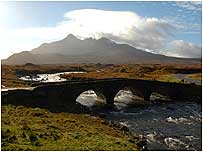 | Situated off the west coast of Scotland, Skye is the largest of the Inner Hebrides. It's been described as 'Scotland in miniature' because of its diverse range of scenery ranging from mountains and woods to lochs, moorland and coastline. | Skye - stunning wildlife wherever you turn. |
The Cuillin Hills dominate the Skye skyline, and are a great spot to see two species of eagle, the Golden Eagle and the Sea Eagle. Sea Eagles  The Sea Eagle, also known as the white tailed eagle, has a wingspan of two and a half metres. The Sea Eagle, also known as the white tailed eagle, has a wingspan of two and a half metres.
It's Britain's largest bird of prey. The eagles nest around coasts and are often spotted around shorelines. Historically the bird was virtually hunted to extinction, but is now making a comeback. Britain's last pair nested on Skye in 1916. In the 70's and 80's Norwegian birds were introduced to the nearby island of Rum. From there the birds have begun to return to their original breeding sites and have naturally re-colonised Skye. Late May and early June are an ideal time to see these birds. They will snatch fish thrown to them from the surface of the water, which is a good way to see them. The Golden Eagle  After the Sea Eagle, the Golden Eagle is the second largest eagle species in the UK. After the Sea Eagle, the Golden Eagle is the second largest eagle species in the UK.
This bird of prey prefers to live in wild moorlands and mountain regions, and favours islands and quiet glens.
Adults soar high with their wings raised in a shallow 'V' shape and the tips of their wings spread out like fingers of an outstretched hand. There are about 30 pairs of these impressive birds on Skye. As is common with birds of prey, the females are generally larger than the males. Eagles are highly territorial and their nesting places may be used by generations of birds.
Stars of the sea Skye is also rich in marine life in the waters surrounding the island. Amongst the many creatures is the Jellyfish which thrives in the late spring when it is reaching its full size, Amongst the species around Skye are the Lion's Mane Jellyfish, Britain's largest, and the Moon Jellyfish. Around 95 per cent of its body is made up of water which gives it a pulsating appearance underwater. Also look out for the Starfish which has the ability to push its stomach out of its mouth in order to digest prey that is otherwise too large to swallow. If it loses an arm, it can grow back a limb. Otters  Skye is one of the best places to see Otters. Skye is one of the best places to see Otters.
There are 350 individuals around the coast and there are many bays where you can get close to them when they are hunting in the sea. As recently as the 1950's they occurred quite commonly around the United Kingdom. However numbers have dwindles due to the former use of chlorinated hydrocarbon pesticides and the loss of habitat. If you are lucky you may spot them on or near the wreck of the HMS Port Napier, a Second World War wreck. Photo credits Photograph of Golden Eagle courtesy and copyright of PA Images.
|