Bird spectacle 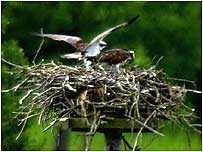 | Rutland Water is one corner of England where you're guaranteed a knock-out ornithological experience.
This waterway is bird-tastic, particularly in spring. | | Ospreys on a nest at Rutland Water. Photo c/o PA Images |
Rutland is the home to one of Europe's largest man made reservoirs.
Built during the 1970s to serve the Midlands, Rutland Water has become a haven for wildlife including migrating birds. When the reservoir was created, a narrow strip of land at the western end was allocated as a nature reserve.
Three large lagoons were also created to provide a habitat for a variety of waders and wildfowl throughout the year. Bird chorus  One of the highlights of a visit to Rutland Water is a trip into the woods to see its singing stars - the Nightingales. One of the highlights of a visit to Rutland Water is a trip into the woods to see its singing stars - the Nightingales.
This attractive brown bird is notoriously difficult to spot but its fabulous voice stands out during spring. The birds arrive at Rutland in late April and it's during the first two weeks of their arrival that they show and sing. But you'll need to get up early to catch them at their melodic best during the dawn chorus between 5.30pm-7.30pm. Rutland is also home to one of Britain's largest Cormorant colonies with between 70-80 pairs of birds. These elongated black birds are easily spotted, although in spring they also develop a large white splodge of colour on their sides designed to attract a mate. Ospreys at close quarters  Rutland Water is perhaps most famous for its Ospreys - it's one of only two locations in Britain where these birds breed. Rutland Water is perhaps most famous for its Ospreys - it's one of only two locations in Britain where these birds breed.
In the mid 1990s some Osprey chicks were relocated to Rurland from Scotland, kick-starting a highly successful reintroduction project. Today the birds are thriving and visitors can see the birds as they hover over the water and perch on their nests from relatively close quarters. Another good way of spotting them close to the water is to take an early evening cruise on the Rutland Belle. Photo credits Osprey photos courtesy and copyright of PA Images (top image) and Scottish Wildlife Trust. |